The dawn broke slowly over Aden on a November morning in 1967, painting the sky with the soft pastels of an overcast desert sky. Beneath the faded colors lay a city in transition, as the air fought between the remnants of the night’s coolness and the encroaching heat of another relentless day. The usually cacophonous harbor was eerily quiet, though the absence of sound heralded more than peace; it whispered of an ending. Amidst the hushed docks and the shadowed silhouettes of cranes, one man’s footsteps echoed, marking the final chapter of British imperial presence in this corner of the world.
The Setting: A City of Tension and Anticipation
Aden, by 1967, was a place heavy with history and burdened by its own significance. Situated at the crossroads of Africa and the Middle East, its strategic importance had been recognized long before the British laid claim to it in 1839. Across the bay, the ancient volcanic rock formations stood sentry, watching over the city as they had for millennia. The climate was a complex blend, dry and fierce, creating an atmosphere where everything seemed intensified. Sounds traveled oddly, bouncing off the hard, reflective surfaces that made up the city’s infrastructure, remnants of colonial ambition.
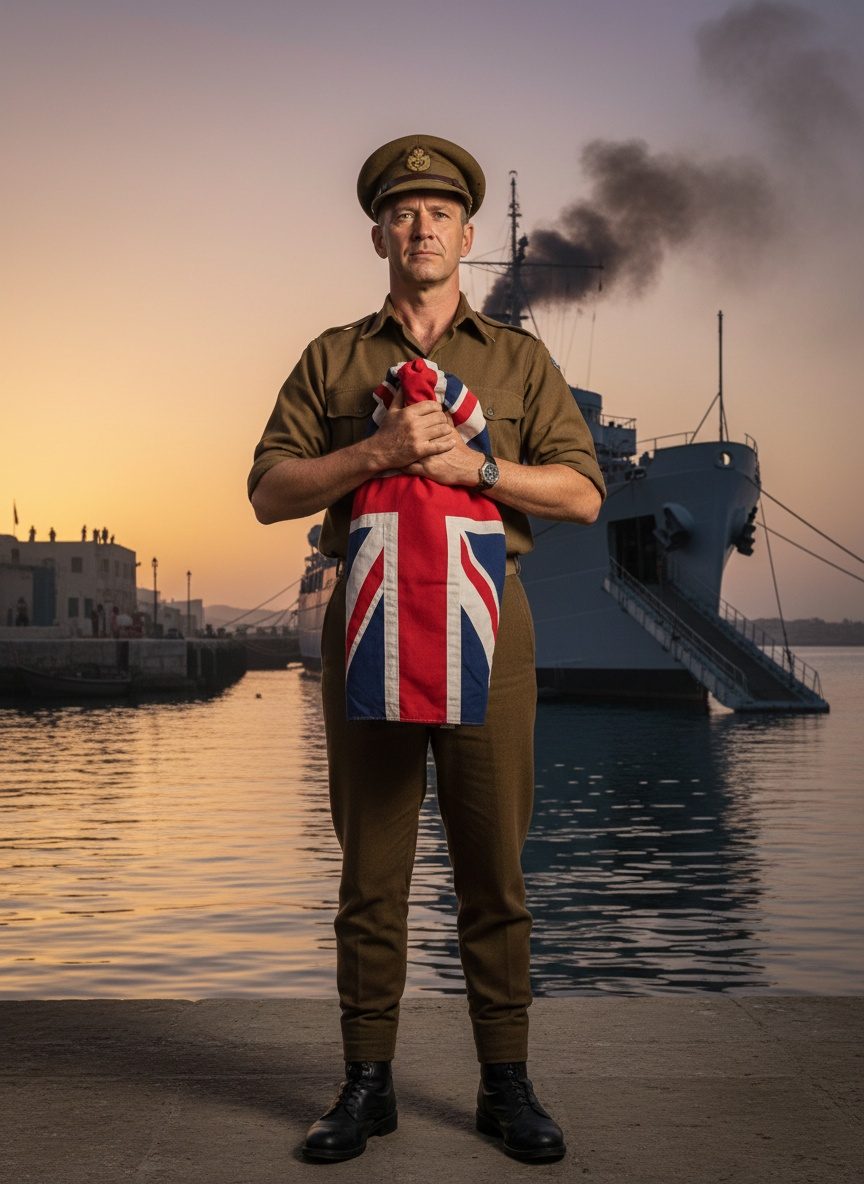
This day, however, the hustle and hard edges of military precision were absent, leaving the city in an uneasy truce with itself. The streets were largely empty, hushed by the fact that the British evacuation, an event in itself, was occurring with little of the fanfare that often accompanies such departures. Like the soft glow of a hidden ember, the historical weight of the moment seeped into the city's fabric without displays of public ceremony or celebration. The indelible mark left by 128 years of British influence was meeting its end, not with shouting crowds or banners fluttered in the wind, but with the quiet unfolding of a flag and the lone figure of a soldier echoing against the backdrop of a fading empire.
The Decision: Who Walks Last
In any great withdrawal, the decision of who stays last carries an almost sacred duty. It is not simply the roll of the dice or the whim of chance, but a moment laden with understanding and reflection. For the British forces in Aden, the inevitability of departure had loomed like the shifting shadows of dusk. Yet, despite the overarching urgency to leave, someone had to remain until the very end, a solitary guardian witnessing the final passage into the next chapter of the city's history.
This task fell to one soldier. Even now, the identity of this individual remains an enigma, shrouded in the kind of anonymity that history sometimes insists upon. What is known is that his responsibility went beyond mere protocol. He walked the length of the dock with a resolute serenity, an embodiment of honor and duty. His presence was both the closure and the last vestige of an era that stretched beyond living memory for most.
There was no grand speech, no dramatic exchanges. The task was simple but profound: lower the Union Jack, fold it carefully, and ensure its safe passage from Aden. This small act of ceremony carried the collected stories of countless people, both conquerors and the conquered, every bit as significant as the history that stained the crimson fabric of the flag itself.
The Silence: An Assembly of Departure
In the absence of cheering crowds or the thrumming heartbeat of a band marking national pride, the soldier assembled silence. Yet this silence was not empty; it was crowded with unspoken farewells and the memories of struggles intertwined with moments of shared humanity. The final sounds accompanying their departure were far removed from any imagined narrative of triumph or heroics traditionally recounted in the annals of empire. Instead, it was a departure rooted in restraint, an acknowledgment of changing times.
The quietness forced reflection, casting a new light upon the heavy clouds hanging low over the docks like reluctant goodbyes not fully articulated. The soldier, through the task bestowed upon him, became more than just the last man standing; he was the embodiment of the changing world order. With each step he took, there was an unfolding realization that as the sun ascended, shadows would grow long on the empty pier, mirroring the lengthened shadows on an empire adjusting to its twilight.
Even nature seemed to conspire to evoke contemplation. The air, dense and anticipatory, smelled of salt and potential, full of stories waiting to be told under the cloak of this enforced quiet. The final moments were captured not in photographs or journalistic flourishes but in the pause before history propelled itself inevitably forward.
The Lesson: Footsteps That Echo Still
As the ship's engines thrummed to life, creating the only disturbance in what felt like a world holding its breath, the vessel slowly pulled away from the dock. The soldier’s footsteps, the very last of the British empire in Aden, would linger in the air as echoes do in the ears of those left behind, reminders of a past imprinted on the future they had begun to forge.
This story, though silent and solemn, carries forward an essential message. It speaks of transitions unadorned by pomp and circumstance but critical to the structures of historical narrative. The anonymous soldier’s duty is a reminder of continuity, that every end ushers in a beginning, irrevocably transforming the landscape it touches—geographical, political, and cultural.
The significance lies not in one man’s duties but in the layered intricacies of empire, autonomy, and identity, all entwined like fibers in a complex tapestry. In a broader sense, the soldier’s final walk from the dock serves as a symbolic passage of time, highlighting the inevitable ebbs and flows of history’s tide—a poignant, understated pause between empires and the paths upon which nations and peoples continue to tread.