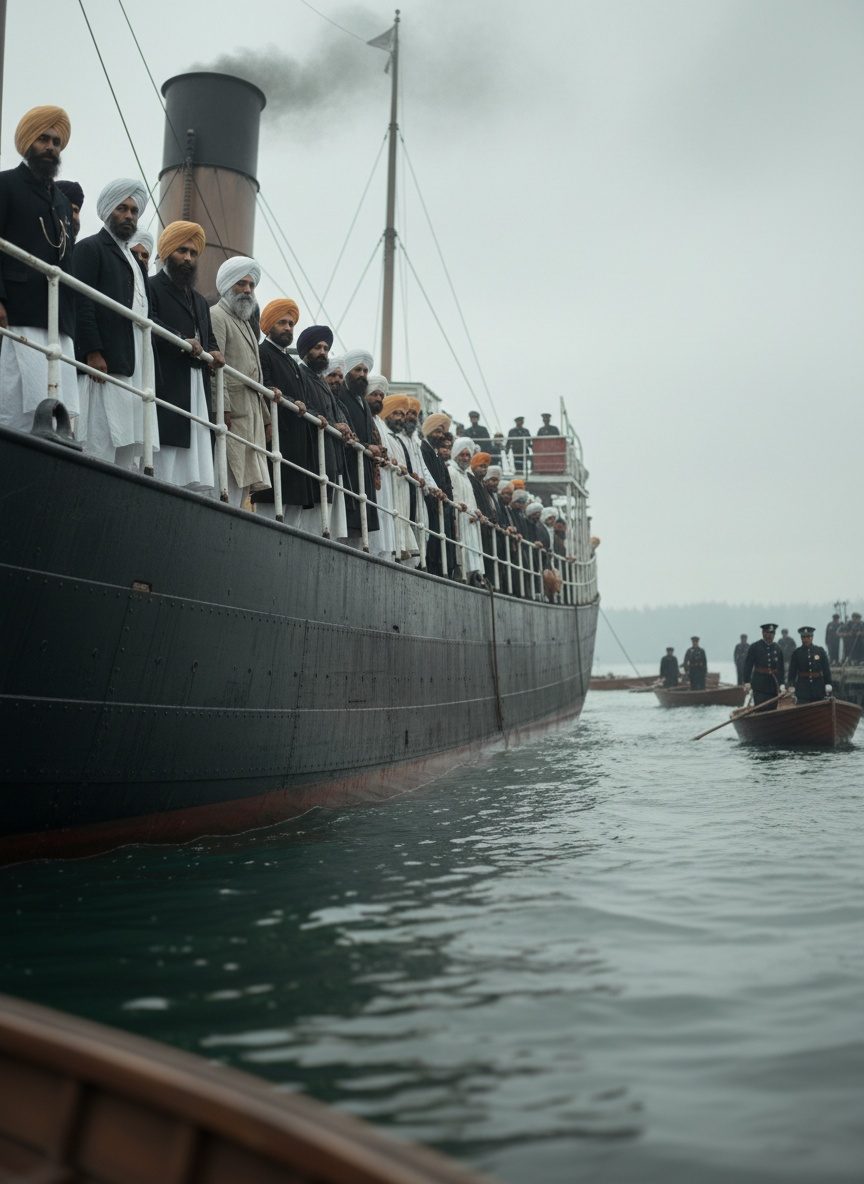
The passengers of the Komagata Maru were not passive victims of empire. They were seasoned soldiers and workers, accustomed to the challenges of their world. For them, defiance was not just an option; it was necessity.
The Decision That Changed the Voyage
On a clear May morning in 1914, the Komagata Maru glided into the harbor of Vancouver, British Columbia, carrying 376 hopeful souls. These individuals, primarily Sikhs with the occasional Hindu and Muslim, had embarked on a journey from the bustling ports of British India. Each of them carried the firm belief that, as British subjects, the doors of the British Dominion of Canada would open for them. However, what awaited them was a refusal that would echo across the continents. This was not merely a ship's journey but a voyage borne from the very fabric of the Edwardian Empire—a fabric unraveling at its threads.
The Legal Labyrinth and Its Hidden Walls
Canada in 1914 was a land of contradictions—a proud member of the vast British Empire, yet also grappling with its identity as a sovereign nation. For over a decade, restrictive immigration laws, cloaked in complex regulations, were built to control the influx of Asian immigrants. The infamous Continuous Passage Act required travelers to arrive directly from their country of origin without a stopover, a near impossibility given the geography and economics of the time for anyone coming from India.
The passengers of the Komagata Maru, having circumvented the treacherous seas from Hong Kong without touching land, argued their case with steely determination. But their rights as British subjects clashed with the politics of racial exclusion that simmered beneath the surface of Canadian society. Caught in this conundrum, these men and women personified the very struggle between imperial loyalty and evolving national sovereignty.
The Harbor: A Stage Set for Resistance
For two months, the Komagata Maru lay anchored in the Vancouver harbor, transforming the ship into a floating fortress of resistance. On board, tensions ebbed and flowed like the Pacific tides. Food supplies dwindled, and conditions worsened, but the resolve of the passengers never wavered. Vancouver's citizens watched with both intrigue and hostility, some rallying to the cause of the newcomers while others shouted for their banishment.
Aboard the vessel, community leaders like Gurdit Singh emerged, articulating the passengers' demands and the legal justifications for their entry. The defiance was methodical, with petitions sent to the shores, each arguing more powerfully than the last. Meanwhile, on the docks of Canada, activists from within the broader South Asian diaspora championed their rights, linking their struggle to global fights against imperial racism.
Imperial Echoes and Heated Tensions
The standoff at Vancouver did not occur in isolation. It sent ripples through the sprawling British system, drawing the attention of media and political figures from across the empire. Negotiations dragged on amidst an unyielding climate, both aboard the ship and in the metropoles of empire. The eyes of thousands across the world turned to this singular ship, floating in harbor, carrying more than just men and women; it carried questions about imperial loyalty, racial justice, and the complexities of migration.
The Empire prided itself on its dominions, allies, and subjects all contributing to the grandeur of a union. Yet here was a glaring exception—subjects denied entry by a dominion not ready to welcome them. As telegrams and letters crisscrossed the globe, the principles of the empire were tested, revealing fractures that would eventually widen into open challenges against colonial rule.
The Momentous Return Journey
By July, Canadian authorities could no longer prolong the stalemate. With no compromise in sight, the Komagata Maru was ordered to depart. Escorted by a Canadian naval ship, the passengers undertook the long journey back to British India, their hopes dashed yet their defiance recorded indelibly in history.
As they sailed back across the world's oceans, the passengers carried with them a narrative of resistance—one that underscored the limitations of belonging within the empire. Upon arriving in Budge Budge near Calcutta, unrest and tragedy awaited, echoing the struggles faced in Vancouver. This was a saga that fueled emotions and inspired generations—revealing the vulnerabilities of a world teetering on the edge of modernity.
In retracing the journey of the Komagata Maru, we uncover a poignant story often overlooked—a moment when people refused to be reduced to arbitrary lines drawn by distant powers. This tale of tenacity and resistance holds a mirror to today's ongoing debates around borders and identity, reminding us that the fight for justice is never bound by time or place. The passengers may have departed Vancouver, but their story remains—a testament to the power of standing one's ground in the face of insurmountable tides.