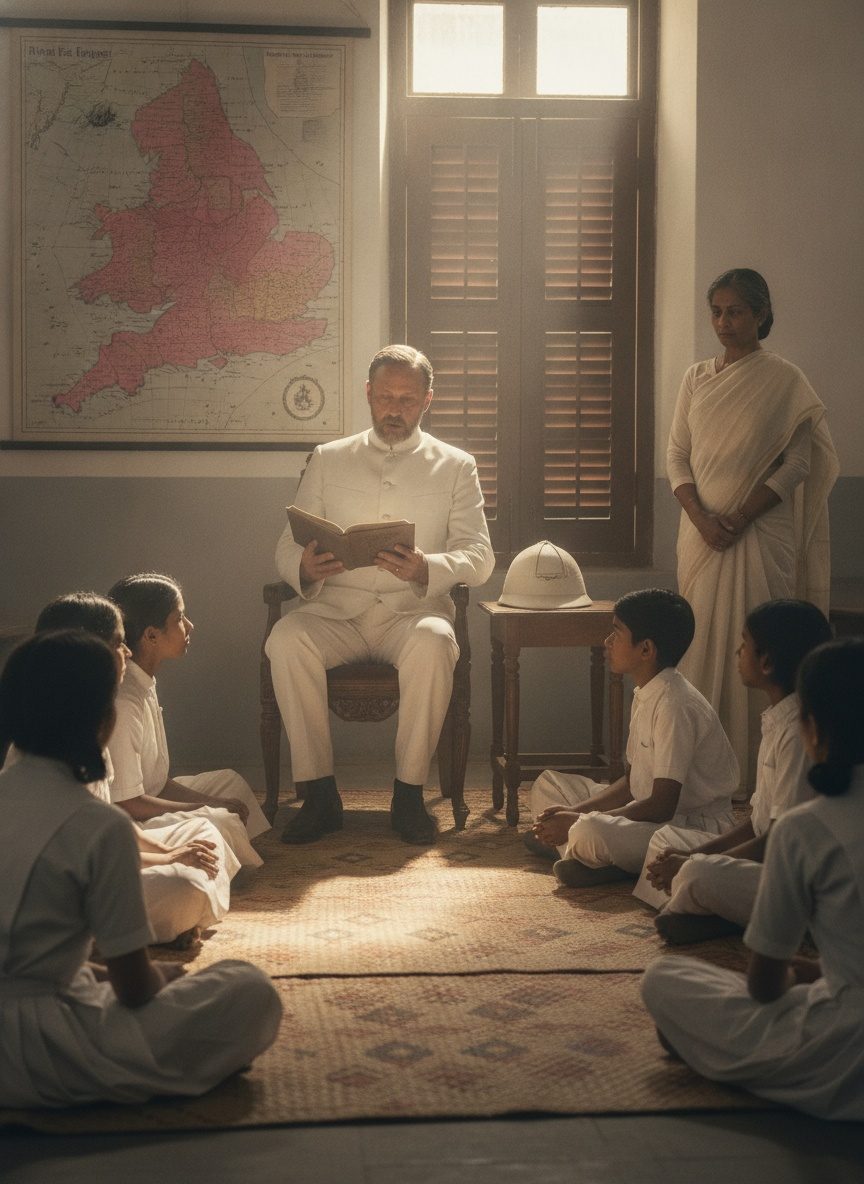
December 1912. The air in Calcutta held a deceptive chill, a weather anomaly for a city that prided itself on its warmth, both climatically and culturally. In an unremarkable schoolroom nestled within one of the city's bustling neighborhoods, light seeped through tall, narrow windows. Dust danced lazily in these sunbeams, oblivious to the significance of the figure standing amidst them.
Lord Charles Hardinge, the Viceroy of India, was no stranger to moments charged with tension. Just weeks prior, under an unforgiving Delhi sky, he had become the prey of an assassination attempt during the grand ceremony of the Delhi Durbar, seated in a howdah atop an elephant. The bomb thrown at him as he participated in the spectacular parade that marked the capital's shift from Calcutta to Delhi had served as a potent reminder of the hostility lurking beneath the grandeur of British rule in India. The attack could have claimed his life, reducing the pomp to a grim tableau much in contrast with what had been planned. Yet, here he stood now, far from Delhi's bedecked streets, in a place devoid of splendor, engaging with a quieter adversary—a simple, gently illustrated children's book.
The events had unfolded with the suddenness and fury of the monsoon, but the aftermath was marked by a resilience that defined Hardinge's tenure. His recovery was swift, bolstered perhaps by an innate determination to continue his duties with renewed vigor. Perhaps it was this tenacity that brought him to Calcutta this day, a city he still considered the intellectual heart of India, to remind both himself and those around him of the softer, humanizing touch of governance, a touch that sometimes evaded the colonial narrative.
The schoolroom in question was not one typically graced by figures of Hardinge's stature, thus amplifying the extraordinary nature of this visit. The children sat cross-legged on the floor, their eyes wide with a blend of curiosity and awe. Their school, an old colonial building with peeling walls that whispered tales of a different era, was suddenly alive with whispers of excitement and the scent of anticipation. Hardinge's presence was enough to render even the chirping birds outside silent, perhaps stunned by the convergence of power and simplicity in this small room.
As he opened the book, the hush deepened. The title emitted a magical aura in the soft intonation of Hardinge's voice, and it seemed fit to be read aloud. The children leaned forward, drawn into a world spun from words, highlighting an earnest curiosity that no imperial edict could quench. The words flowed from the pages like a gentle stream, meandering through tales of heroism and virtue, morality and wisdom. It was a momentously small act, rendering great empathy toward a generation that balanced on the precipice of their colonial present and uncertain future.
For Hardinge, this visit to Calcutta was more than an act of benevolent duty. It signaled a moment to reflect within. In many ways, Hardinge was a juxtaposition of strength and sensitivity, resonating with the empire's paradox itself—an enforcing power cloaked in civilizing intent. The readings, threaded with stories of moral goodness and rightful justice, were not merely for the children but also for his own introspective listening, a time for recalibrating after the momentous shock of the assassination attempt.
Outside, the cacophony of Calcutta life never relented. The city's streets teemed with rickshaws pulled by men of sinewy strength, women wrapped in rustling saris, and traders calling out in musical tones their wares of everyday produce. The British raj existed here as a peculiar sort of overlay, a constant presence but also an object of distant familiarity to the teeming masses, existing simultaneously in imposition and assimilation.
This day and this room stood in stark contrast to the collective narrative of colonial India, stories of power depicted by majestic edifices and rigid protocol. Here was a moment devoid of grandiosity, grounded in simplicity. For a brief time, titles faded, and in their absence, there were just a storyteller and his spellbound audience. It underscored an aspect of the colonial enterprise that rarely found a voice—the intimate connections between rulers and the ruled, brief but crystalline moments of shared humanity.
As the session drew to a close, the students rose, shyly but enthusiastically, their eyes alight with the primitive joy only stories can summon. Hardinge shook each of their little hands, enunciating words of encouragement, finding joy in these fleeting interactions. His demeanor was gentle, as if the act of reading had softened the imperial veneer that esteemed him as one of the empire's towering figureheads.
That day, Lord Hardinge left the schoolroom with reflections infused by the laughter and earnest queries of children, refreshed interpretations of power through the prism of innocence. He walked away mightily transformed—not in rank or title, but in a manner that only genuine interactions can sculpt. The children, for their part, returned to their ordinary classes, each unknowingly altered by a legacy that intertwined the profound and the mundane, the powerful and the powerless. The simple art of reading had once more proven its robust ability to bridge unimaginable divides, if even temporarily.
In retrospect, these encounters remind us of the infinite value of connecting across unlikely boundaries, of recognizing our shared narratives within the folds of history, often glossed over by textbooks. It is a reminder that beyond politics and power, the fundamental links between strangers can yield surprising windows into what it means to be human and part of each other's stories. Such moments challenge historical discourse, once colors fade, to acknowledge not just the elephants and bombs, but the quiet moments with books and future storytellers, nestled in the empire's shadows.