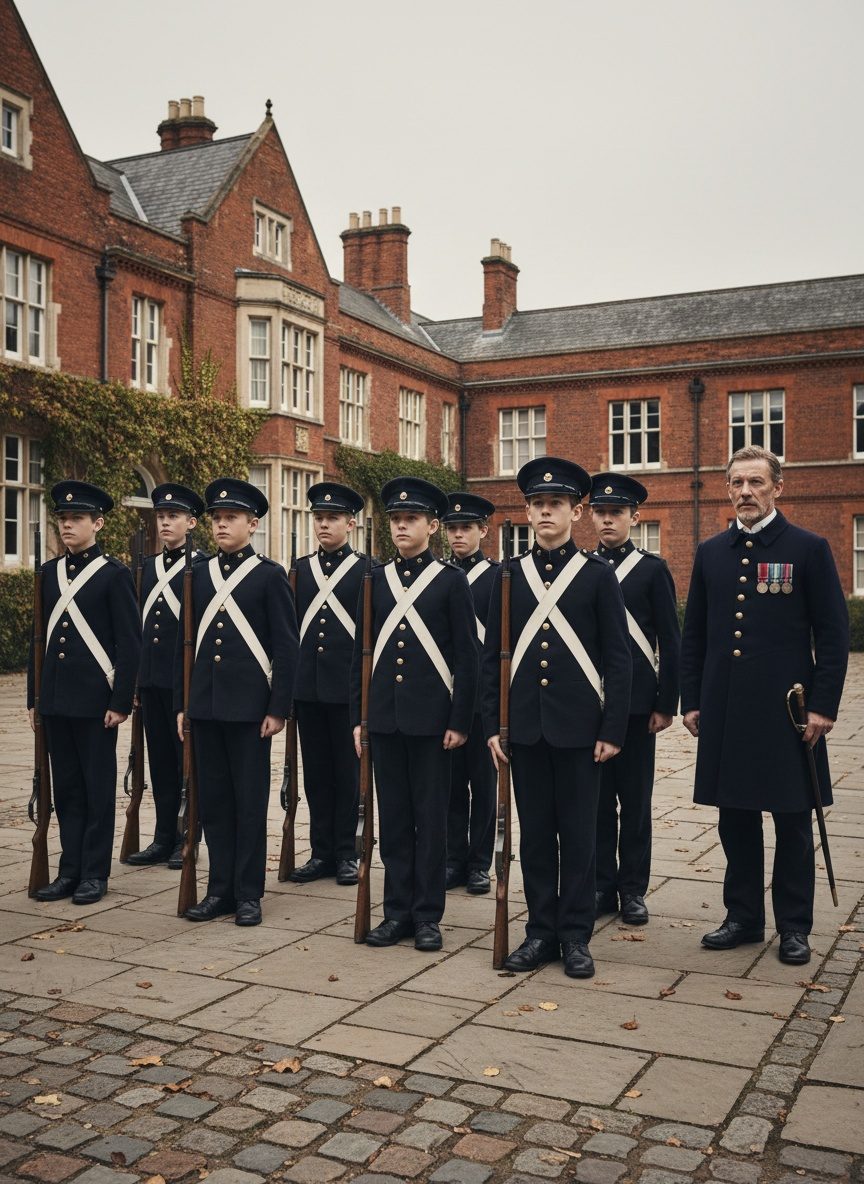
The crisp morning air hangs motionless over the English countryside, where the muted sun begins to cast its first shy rays over carefully manicured lawns and the gothic arches of an imposing school building. The calm belies the energy brewing in the heart of the schoolyard. Suddenly, the silence cracks with the sharp blow of a whistle, instantly animating rows of uniformed boys into synchronized motion. Their feet stamp the earth in unison, their movements directed by a faultless choreography taught through countless hours of practice. Yet, these are not young men preparing for a sporting contest; beneath this serene facade lies the nascent machinery of the British Empire’s insatiable military quench. By the year 1860, a system was in place, funneling youthful ambition toward the empire's frontier battlegrounds—a system that would, before long, draw thousands of boys into its dynamic web.
Forging Soldiers in Schoolyards
The mid-19th century saw Britain wield its imperial might across continents, stretching its influence in a bid for dominance. However, the empire’s grand ambitions came tethered to a practical need: a steady supply of soldiers. In 1859, in response to fears of a potential French invasion and other geopolitical pressures, the Volunteer Movement burgeoned. It catalyzed a shift among Britain’s upper echelons, who began to invest in a new kind of defense — one not born on the battlefield, but in the schoolyard.
Public schools across Britain, long-standing bastions of the elite, became integral cogs in this strategic pivot. They quietly adopted cadet companies where boys as young as twelve were introduced to martial discipline. Under the stern gaze of instructors, these cadets donned uniforms and grasped dummy rifles—wooden facsimiles that bore the weight of expectation, if not lead. The clang of wooden guns snapped against shoulders, echoing the army's heartbeat into the skeletal wooden rifles tucked against the growing shoulders of determined boys. These fledgling recruits learned the mechanics of war long before they encountered the realities of battle.
Professor Gavin Scott’s analysis, preserved in historical records, hints at the dual purpose of these cadets’ activities. While ostensibly a means of physical education and character building, the real intent was preparation — grooming boys to feed into Britain’s voracious military machine. The scene betrays a complex reality: here, in these seemingly innocuous drills, lay the origins of something ominously vast and intricate. Yet, the mundane ties of community and school routine cloaked its imperial significance from view.
The Invisible Pipeline to the Colours
While history classes today might gloss over these early preparations that fed the empire, young boys experienced an immersive primer steeped in patriotism and duty. Cadet drills inserted themselves in the quotidian, achieving a two-fold effect. Not only did it arm the boys with the skills needed for military life, but also it cultured a sense of identity intertwined with military service. These schools became veritable incubation zones, where loyalty to the crown was not taught—it was felt, breathed, lived.
But what historical narratives often fail to reveal is the broader undercurrent running beneath the surface—these were not merely exercises. It was an exercise in imperial conditioning, engaging the psyche before the body could fully comprehend the weight of such responsibilities. The decision to join the military was heavily influenced by these formative experiences. For many cadets, the notion of pursuing a career in the army was preordained, nurtured in the very marrow of early adolescence through direct exposure to martial discipline.
As cadet companies proliferated, thousands of boys were effectively funneled toward military service—quiet catalysts in the empire’s expansionist agenda. Yet, the massive scale of this initiative could not have been apparent to the boys who drilled in their schoolyards, oblivious to the subtle machinations at play. This early discipline did not necessarily ensure that each cadet would don the redcoat or blue uniform of the British Empire’s forces, but it crafted a climate of readiness and eagerness for adventure that the empire deftly exploited.
The Legacy Cemented in March
As the Victorian era unfurled, these schoolyards with their youthful soldiers-in-training became emblematic of an empire’s strength and continuity. Tales from alumni would trickle down through personal correspondences, influencing younger siblings and neighbors, and crafting a cultural cipher that equated service with honor and opportunity. The cadet experience imbued these boys with a sense of confidence and proficiency—qualities prized on the great tapestry of empire expansion.
Revisiting this history spotlights an invisible chapter in the chronicles of Britain’s imperial narrative. The schoolyard might seem a distant space from colonial lands and warfronts, yet it was the provenance of a formidable force—preparing, nurturing, and eventually, sending its young into the world. On the polished wooden floors and clipped grasses, they engaged in intricate formations that seemed more hoeful play than preparation for the sprawling campaigns that awaited them. The cadet companies were a precursor not only to individual service but also to the broader societal expectation that British boys were men-in-the-making long before they reached the age of majority.
These drills may have started in the whisper of morning mist and the discipline of practice, but they left their mark on history. The boy soldiers, cast from the stone of duty, became an essential strand of the empire’s inexorable story—a poignant reflection on how deeply planted were the seeds of militarism, and how silently they grew. In today's reflections, the notion emerges clearly: the legacy of these cadet companies lives on, an echo of martial rhythm, underscoring the vast and nuanced tale of how an empire raised its fighting men—not just on distant battlefields, but in the schoolyards where their journey began.