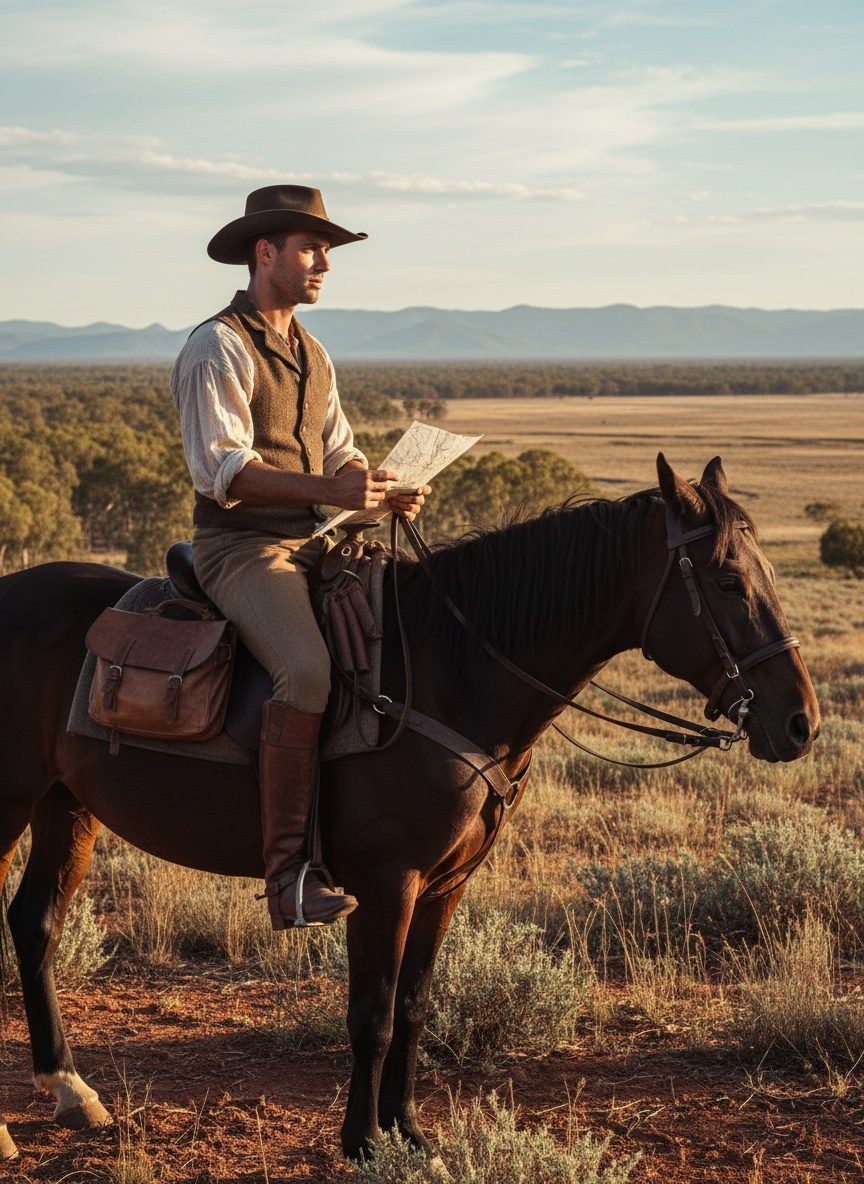
The early morning mist clung to the wild grasses like a shroud as the sun began its slow rise over the sprawling bushland of New South Wales in 1827. James Macarthur sat astride his horse, silhouetted against a canvas of endless green, with the towering eucalyptus trees whispering secrets of an untouched land. The air was thick with anticipation and the earthy scent of the forest mingled with the distant cry of a kookaburra. For young James, this was more than just a ride into the unknown; it was a ride into history. The stakes were enormous. Without a guide or any known path, he ventured forth into unmapped territory, armed with his determination and the hopes of securing land that could forever change his family's destiny.
The Untamed Land
To the settlers of early colonial Australia, the vast, mysterious interior was both a canvas of opportunity and a realm of daunting challenges. For the Macarthurs, a family already legendary for their vital role in introducing the merino sheep and revitalizing a starving colony with their wool exports, this was the next frontier. James Macarthur, the eldest son of the formidable John Macarthur, was tasked with claiming grazing land that lay west of Camden Park, far beyond the fringes of European settlement, where civilization's touch was but a faint whisper. His father, a robust patriarch curiously absent from this journey, trusted him with the pivotal task that could see the family's empire flourish.
The landscape James faced was an untamed wilderness where each rustling leaf and distant call of wildlife spoke a language he had yet to learn. Here, ancient trees extended like watchful guardians and rivers flowed with untapped promise. Riding alone, the isolation heightened his senses, with every crack of a twig or rustle of undergrowth sending echoes through the silent expanse. His journey was one not just into the land, but into a burgeoning sovereignty — an opportunity to carve a Macarthur mark into history, still malleable with the promise of prosperity.
The Claim
In those days of early settlement, the acquisition of land was both an art and a gamble, with no maps to guide ambitions or rules to delineate boundaries. Young James knew the weight of responsibility he bore. It wasn't merely about expanding family holdings but about forging an indelible mark on a nation being born. With only sheer grit and instinct as his guide, he crossed ridges and serpentine rivers, braving the thick scrub and the ever-present specter of danger that lurked on the unexplored paths.
Alone and wary, every landmark was meticulously noted in James' mind: The towering gum by the riverbend, the strange rock formations casting shadows akin to ancient spirits, and the vast expanses of rich earth beckoning ever westward. Each day on his return journey, as he retraced these mental notes to ensure his claim was secure, his resolve only strengthened. The land he aimed to call his own was not simply an empty canvas but a critical component of the vast tapestry the Macarthurs were weaving into Australia's economic and social fabric.
James' solitary ride into the unknown speaks of more than just a young man seizing an opportunity. It was emblematic of a spirit intrinsic to those who dared to call Australia's wild land home. As he marked the extent of his journey, he was not only marking new territory for a family empire but also contributing to a narrative of colonial expansion driven by personal ambition and enterprise.
Legacy of the Ride
Upon his return, the young adventurer found himself in possession of a swath of land that promised to double his family's holdings. James Macarthur's expedition signaled more than just a significant expansion of his family's reach; it symbolized the bold and often perilous pursuit of prosperity that defined much of Australia's early colonial history. The land he claimed would indeed bolster the Macarthur legacy, as much a testament to the family's grit as to the transformative potential of the Australian landscape on the enterprising few who dared to venture beyond the known.
James Macarthur's journey is a lesser-told saga of the courage and determination that carved a new world out of wild bushland. His ride into the bush alone underscores a pivotal moment when the uncharted wilderness transformed into a canvas for ambition, forever changing the landscape and economic potential of colonial Australia. This act of solitary courage not only speaks to the personal strength required to tame such a land but also mirrors the broader struggle of a young nation in formation: a vast expanse of opportunity shaped and claimed by those with the audacity to believe in its promise. As we reflect on James' solitary venture, we glimpse the tenacious spirit that underpinned each stride toward the development of what would become modern Australia.