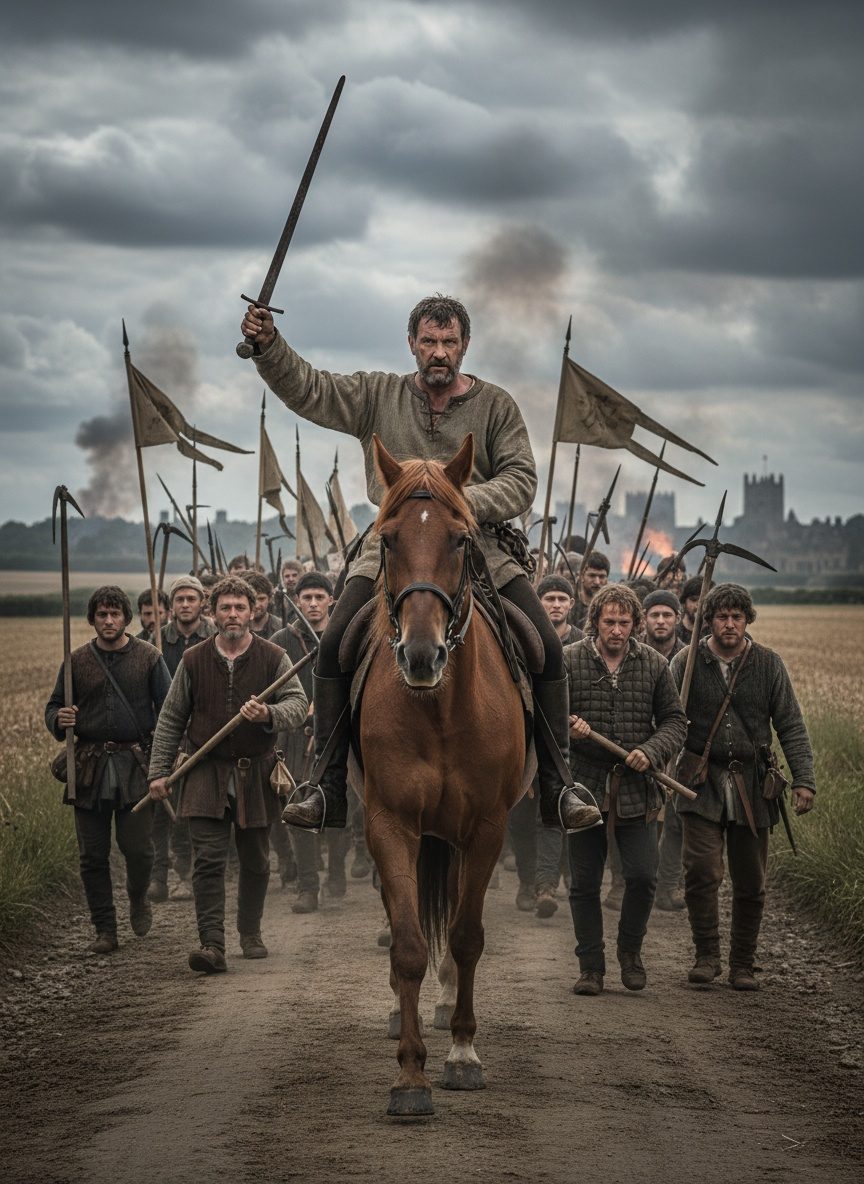
June 1381. Dust settled on the roads leading to London.
Seeds of Rebellion
The midsummer heat bore witness to an army like no other. These were not armored knights nor seasoned warriors but men hardened by toil and injustice. The peasantry of England, led by a seemingly unassuming tiler named Wat Tyler, surged forth as an expression of pent-up anger and frustration. Their grievances were many, but one dire straw had broken the camel's back: the imposition of the poll tax, a fee levied on each adult indiscriminately, meant to fund the failures of the Hundred Years' War.
But this tax contributed more than just royal coffers; it sparked the flame of revolt. From Kent to Essex, entire communities turned to Tyler, a charismatic figure whose eloquence matched his resolve. With a quickly swelling force, the rebels aimed not just to protest but to dismantle the oppressive systems that had ensnared them for generations. They marched towards a complicated destiny, at the epicenter of which stood the ancient city of London.
What made these events particularly astounding was their sheer scale. Tens upon tens of thousands, some estimates suggesting nearly a hundred thousand, answered Tyler's call. They were driven by desperation and a dream of justice. Along their path, they decimated tax records and laid siege to governmental strongholds, including the infamous Savoy Palace, home to the unpopular John of Gaunt. Liberation followed destruction, as prisoners were freed and corrupt officials faced their judgment.
It was not just the physical collapse of symbols that the rebels sought; it was change in its purest form. This uprising set a precedent; the voice of the oppressed was no longer resigned to whispers along village lanes. Rarely had history seen commoners organized with such fervour, determination, and purpose, marching under a jaded sun towards what many believed to be their undoing or their salvation. The march on London promised a confrontation unprecedented in English history. England trembled at this newfound power amongst its people.
The City Under Siege
On their approach to London, the sheer magnitude of the peasant army shadowed its walls. The city itself was at a crossroads of history, an urban beehive caught between fear and curiosity. Within its bastions, anticipation tinged with dread spread among the citizens and nobility alike. Whispers of the insurgents’ advance echoed through cobbled streets. What compelled these tens of thousands to march was more than just the immediate oppressions they faced; it was the hope for a fundamental transformation in the way they lived and were governed.
Wat Tyler was no ordinary leader. His strategies were bold, his convictions unyielding. Upon reaching Southwark, he parleyed not beneath the banner of a conqueror but under the mantle of righteousness. Understandably, the authorities were caught flat-footed, bewildered by Tyler's unexpected diplomatic acumen, which matched the ferocity of his resolve. It was a movement previously unimaginable—a stark confrontation between the mighty walls of tradition and an unprecedented outcry of peasants for justice.
Within the city, the Tower of London—a symbol of royal might—became both refuge and prison to those officials scrambling for control. Meanwhile, the teenage king, Richard II, found himself at the center of a maelstrom, thrust into a role far larger than his years might suggest. The rebellion’s impact resonated beyond mere confrontation; it highlighted the stratification and tensions that had been brewing under England’s social skin for decades. But no one, least of all the ruling class, could predict the outcome of this dramatic excursion.
In this crucible of unrest and tumultuous aspirations, a delicate negotiation ensued outside the city walls. Tyler met with the boy king, rider to rider. Imagination reels at the scene—an uneasy truce held by tense breaths and solemn oaths, each syllable spelling the potential for great change or tragic folly. It was the face-to-face meeting of two Englands: one steeped in feudal rigor, another yearning toward modernity. Around them, the air bristled with anticipation—would their parley usher in a dawn of understanding, or would it succumb to the palpable risks lurking beneath the surface?
A Fractured Resolution and Its Echoes
As midsummer's dust gave way to negotiations, the political theatre played out under a hawk-eyed sky. With a promise of reforms whispered among the gathering, the peasants expected the dawn of a new era. However, fate is never so easily scripted. In a swift and controversial stroke, history rendered its verdict. A commonplace cause, a rare and fragile peace, unraveled within moments, as Tyler met an untimely and unresolved fate—felled during one of the parley sessions.
The heart of the rebellion stuttered. Without their stalwart leader, momentum faltered, and in the ensuing chaos, the throng that had dared to challenge the throne struggled to regain its footing. The king’s promises proved ephemeral, whispered assurances vanishing along with Tyler’s vigil. The royal machinations swiftly readjusted their stratagems, dispersing the peasant ranks with lordly forces. The rebellion, though quenched, left an indelible mark on England's political landscape.
The Peasants' Revolt, though quelled, resonated through the annals of England's history. It demonstrated the potential of the common populace when united under grievance and vision. This rebellion was not simply a tale of immediate defeat but the highlighting of a narrative that saw the underlying social tensions burst to the surface. The movement exposed the vulnerabilities of the elite and planted seeds for future reform. It was a harsh reminder that the socioeconomic disquiets of the lower strata remained ever-ready to rise forth when sparked by oppression.
Wat Tyler and his rebels dared to dream of a new social contract, paving the way for incremental but inevitable progress. In examining their march and the profound audacity it embodied, we find an echo of the eternal dance between power and the people—demonstrating that even a seemingly insurmountable system can be challenged by the will and unity of ordinary individuals. It serves as a mighty chronicle of aspiration and rebellion, a chapter that history could never afford to leave in the shadows.