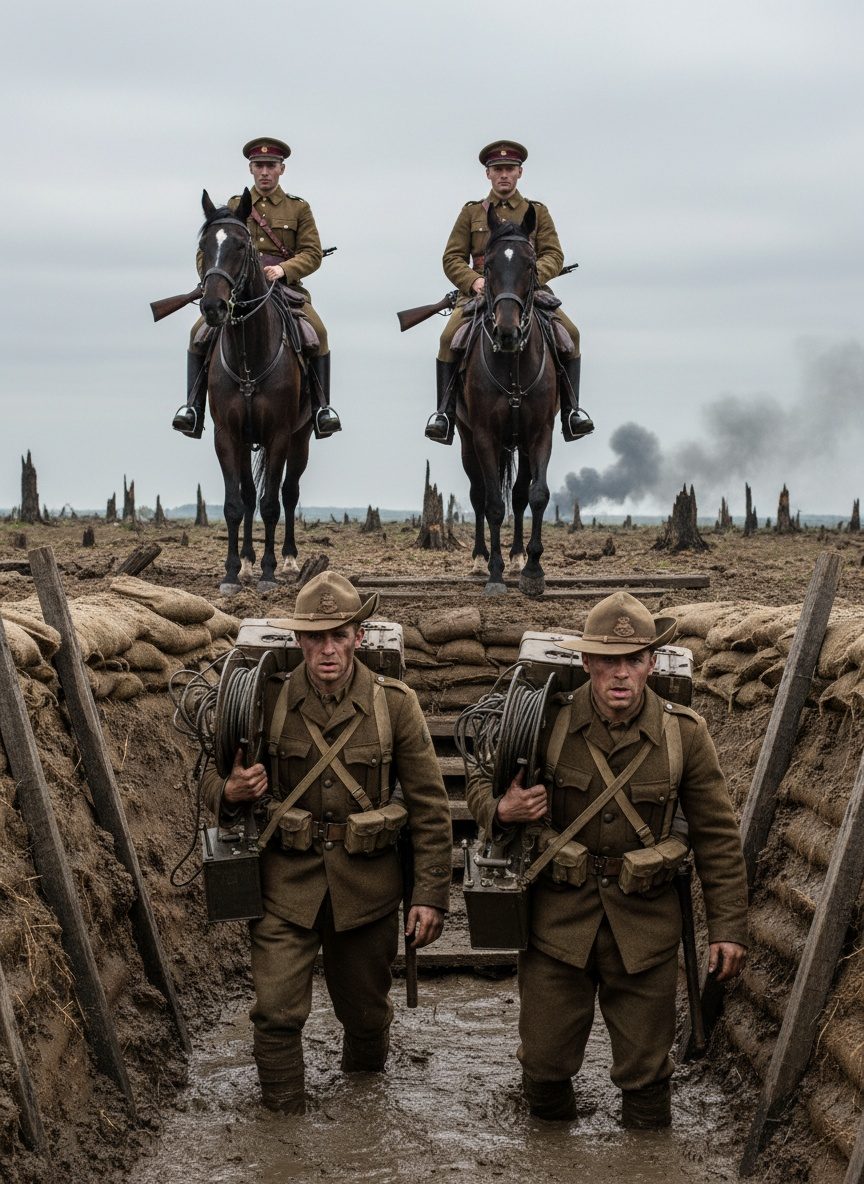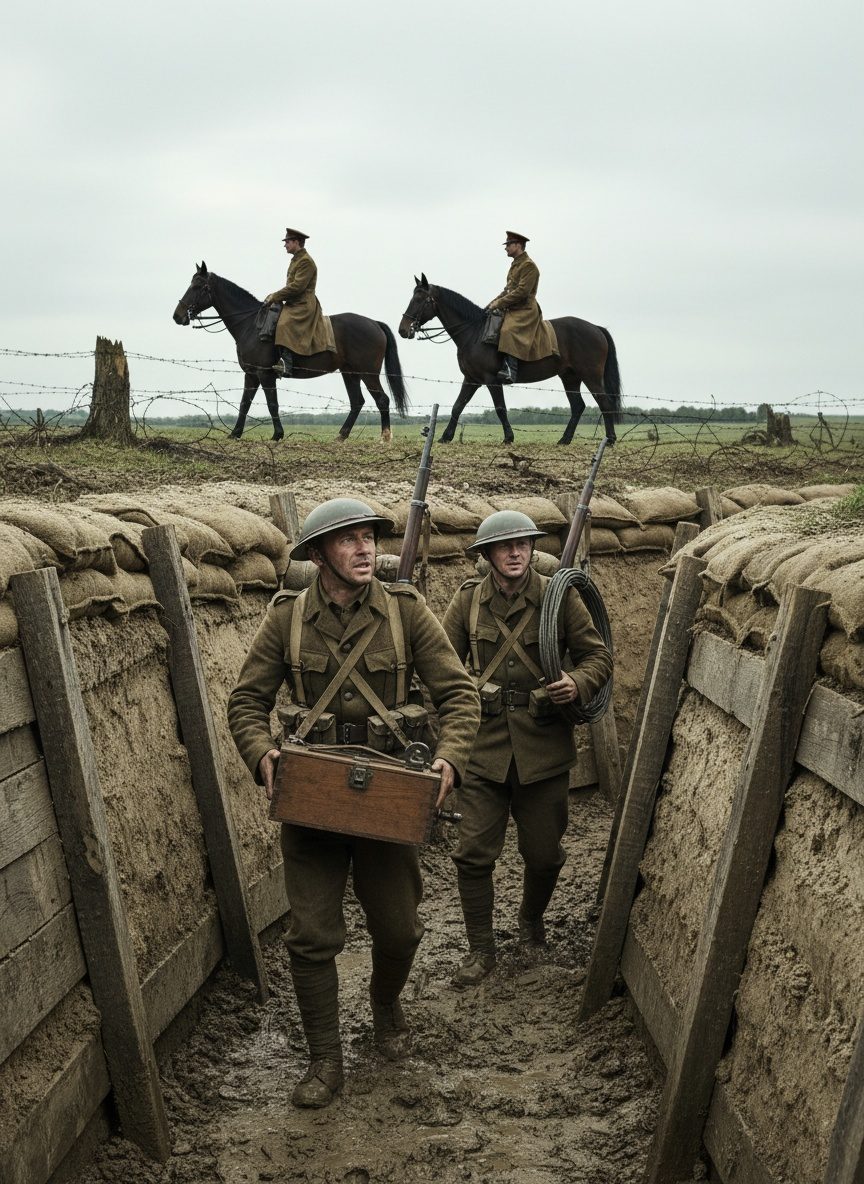
The clatter of hoofbeats echoed like distant thunder as Australian signallers glanced upwards, watching shadows pass briefly across the trench, cast by British cavalry cutting an imposing figure against the bruised sky. A sharp whistle sliced through the air, binding them back to their task, their world below ground so starkly different from the one that galloped overhead. Amidst the drizzle and the muffled rumble of artillery, the men soldiered on, lugging cumbersome wire and telephone equipment that promised connection amidst chaos, all while silver-plated sabres gleamed above in another theatre of the same great war.
The Men Beneath
Inside the trench, they moved like weary moles, carving existence through the sullen earth. The scent of damp soil mingled with the metallic tang of sweat and mechanized grease as ANZAC signallers trudged along, their bodies encased in heavy oilcloth capes to fend off the pervasive wet chill. Each man carried more than just tools; they were burdened with the invisible weight of responsibility—a mission to maintain the communication lifeline between units scattered across an expanse littered with barbed wire and craters.
Communications during World War One were complex, and the trenches were the circulatory system. Messages, like blood, needed to flow quickly and efficiently to keep the machine of war alive. The signallers were the unsung cogs within this mechanism, connecting front-line infantrymen to command posts. Their work was often thankless yet vital—lines were laid and repaired under fire, voices crackled over primitive field telephones, and Morse code tapped into the ether where every second might mean the difference between life and death.
Above, the whinny of a horse suggested an antiquated image more suited to Napoleonic times than the industrial hellscape of the Western Front. Yet the reality was far from romantic. The British cavalry's wooden sabots clacked on boardwalks affixed to earthen ramparts, a stark juxtaposition against the mud-splattered boots below. These soldiers, many from storied regiments like the Queen's Own Hussars, were symbols of steadfast bravery—even as their role transformed almost beyond recognition.
A shared existence and purpose united them beneath the skies of Neuve-Église despite their differing duties, each driven by unshakeable determination. On May 7, 1917, they passed—neither aware of how their convergence would echo through the annals of history.
The Gallop Above
Meanwhile, above the trenches, the cavalry rode with a different burden—one that was paradoxical and unique to their era. Horses, once central to warfare, now coexisted awkwardly with new technological advances. The sight of these proud beasts, trained to trust and respond amidst the noise and chaos, provided morale and they still held a notable role for reconnaissance, supply, and rapid movements behind the lines.
The British cavalry, while not a frequent fixture in the stalemated trenches of World War One, always carried the potential of breakthrough. From atop their saddles, these men could see over the mundane into the horizon, their eyes holding the line—symbols of dash and daring. This duality between romantic idealism and gritty reality played out every day under the brooding clouds of France's unforgiving battlefields.
Indeed, sabres, once romanticized in dashing charges, were now sheathed more often than drawn. With modern trenches disrupting mounted charges, tactics evolved; carbines slung at their sides became a more pragmatic choice. In these fleeting moments above the trench, the cavalry symbolized a bridge—between the warfare of old and new. Yet, the spark of glory remained, flickering like a brass-polished badge on their uniforms. The cavalrymen grasped their reins resolutely, often passing uneventfully over the toiling signallers below, each locked into their silent, symbiotic crusade against chaos.
A Shared Moment
The contrast between the two worlds was stark, yet their meeting on that muddy earth symbolized a rich tapestry of coexistence. In the clay-laden troughs beneath Neuve-Église, these fleeting seconds of silent acknowledgment echoed the evolving narrative of war—one where roles had fundamentally shifted, yet mutual dependence was constant.
While the signallers bore their arms of wire and telegraph poles, the cavalrymen bore traditional weapons that history had all but superseded. As progress forged forth in fits of brilliant invention and cruel necessity, each soldier's struggle was etched in the mud that sucked at their boots or the rhythmic cadence of hooves above.
This connection became the unwritten chronicle of adaptation in a brutal theatre of war. It was the whisper across generations—a poignant reminder of human resilience and the drive for communication in an era striving to bridge the chasms between past and present. The crossroads of traditional heroism and the grittier realism of modern warfare, sometimes just a glance away from each other.
In the shared silence of that common ground, they left an indelible mark—a story not loudly proclaimed but gently settled in the soft sigh of the French winds. Here, among the endless echoes of conflict and the silent pulse of bravery, the lineage of courage and communication danced a brief, unwritten vaudeville, gracefully bridging the antiquated and the novel. Though little documented and often overlooked, this convergence remains, whispering to those who seek the legends they left out of the textbooks.