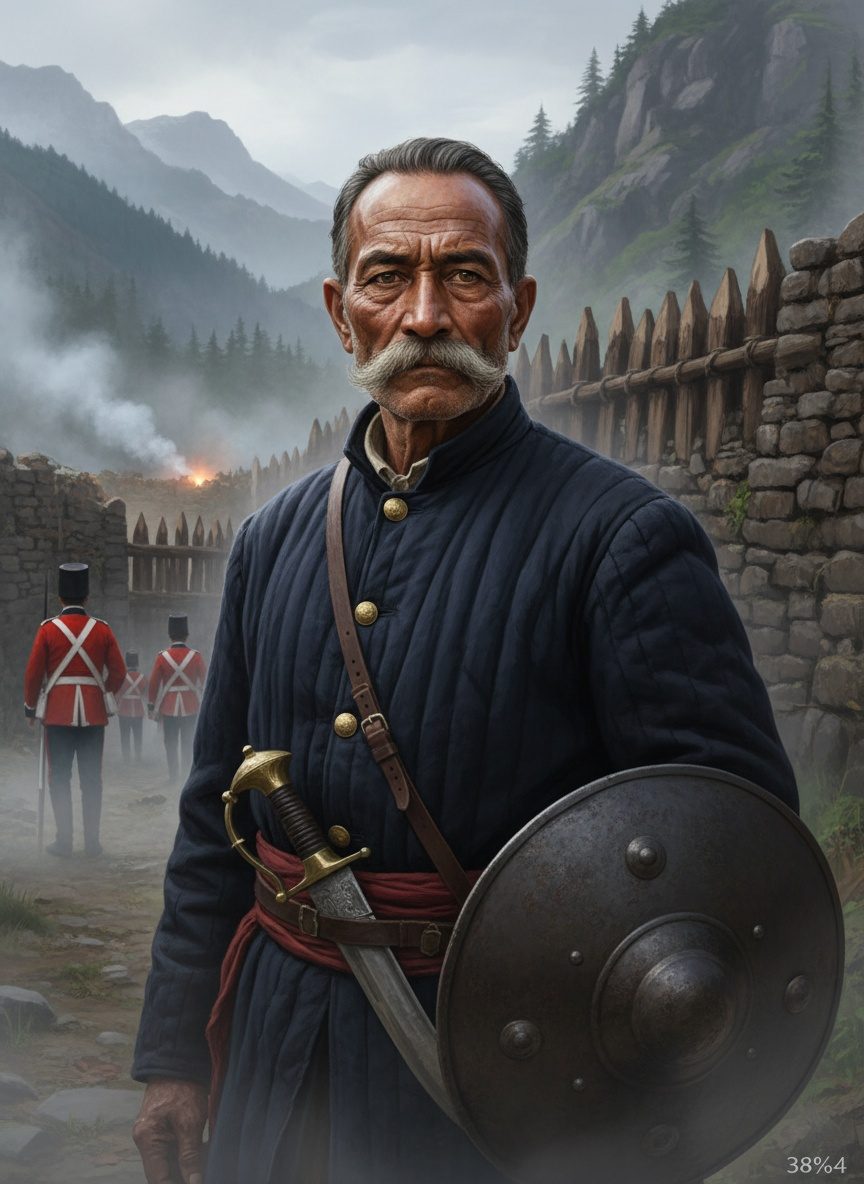
He was seventy-four years old. Age could not keep him from leading his men into bloody conflict amidst the Himalayas.
The Unyielding Wall of Nalapani
October 1814 marked the beginning of the Anglo-Nepalese War, which unfolded under the shadowy crests of the Himalayas. At the heart of this tumultuous conflict lay a seemingly inconsequential fort near Dehradun: Nalapani. The British East India Company, with its mighty arsenal and unmatched military reputation, faced an unexpectedly fierce resistance. Within these mud-and-timber walls, 600 Gorkhali soldiers stood resolute under the command of the venerable Bhakti Thapa, a man who defied military conventions not just with strategy but with the very unfaltering spirit of a warrior too old, by conventional standards, for the battlefield.
Commander Bhakti Thapa was not just any leader. Born in 1741 in Lamjung, Nepal, he fought fiercely against the Gorkhali before fate would see him defending its cause. The British underestimated the defenses of Nalapani, expecting a swift victory but found themselves embroiled in a grueling six-week siege. The Gorkhas employed guerrilla techniques and utilized their knowledge of the treacherous terrain, strategies unfamiliar to European forces accustomed to open field battles.
An Age of Legends
Bhakti Thapa was already a celebrated veteran when he defended Nalapani. Known previously as the Sardar of Lamjung, Thapa's career traversed alliances and battlefield reversals. After being captured during a siege by Gorkhali king Kehari Narayan's forces, he was transported to Kathmandu as a prisoner. Rather than languishing in defeat, Thapa rose swiftly, embracing roles that would see him shift from prisoner to commander of the very forces he once valiantly fought against.
By 1814, Thapa, now a Sardar in the Gorkhali army, had become a linchpin in the defense against British advances in the Himalayan frontiers. Underestimating the old soldier's renown and strategic acumen was among the errors of the East India Company's approach. Soldiers of the Company assembled at the fort's gates, confident they could crush the so-called dilapidated defenses of Nalapani. Yet, the fort emerged as an erstwhile rock in an ocean of imperial aspirations.
A Fort’s Last Stand
The initial siege underscored British miscalculations. Under Brigadier-General Robert Rollo Gillespie, the British forces launched successive assaults that echoed through the hills but continuously met a rain of resistance from within those wooden walls. The Gorkhas, led by Thapa, not only matched the might of their adversaries but also broke ground in demonstrating what tenacity could achieve against overwhelming odds.
On November 30, 1814, amidst cannon fire and smoke so thick it mingled with the morning mist, Bhakti Thapa made his mark on history. Fighting from high atop the walls, the Gorkhas saw their numbers dwindling, supplies depleting, and hope wavering. But, surrender danced nowhere in Thapa’s plans. Facing inevitability not with resignation but resolve, he donned his battle gear and rallied his men for one final defiant charge. As Thapa advanced, he embodied fortitude, leading by example as he met his fate, a cannonball ending his venerable life upon those cherished defenses.
Battlefield Respect: Unlikely Tributes
In an era where animosity often lingered like the fog of war, how the British responded to Bhakti Thapa’s final act speaks volumes of the warrior’s stature. Although adversaries, the British accorded him the rare decorum of burial with full military honors. This honor bestowed upon a foreign foe speaks not just of respect for Thapa but also offers glimpses into the world of martial honor that transcends cultural boundaries.
The British forces were compelled to reevaluate their perspectives, recognizing in Thapa not an enemy commander but a soldier whose valiance mirrored their own martial ethos. Acknowledging such bravery reflected a moment where war's brutal realities yielded to mutual respect, an acknowledgment of the commonality of purpose that soldiers, whatever their allegiances, often share.
Remembrance of a Warrior Eternal
In history's lofty annals, the tales of fortresses besieged and armies vanquished run abundant, yet within the narrative of Nalapani, broader themes of human resilience and respect for courage carve a deeper impression. Bhakti Thapa's narrative endures because it prompts reflection not just on the man himself but on the broader theater of human conflict where ideals and realities intersperse.
The Gorkha’s stand at Nalapani was but a skirmish in the prolonged saga between the British Empire and Nepal's highland defenders. Yet, it endures as an episode illustrating that courage is ageless. Today, as the winds sweep through the ruins of the Nalapani, the spirit of that final stand – the cheer of the warrior who was more than mere combat – whispers to us across time, reminding us that along the contours of human history, it is often the battles unchronicled in textbooks that tell us most about the undying mettle of the human spirit.