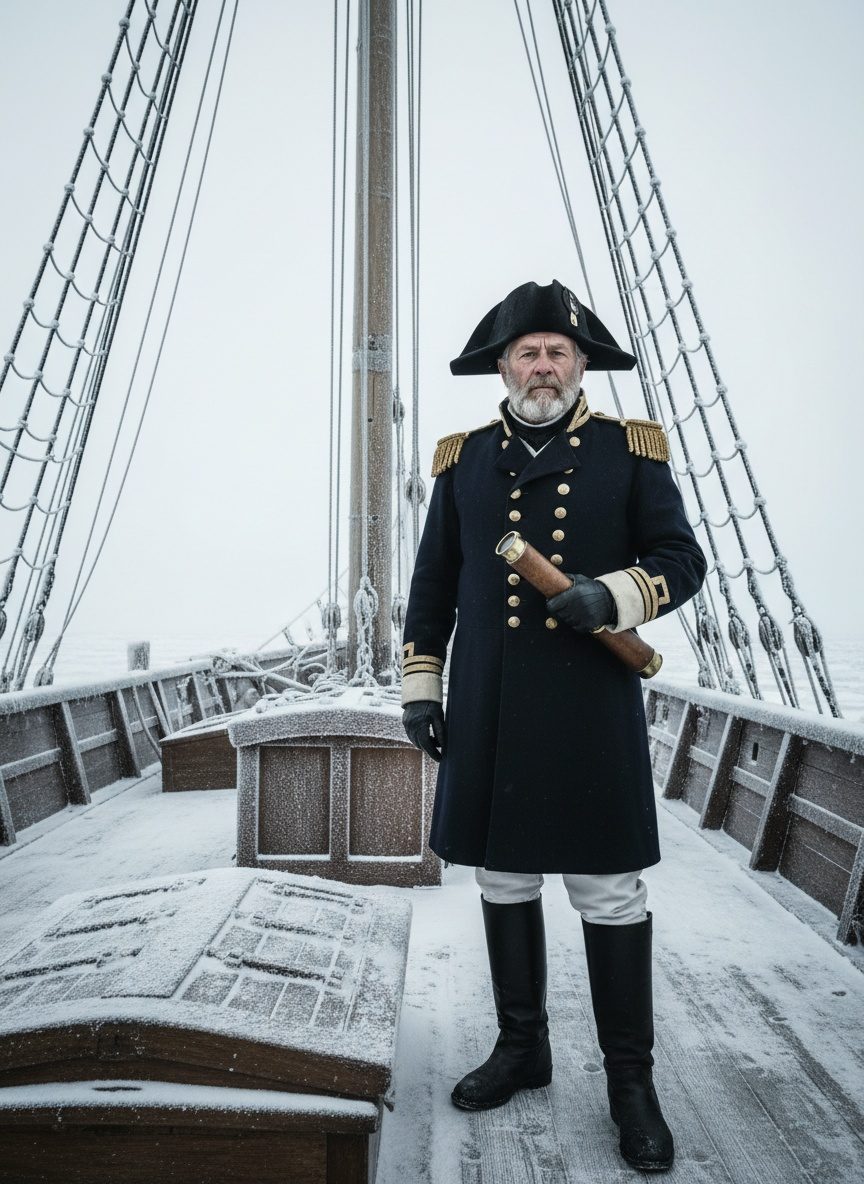
The Arctic in September is a world of contrasts. Light wistfully clings to the horizon, casting an ethereal glow across the sprawling, frozen wilderness. The air is crisp, tinged with the salt of the sea and the promise of oncoming winter. It's a realm untamed, vast, and silent but for the near imperceptible groans of the encroaching pack ice. Into this chilling expanse, HMS Erebus and her lost companion vanished in 1845, swallowed by merciless tundra and time. Britain’s finest expedition, seeking the mythical Northwest Passage, disappeared without a trace, leaving behind whispers and tales amidst the icy north.
The Vanishing
In May 1845, Sir John Franklin embarked from England on what was to be a pinnacle of naval prowess. With 129 men and two majestic vessels, HMS Erebus and HMS Terror, the expedition sailed into mystery. Provisioned for years, the ships carried not just men and material, but ambition — the dream of charting a route that had eluded and fascinated explorers for generations. The world waited intently as the ships plunged into the Arctic’s secrets, but silence followed them as the years rolled on. Search parties embarked; frustration mounted as the greatest rescue mission of the century returned stymied.
The era buzzed with theories — starvation, cold, lead poisoning from soldered cans. Yet, even as stories fed imaginations, the Lazarus-like return of Erebus eluded all. Across the icy canvas, hope dwindled while legends grew — whisper-spoken fables in communities that danced with the shadows of the tall ships’ memory. As the last vestiges of direct encounters with the expedition faded, it was the fabric of Inuit oral tradition that endured, though largely ignored by Western searchers who dismissed indigenous knowledge.
The Arctic's quiet witnesses, unknown to those whose names dominated newspapers, retained threads of truth in their tales of masts and eerie visions emerging from the ice. Theirs were narratives of mast peaks seen through frosty mists, ethereal and ghostly — relics untouched, save for those whose lives interwove the land's infinite mysteries with their own.
The Return
The Arctic conceals but occasionally reveals in acts of rare generosity. Intrigue rekindled in 21st-century Canada, where explorers with high-tech gadgets sought the lost Erebus. However, it was not the sophisticated tendrils of technology that seized from this icy grasp, but rather the simple recollections of Inuit hunter Louie Kamookak, echoing voices of those who navigated inch by foot with eyes and memory sharp against oblivion’s call.
For 171 years, Erebus lay adrift beneath layers of ice and history. The cultural chasm of the Victorian era overlooked the rich tapestry of Inuit storytelling — a crucial compass pointing North past inexcusable negligence. With stoic perseverance, Kamookak connected phrases passed through generations — phrases long dismissed as quaint hearsay — with maps and aerial shots, galvanizing a geographically and historically poignant discovery.
It was in August of 2014 when the Canadian research vessel, equipped with sonar and informed by Inuit testimony, drew near the record of these tales. Despite years spent in specialized searches and vast resources employed, these efforts faltered until Kamookak’s direction harmonized with modern curiosity. In a mere 2.5 hours upon their guided arrival, Erebus surrendered herself to both the eye of the camera and the eyes of the world, rising myth to palpable truth.
The Legacy of Voices
In the Arctic's mysterious brink, where cold reduces hubris to humility, the intricate entwining of legend and logic remains paramount. The unyielding Erebus' resurrection attests not to the cutting-edge alone or the prowess of military might. It underscores a larger narrative — one where colonial attitudes bow not without a measure of grace to the depth of knowledge carried by those who lived near the haunting remnants, listening all the while.
This poignant rediscovery reiterates the manifold ways in which history, flora-like in nature, unfurls toward the striking light of understanding. Once dismissed, the tellers of tales proved more than mere raconteurs; they were custodians of a history not forgotten, only waiting. In a world unrelenting in its pace forward, sometimes the path revealed is not merely a lesson in endurance or discovery but a profound acknowledgment of wisdom long at rest, ready again for its rightful place in the ever-spanning narrative of humanity.