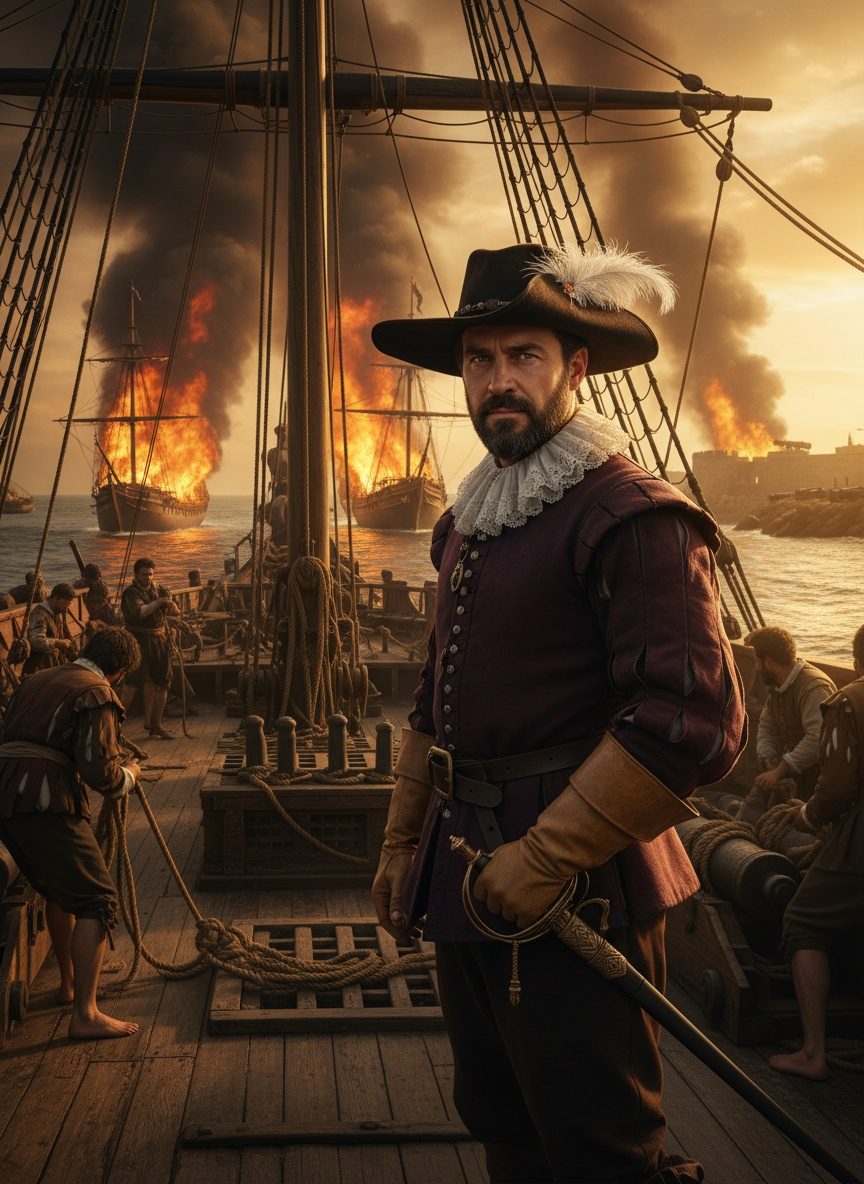
Francis Drake's bold attack on the Spanish Armada is often remembered as a daring victory. But history's legends often gloss over the finer details that reveal deeper truths. It's not just a story of naval glory, but also one of cunning strategy and high-stakes espionage in the age of empires.
The Precarious Stage Seemingly Set for Defeat
By the spring of 1587, tension between Elizabethan England and Philip II’s Spain simmered to a boiling point, manifesting in the form of a massive naval undertaking. The Spanish Armada, considered the greatest fleet of its time, was forging ahead under the sun-drenched skies of Andalusia. Philip II, a monarch renowned for his staunch Catholicism and relentless ambition, had set his sights on bringing Protestant England to its knees. England knew of the impending threat; intelligence reports and whispers across the channel spoke of ships, weapons, and men gathering in Spanish ports, building like a brewing storm on the darkening horizon.
In this context, Sir Francis Drake, the revered English privateer, stood not merely as a seafarer but as a potent symbol of Elizabeth I’s indomitable will against foreign dominion. Lacking specific orders to strike, yet driven by an acute sense of urgency, Drake set sail toward the Spanish stronghold at Cadiz. His arrival was unexpectedly daring. Commanding an agile squadron, he entered the harbor, each of his ships cutting through the waters under sails stretched taut by the salt-laden air.
Cadiz, a bastion of Spanish maritime might, proved vulnerable to Drake's assault. Information about the Armada's construction had reached him through intricate networks of spies and informants—an aspect often overlooked. In a tumultuous dance of battle, his fleet unleashed a storm of fire and fury. The sky over Cadiz darkened with the billowing smoke of burning vessels; thirty ships met their fiery fate that afternoon. For Spain, cradled in the illusion of invincibility, the losses proved a severe wound.
Three Days of Sheer Audacity
The first day of battle had demonstrated Drake’s audacity, yet what followed was an even more astonishing chess match of warfare. Rather than retreat after the element of surprise had run its course, Drake held Cadiz harbor for three tense days. His fleet, though significantly outnumbered, expertly maneuvered within the confined space, blocking potential Spanish reinforcements and sowing confusion among the ranks.
The Spanish response was hampered by disarray and communication failures as the news of Drake's incursion spread. Shore defenses scrambled to react, while local commanders, caught unawares, struggled to organize a counterattack. Drake's meticulous planning came to the fore: knowing the terrain and the tides, his navigation within the harbor was both daring and calculated. The English fleet danced along the water like specters of doom, spreading fear and mistrust.
The psychology behind Drake's decision to linger was multifaceted. By holding the harbor for those three days, he projected an image of unwavering confidence and strength, signaling to the Spanish crown that England was far from the easy target Spain had imagined. His actions delayed the Spanish war preparations significantly, buying precious time for England to ready its defenses. Though just days in duration, Drake's occupation of Cadiz shattered Spanish morale and garnered a delay crucial to England's later triumph over the Armada.
Why It Matters: Undermining the Might of an Empire
Drake’s feat at Cadiz in April 1587 isn't often given its due in standard historical accounts. Yet, it represents a pivotal moment when a solitary decision influenced the course of empires. The repercussions of Drake’s raid ripple through history. By delaying the Armada's advance for over a year, England was able to bolster its defenses, secure vital resources, and galvanize a nation around resistance to subjugation.
Drake’s escapade also underscores the critical nature of intelligence and psychological warfare in military strategy. It was not mere force but information and the manipulation thereof that empowered England’s underdog victory. He showcased the significance of naval power in the modern era and redefined England’s position on the global stage, planting seeds for an expansive maritime empire that would flourish in the century to come.
As we unearth the often-shadowed tales of Drake’s daring at Cadiz, we uncover not only a saga of explosive naval confrontation but a mirror reflecting the wider, tangled tapestry of European power struggles in the sixteenth century. It serves as a potent reminder that history, much like the furrows carved by ships on the waves, is shaped as much by the unseen as by the overt. England’s heartening delay of Spanish dominance may have begun in a blaze of cannon fire and smoke-choked skies, but it endures through the flames of courage and cunning that changed the course of history.