In the annals of naval warfare, tales of heroism often rise to the surface like ships emerging from sea mists—unexpected, striking, and inescapably gripping. On May 31, 1916, in the bloody maelstrom of the Battle of Jutland, one such tale was forged, involving a boy whose valor defied both his years and the fury of war. This is the extraordinary story of Jack Cornwell, the Boy Cornett who held the signal line at Jutland.
The Preparation: A Nation at War
The onset of the 20th century had plunged Europe into a tempestuous period of conflict, and the British Royal Navy stood as Britannia’s bulwark against the rising tide of German aggression. The Battle of Jutland was not just another clash on a vast chessboard of the North Sea. It was the largest naval battle and the only full-scale clash of battleships in World War One. The stakes were oceanic, with the British Grand Fleet confronting the Imperial German Navy’s High Seas Fleet.
Amongst the iron giants, a nimble and valiant contender was HMS Chester. A Town-class light cruiser, the Chester bore a youthful soul within its steel embrace—16-year-old John 'Jack' Travers Cornwell. Like many of his generation, Jack enlisted in the Royal Navy eager to serve king and country. On this fateful day, he did more than serve; he stood immortal in courage.
The Hurricane of Battle
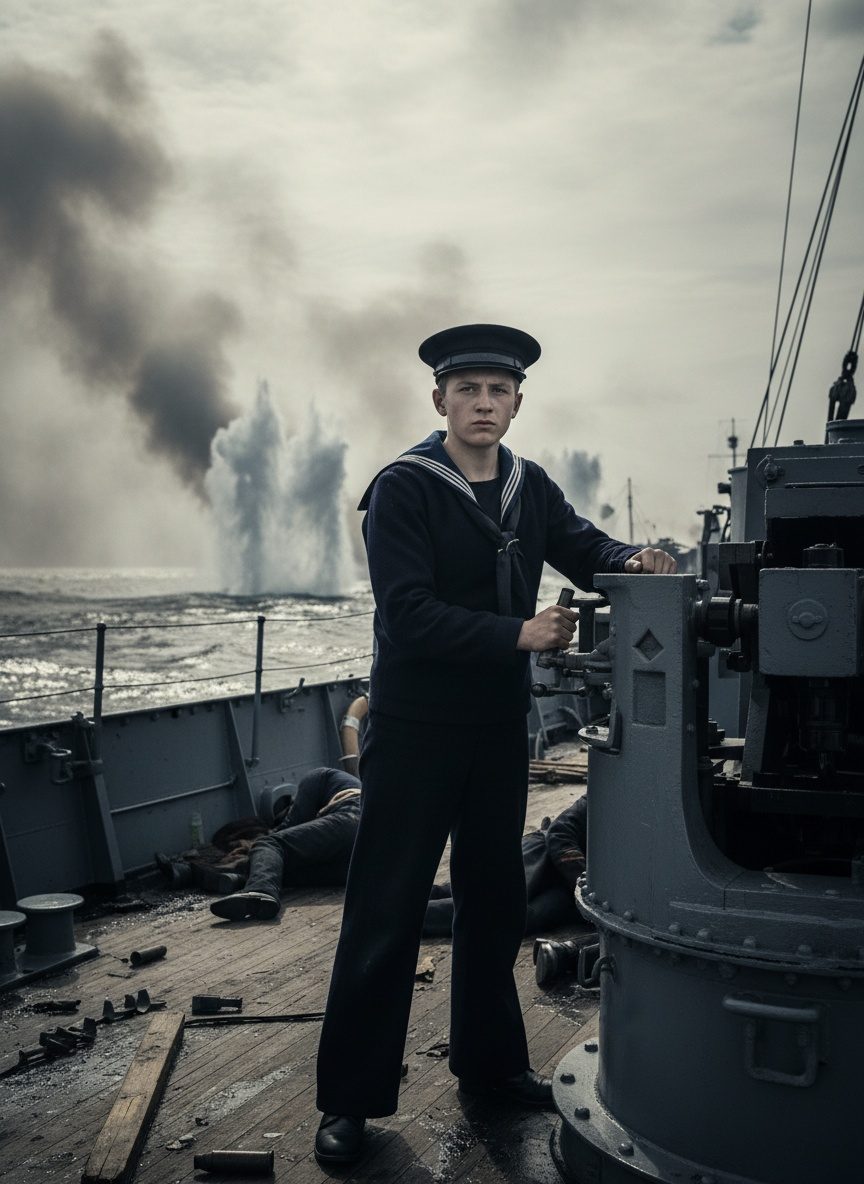
The Battle of Jutland was a cataclysm of fire and chaos. On the morning of May 31, HMS Chester steamed ahead, part of a squad determined to stub out German reconnaissance. Suddenly, the vessel found itself under a barrage from four German cruisers. Cannonades thundered and the sky was blotted with smoke and shrapnel; each explosion like a cruel predator, seeking to devour young souls.
Amidst this bedlam stood Jack Cornwell, assigned as a sight-setter to the forward gun of the Chester. When enemy shells ensnared their target, the apparatus around him was devastated, his gun crew eviscerated. Yet, Jack remained steadfast, wounded and alone, clutching to the last vestiges of his duty, waiting for orders amidst the pandemonium—a ghostly figure etched against the inferno as if captured in a macabre portrait.
The Valor Beyond Comprehension
When the smoke of battle retreated to reveal the day's grim residues, Jack Cornwell's body bore grievous wounds. Transferred to Grimsby Hospital after the action concluded, he succumbed to his injuries on June 2, 1916. Jack never received orders, never retreated; he held his post with a resolve that belied his tender years, a testament to an indomitable spirit.
His intervention heralded a recognition that surpassed the gunfire—a posthumous award of the Victoria Cross, Britain's highest military honor for gallantry. His citation read, “His age, his devotion, and his death... will be an inspiration throughout the whole British fleet.” And indeed, it was; Jack Cornwell became a symbol of patriotic dedication, and his story resonated across a nation at war.
An Unexpected Legacy
Jack Cornwell’s legacy extends beyond a solitary act of bravery; it is wrapped in surprising facts that deepen its richness. Jack was not initially accorded a hero’s burial; it took months of public pressure before he was re-interred with honors at Manor Park Cemetery. Furthermore, his sacrifice set off a wave in civic consciousness, leading to a surge in recruitment among boys—keen to emulate ‘Jack Cornwell’s spirit.’
Furthermore, he became a communal symbol. The Scouts inaugurated ‘Cornwell Scouts,’ recognizing younger members with potential. Schools, streets, and maritime vessels bore his name, and he became emblematic of the spirit that Britons aspired to in the face of adversity—his image immortalized in medals and paintings epitomizing 'Defenders of the Empire.'
Echoes Across Time
Today, Jack Cornwell’s story may appear to some as encased in sepia-tinted nostalgia, yet it echoes a profound legacy that transcends its historical bounds. It exemplifies youthful courage met in extremis—a clarion call that strength can manifest in the most unassuming individuals, inspiring extraordinary deeds from ordinary beginnings.
As we linger upon tales of such valor, Jack Cornwell's motives gently nudge modern discourse towards broader themes of sacrifice and duty. It urges reflection on how we—all soldiers in our daily struggles—might heed the inner call to stand against adversity. In a world that still sees countless young people enter arenas of conflict, Jack's story remains a poignant reminder of the power of resolve, the universality of courage, and the enduring impact of one boy’s indelible footnote in history.