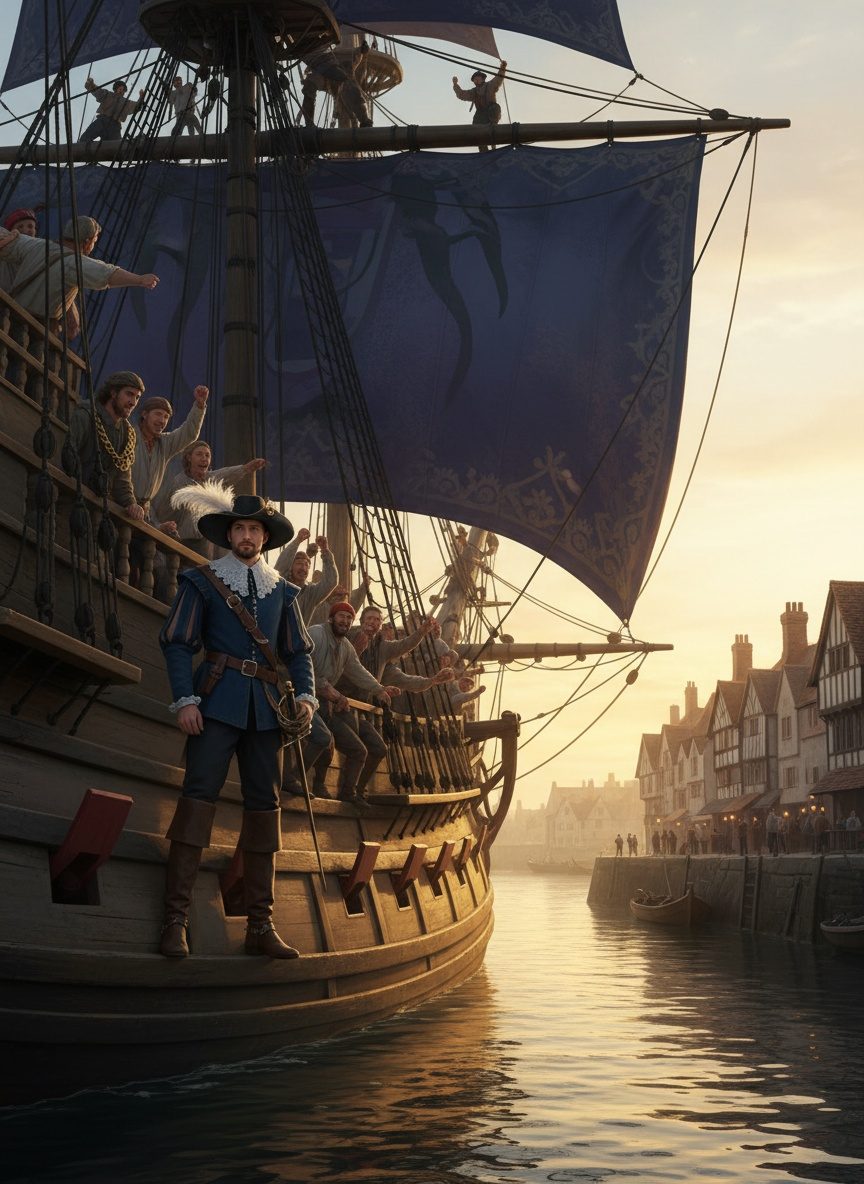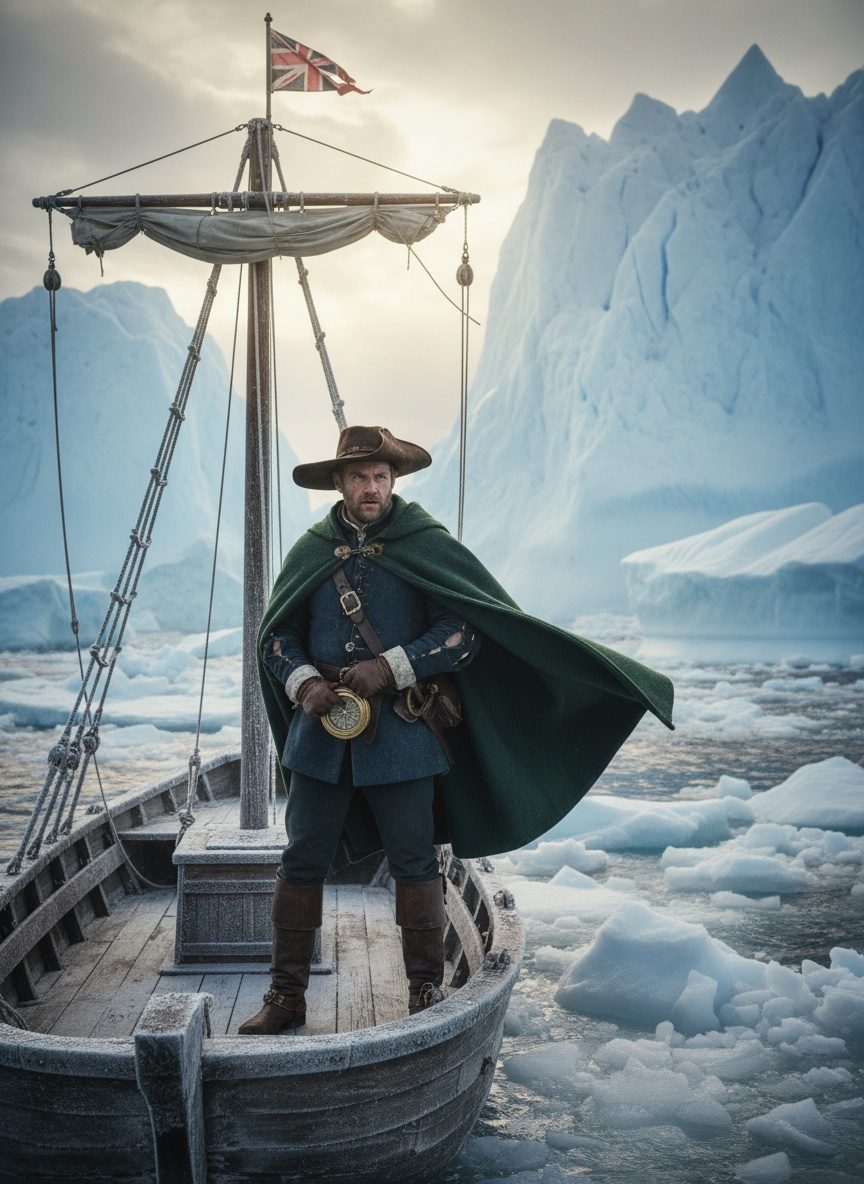
Picture this: a lone ship battles its way through an unforgiving Arctic storm. The deck is lashed with icy waves, the rigging frozen stiff, and every breath comes out as a cloud of frost. The year is 1585, and on board is a navigator as bold as the seas are wide. His name is John Davis, and while his search for a Northwest Passage may have ended in elusive ice, his remarkable voyages charted a new map of the world, unveiling lands that had been whispers on the wind for European ears.
The Call of the Northern Sea
In an age when Elizabethan England was a burgeoning maritime power, the stakes were high to discover a new route to the East. The conventional paths were fraught with peril and controlled by rival empires. Driven by the promise of new trade routes and riches, England turned its hopeful gaze northwards. It was against this backdrop that John Davis, a keen-eyed navigator from the coastal town of Dartmouth in Devon, embarked on his daring quest. The year of our Lord 1585 marked the beginning of Davis's first expedition, and it was nothing short of audacious—a journey into waters where maps ended and the unknown began.
Davis was not without companions in his ambition. Enthusiastic backers like Sir Francis Walsingham and Adrian Gilbert, eager for England’s piece of the New World pie, provided support. With two ships, the Sunshine and the Moonshine, Davis and his crew left Dartmouth, sailing not for familiar ports, but for the ice-ridden corridors of the Arctic, with a navigational map that was half imagination, half speculation.
Into the Icebound Abyss
The journey was arduous, to say the least. As the Sunshine led the expedition north, the men faced brutal conditions. The icy labyrinth was populated with drifting icebergs taller than the tallest ship masts, banging and clashing in concert, as if nature itself conspired against them. The cold was unrelenting, biting through layers of wool and leather, while the howling winds mocked their progress.
On July 20, 1585, Davis reached the west coast of Greenland, an area he detailed with precision in his logs and one which no European had mapped before. This was just the beginning of Davis's cartographic legacy. Despite never finding that fabled Northwest Passage, by August, Davis charted the ’Strait’ that bears his name—Davis Strait—lying between Greenland and what we now know as Canada's Baffin Island.
Survivors of the Frozen Frontier
By the time John Davis made his return in 1586 for a second attempt, the fervor was undiminished. The mission's intensity was amplified by personal resolve and the hope instilled by a fresh Armada of well-supplied ships. Yet, the challenges remained daunting. Starvation loomed over the crew like a specter, their supplies dwindling as they pushed further into the frigid wilderness. The insatiable chill sawed through tarpaulin and timber alike, numbing fingers and fraying nerves.
Despite these conditions, Davis’s crew was met with unexpected warmth—the Inuit peoples whose hospitality proved vital to their survival. They shared techniques of hunting seal and walrus, imparting knowledge that was as invaluable as gold. While today we might take friendly cross-cultural exchanges for granted, in an era of discovery fraught with misunderstanding and mistrust, Davis's respectful interactions were pioneering.
Mapping the White Unknown
The third voyage in 1587 saw a more experienced Davis pressing onwards with tenacity. It was during this time that his skills as a navigator and cartographer shone brightest. His meticulous charting and descriptions of the coastline he explored provided an unprecedented look at the geography of extreme latitudes.
Perhaps the most astonishing was Davis's persistence to continuously push further despite recurrent setbacks. His charts included details such as inlets and sounds, fjords and promontories—a true legacy etched on the ever-changing canvas of Arctic ice. These maps were crucial to future explorers and eventually played a significant role in piercing the mysteries of the Canadian Arctic Archipelago.
The Voyage Echoes Into Eternity
John Davis never found the Northwest Passage—a geographic enigma it would remain for centuries—but he did something undeniably greater. He mapped the impossible, he faced the unimaginable, and he returned to tell the tale. His voyages expanded the known world for Elizabethan England and laid the groundwork for later explorations.
Today, as global warming reshapes Arctic landscapes once more, Davis's charts remind us of the transient nature of planetary features and the enduring spirit of discovery. His expeditions teach us a timeless lesson: that the pursuit of knowledge, just like exploration, has no true endpoint. While they don't fill textbooks, these legends showcase the lesser-known triumphs of the human spirit over extremes.
If Davis's icy odyssey teaches us anything, it is that the journey itself can hold as much reward as the destination. His story remains a beacon for those who dare to map the unknown, urging them to sail forth, chase the horizon, and leave a legacy of exploration that might one day light the way for others.