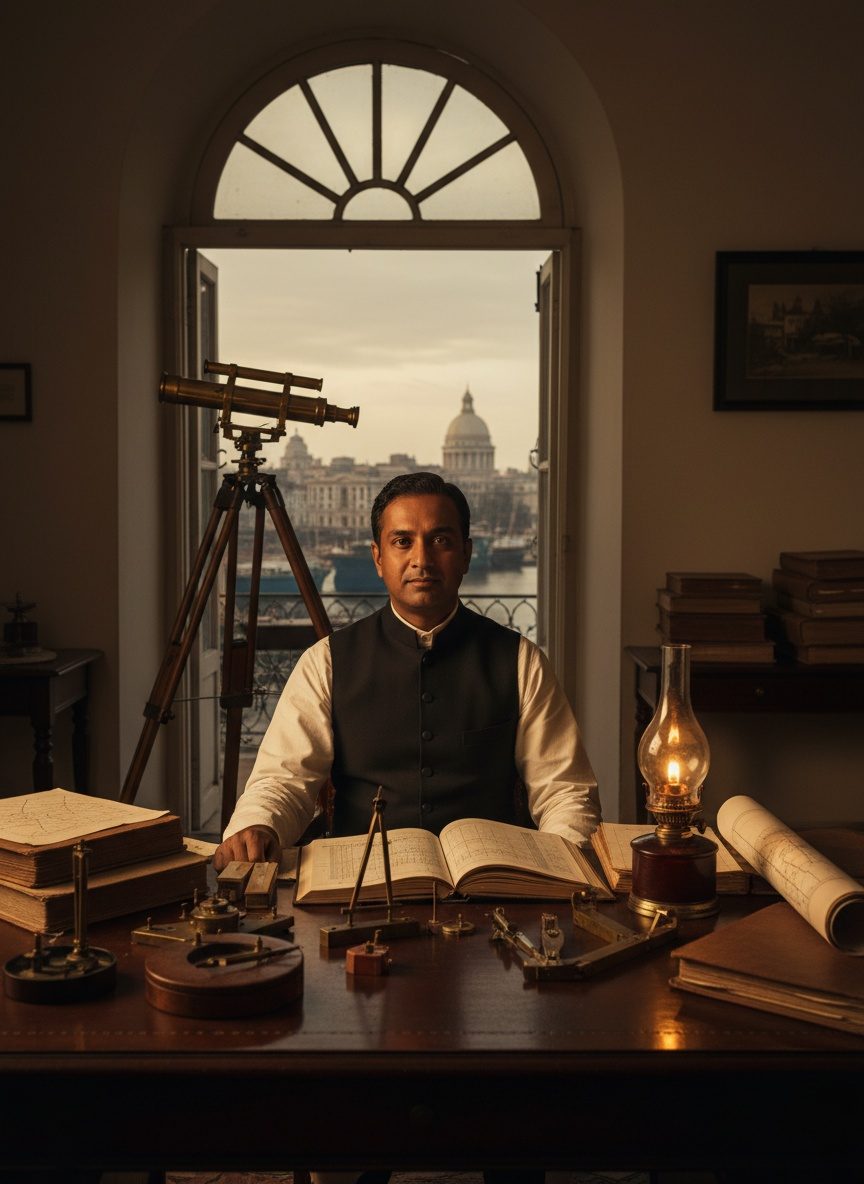
At the heart of the bustling city of Calcutta, now Kolkata, amidst the cacophony of horse carriages and street vendors, a brilliant mind toiled away in quiet triumph over mathematical labyrinths. It was here, in the year 1852, Radhanath Sikdar, an Indian mathematician of prodigious intellect, made a remarkable discovery that would etch the name of Mount Everest into the annals of history. But when his discovery was unveiled, his name was nowhere to be found. Instead, all the accolades showered on another—a twist of fate that would remain one of history's most unsung tales.
The Astonishing Calculations from Afar
In the mid-19th century, the British Empire was at its zenith, and with it rose the ambition to map its vast expanse. The Great Trigonometrical Survey was an audacious project that sought to meticulously chart the Indian subcontinent. At its forefront was George Everest, Surveyor General of India, and his team of astute mathematicians and surveyors.
Radhanath Sikdar, a devout mathematician with profound knowledge in trigonometry, was one of the prized gems of this venture. Working from an observatory in Calcutta, Sikdar was responsible for an incredible feat – calculating the height of the world's tallest peak over 160 miles away, its distance cloaked by the haze of the Earth’s atmosphere.
The mathematics involved were no less than sorcery. Utilizing a technique known as triangulation, Sikdar employed a series of complex angle measurements and calculations, factoring in refraction and curvature of the Earth, to deduce that what was then called "Peak XV" stood at a staggering height of 29,000 feet. But realizing that a number so perfectly round might be regarded with suspicion, the final elevation was pragmatically restated as 29,002 feet.
Silent Thunder in the Story of Discovery
On March 1, 1856, the significant announcement was made by Andrew Waugh, Everest's successor, and then Surveyor General of India. He declared that Peak XV was the highest mountain known to mankind, a revelation to be echoed across the myriad halls of wonder and intrigue of the British Empire.
However, in Waugh’s communiqué to the Royal Geographical Society, there was a glaring omission. The letter made no mention of the genius responsible for the magical numbers that celebrated summits tend to attract: Radhanath Sikdar, the silent thunder behind the discovery, was left in shadows.
This slight to Sikdar was indicative of the times—an era where colonialism oftentimes overshadowed the accolades of native intellects in favor of their British superintendents.
The Mountain Gets a Name
Before Everest was Everest, it was known by local names, and yet there was an imperial impetus to bestow upon it a moniker that would reflect British triumph. Waugh proposed the name Mount Everest, in honor of his predecessor George Everest, despite Everest himself opposing the movement to name it after him, favoring local names.
Conflicts over names aside, Mount Everest was forever christened in global consciousness, eclipsing its discoverer’s contributions even further in the annals of obscurity.
The Mysterious World of Numbers
Years would pass before Mount Everest’s elevation was revisited. Technology and scientific advancements wielded new powers to measure and contest what the human mind had calculated first. In 1955, using more potent instruments, Indian surveyors revised the height to 29,028 feet, a number that, intriguingly, remains incredibly close to Sikdar's persistent calculation.
Decades later, numerous measurements with cutting-edge apparatus claim slight variations, yet the original finding of 29,002 managed to dazzle with its proximity to modern estimations, a testament to Sikdar's extraordinary intellect. His calculus defied the perceived limitations of the time and paved paths for future endeavors in precision measurement.
Why Sikdar's Story Matters Today
The saga of Radhanath Sikdar and Mount Everest speaks beyond mountains and maps; it delves into the deeper crevices of credit, recognition, and the overlooked talents that lie in the shadows of giants. Sikdar's story resonates with the ongoing call for acknowledging diverse contributions, a reminder that brilliance knows no boundaries, and excellence in discovery transcends the strides of colonial silhouettes.
Today, as the world becomes more conscious of the unsung heroes who have shaped our understanding and heritage, Radhanath Sikdar emerges as a beacon. His tale is a call to revisit our histories, to uncover and celebrate indeed all the legends they left out of our textbooks.