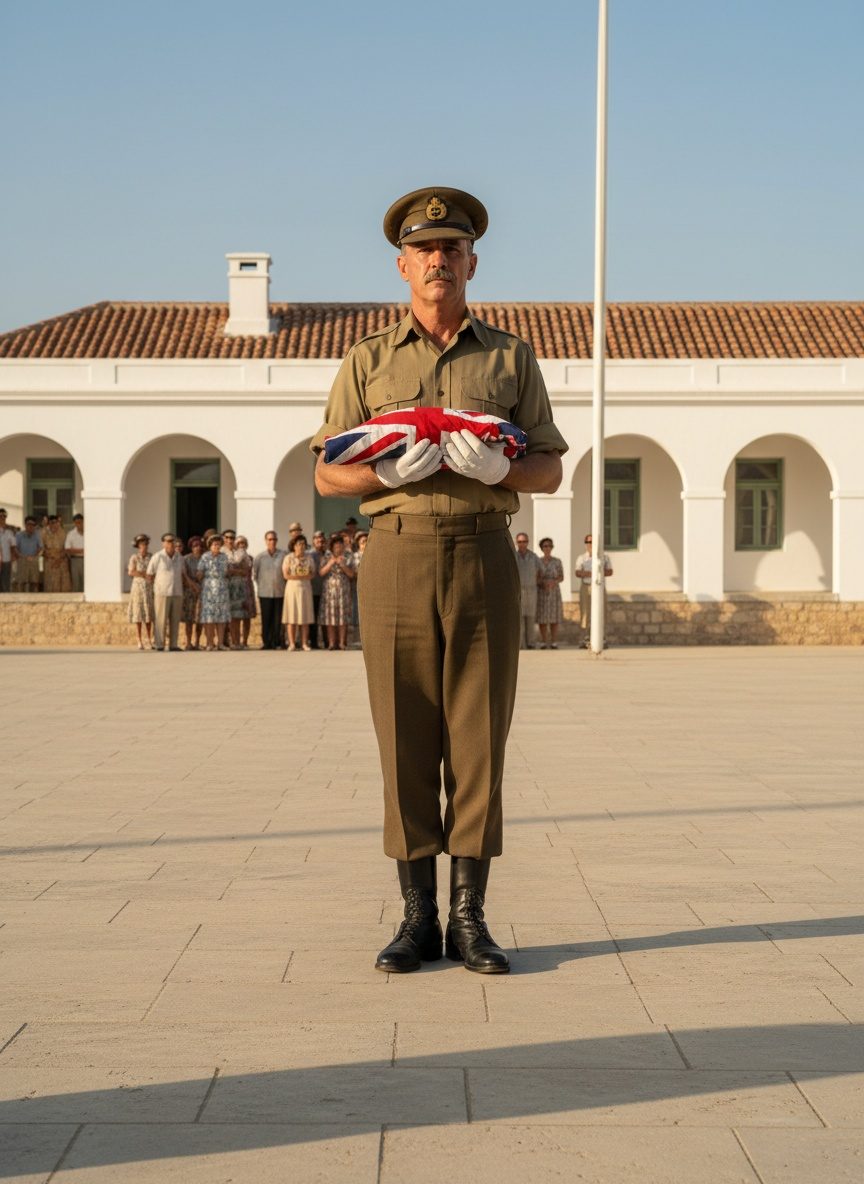
The crisp morning air on the parade ground clung to the dawn like a hesitant farewell. The Union Jack flapped gently in a light Mediterranean breeze, its familiar colors vying for attention against the deepening hues of a Cypriot sunrise. A lone British color sergeant moved with deliberate precision, his fingers expertly folding the flag he had unfurled countless times before. He paused for a moment, his eyes cast downward, before handing the now-folded cloth not to a waiting officer, but to the vacant air beside him. Quietly, he turned away and stepped towards the waiting truck, the echoes of his boots a poignant rhythm on the brick-red earth.
The Jewel of the Empire
For eighty-two years, Cyprus stood as a strategic bastion in the vast maritime chessboard of the British Empire. Nestled in the easternmost crook of the Mediterranean, the island was more than just a landmass bordering volatile judiciaries; it was a crucial perch for overseeing the entrance to the Suez Canal and for maintaining Britain’s military presence in the region. With its sun-dappled shores and resource-rich landscapes, Cyprus became a jewel that Britain, like countless conquerors before it, had longed to possess.
Initially annexed in the late 19th century amidst the crumbling Ottoman rule, Cyprus served as a listening post during tumultuous times—its military bases standing as silent sentinels against emergent Middle Eastern crises. World War II saw the island transition into an irreplaceable aircraft carrier without propellers, its terrains utilized as airstrips and training grounds. Despite this, the island’s importance lay as much in its symbolic presence within the Empire as it did in its utilitarian ambitions.
A Plot Thickens: Cyprus in Dissent
Yet beneath the surface of Britain's rigid colonial administration simmered the smoldering tensions of a fiercely nationalistic Cypriot population. The notion of Enosis, or union with Greece, catalyzed the collective aspirations of Greek Cypriots, who viewed the island's British governance as an unnatural and unwanted stewardship. Contrastingly, the Turkish Cypriot community, wary of Greek dominance, found themselves placed awkwardly in Britain’s political maneuverings; they sought Taksim, a partition that would ensure their own cultural preservation.
The post-war years witnessed a ferment of unrest. Independence movements swept through former colonies around the globe, sparking a resonant echo on Cyprus’s shores. The EOKA campaign, led by the indomitable General George Grivas, ignited a fervent resistance. Bombings, ambushes, and assassinations plunged the island into an atmosphere of insurgency, revealing the fracturing veneer of imperial control. The response was swift and severe; what started as an ideological skirmish rapidly morphed into martial law, as Britain sought to retain its dwindling grip on Cyprus.
Breaking Dawn: The Ceremonial Handback
As August of 1960 unfurled, Britain's long-held grasp on Cyprus loosened finally, though not in the blaze of fervent rebellion that had so colored the decade. Instead, a quiet ceremony under the watchful eyes of both Cypriot locals and British soldiers marked the island’s dawn of independence. The queer silence of the parade ground hummed louder than words; it was the closure of an era punctuated not by gunfire, but by ceremonial precision and practiced decorum.
Amidst the formality, the color sergeant’s duty was understated yet profound. His solitary figure folding the Union Jack encapsulated a moment chiseled into the annals of Cyprus's narrative—symbolic of a great power’s yielding, a relinquishment of empire in the face of inevitable change. A witness to the tides of history, the flag instead found its resting place in memory rather than on yet another halyard.
The Echo of Empires
The handover was more than a mere administrative act; it was a metaphor for the broader dissolution of a once-sprawling empire. For Britain, Cyprus represented the end of colonial control in the Mediterranean—a reminder that empires, no matter their might, are not eternal. The echoes of this quiet ceremony remained in the circles of diplomacy, prompting both reflection and a reevaluation of power dynamics.
In the decades following, the legacy of the withdrawal shadows the politics of a now-divided island. As negotiations and reconciliation efforts continue to unfold across barbed wire and landmines, Cyprus's journey from colonial subject to sovereign nation offers a contemplative study on the nature of freedom and self-determination. It invites modern-day observers to muse on the cyclical rhythms of history and humanity's constant strive towards autonomy. This sunlit chapter reminds us that, beneath the regalia of empire, the heart of a nation beats strongest in silence.