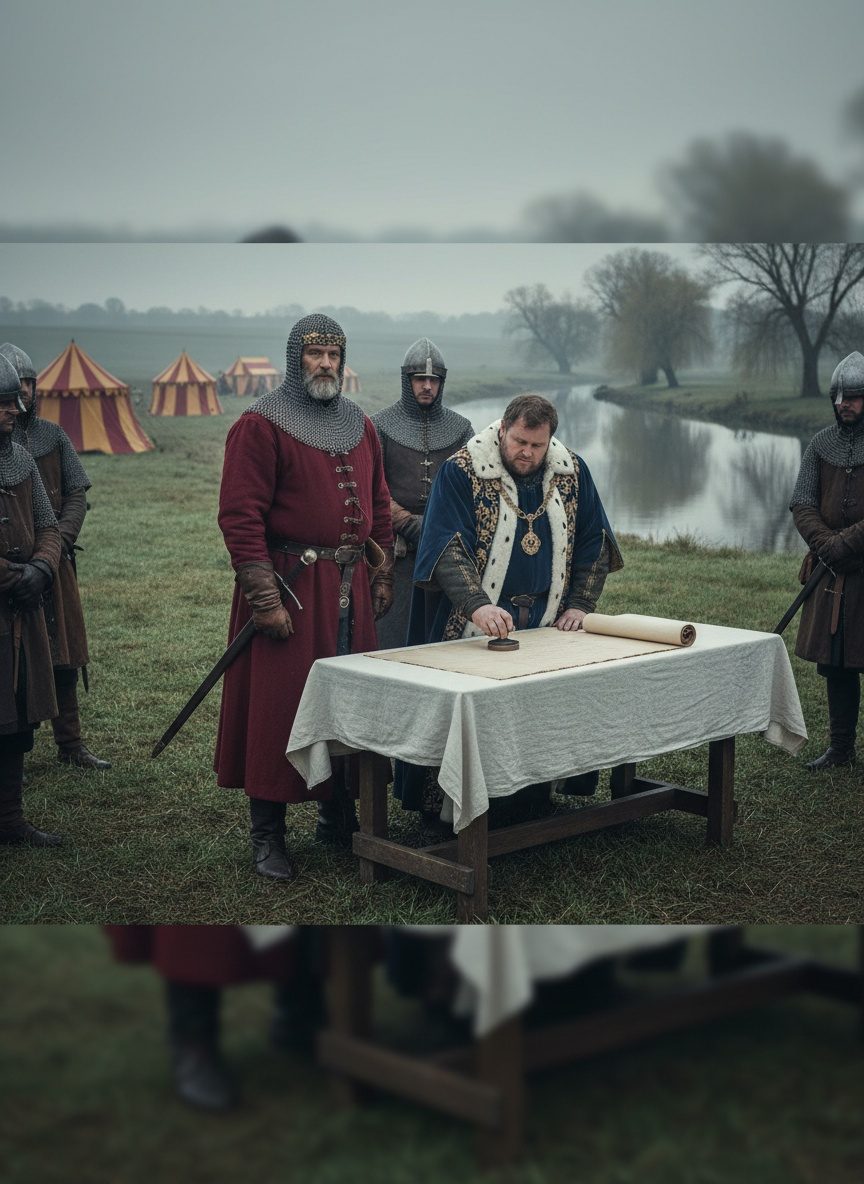
The air was thick with tension as King John reluctantly dismounted, the squelch of mud underfoot mingling with murmured conversations and the shifting forms of restive barons. His regal attire offered little protection against the damp chill of the Runnymede meadow, nestled beside the swirling Thames. Though the gentle roll of the river seemed serene, the scene was charged with the electricity of confrontation and reluctant accord.
It was here, on this unassuming field in 1215, that the Magna Carta was sealed. This simple act, pressing a wax seal into the parchment's surface, was underscored by John’s barely concealed animosity. He detested the limitations being thrust upon him by his rebellious barons, yet desperation forced his hand. England was in chaos—with rebellious nobles challenging his rule, and foreign threats looming. Signing this document was his only viable path to quelling the unrest. But in losing this battle, King John unwittingly sowed the seeds of a far greater legacy.
The Magna Carta was not born of highfalutin ideals or grand philosophies. Instead, it was a deeply pragmatic document, crafted in the crucible of necessity. Yet within its terse clauses lay the origins of the principle that nobody, not even a king, is above the law—a notion as subversive then as it is cherished today. Interpreted and reinterpreted over centuries, it became the silent architect of justice, instilling the fledgling concepts of due process and habeas corpus. These ideas would travel far, encapsulated within the legal sinews of nations stretching across continents.
Consider the jostling lines of baronial tents dotting the meadow, like restless soldiers awaiting orders. Their occupants were no revolutionaries, merely pragmatists demanding redress for grievances accumulated under John's volatile reign—execution without trial, seizure of property, and relentless taxes to fund his endless military failures in France. Amongst these demands were the first shadows of trial by peers, and the embryo of what we recognize today as a constitutionally supervised government.
Although King John revoked the Magna Carta mere months after its sealing—just as distrustful as he'd been at Runnymede—the bold lines drawn in the muddy meadow could not be easily erased. Its significance was cemented by subsequent recommitments by later monarchs who found themselves similarly besieged. Step by step, century by century, its principles seeped into the cultural and legal bedrock of Britain and, through its expansive histories, into the world.
Cross the channel of time, and you’ll find traces of this ancient document in unlikely corners. When the Founding Fathers shaped the United States Constitution, they drew heavily from the Carta’s legacy. They, like the medieval barons, sought to guard against tyranny and protect personal liberties. Move forward again, as myriad nations cast off colonial legs to stand upon their own, and watch the Magna Carta’s threads stretch taut, woven into more than sixty constitutions worldwide. Each new nation added its own embroidery to the English tapestry, a dialogue between past and present, an echo amplified through time.
The meadow beside the Thames is quiet now, a place where tourists tread softly on ancient ground. They walk paths fragmented by time, seeking the ghostly resonance of a momentous day. Few will grasp the full enormity of the event that transpired here, nor its ripple effects over centuries. Runnymede seldom finds space in dry history textbooks, its impact obscured by dates and battles, rulings, and revolutions. Yet those aware of its deeper story understand that what began here transformed the legal landscape for billions. Unseen but omnipresent, the tenets inked into that historic parchment extend beyond borders and generations.
King John believed he could trash a document that bound his hands, rather than recognizing it for the reshaping force it was. While it failed to bind him permanently, it bound humanity to a new path, one that elevated the individual’s rights and placed the law above the ruler—a paradox of weakness from power and strength from submission. That's the real tale of Runnymede: that sometimes, it’s not the highest towers and grandest proclamations that change the world, but the quiet acknowledgment of constraint by one and many, the whispered codex of human dignity persistently rewriting itself through the ages, narrating freedom with a voice more enduring than any sovereign's decree.