He was twenty-three years old. He had never held a sword in combat before that morning.
Storming the Arabian Seashore
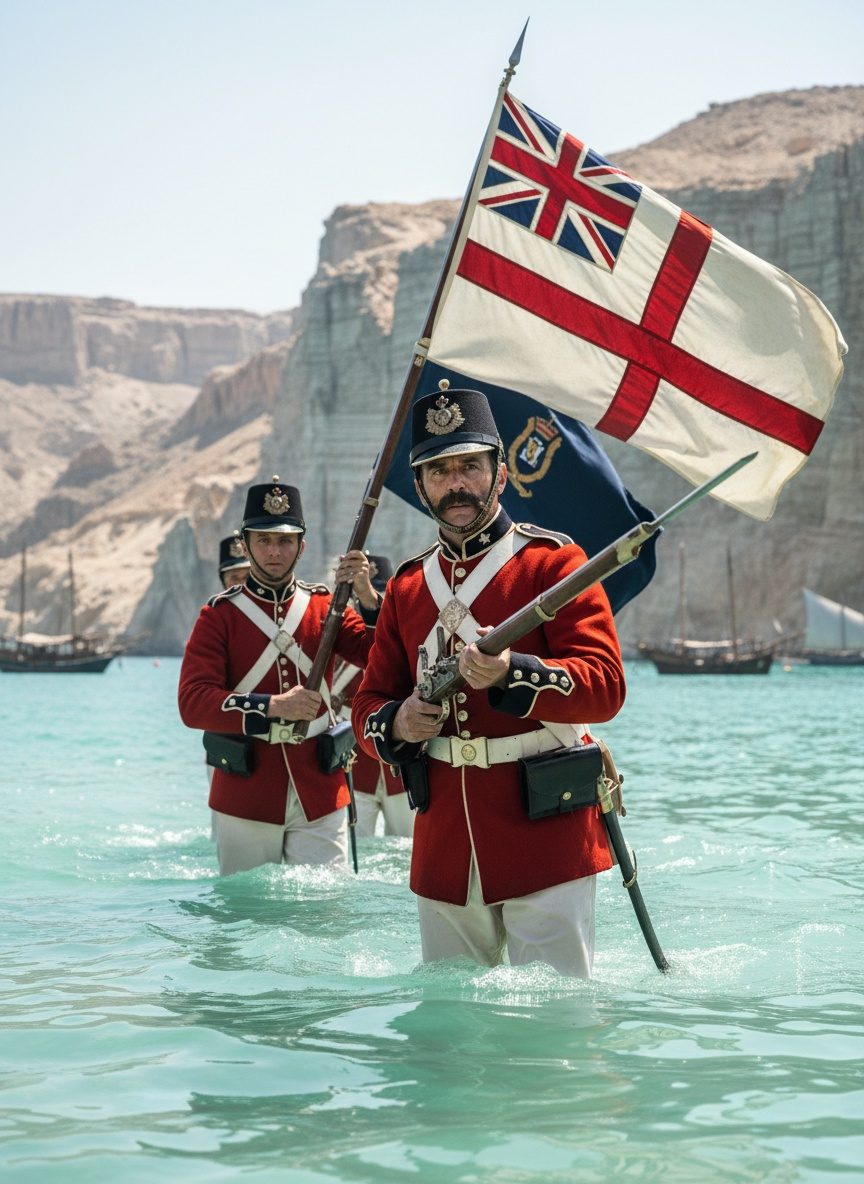
In the dawn of the Victorian Empire, a handful of British troops, their uniforms immaculate against the sun-bleached sands, landed at the strategic harbor of Aden. It was January 1839, and this seemingly inconsequential peninsula appeared more accessible to London’s ambitions than the war-torn European landscape. As the Royal Marines swiftly secured the area, few contemplated the permanence of their action. What was conceived as a fleeting military maneuver to protect the lucrative India trade route evolved into a prolonged sojourn that would later invite scrutiny on global colonial practices.
Image the azure waters lapping gently against the shorelines as British soldiers established their foothold. Their mission: to create a coaling station in the vast stretch between the Suez Canal and Bombay. With the acquisition of Aden, British steamships gained an unfaltering lifeline connecting the empire. Yet, the landscape of this tactical outpost was to hold more than fuel reserves; it was to become a geopolitical pivot against piracy and an unexpected frontier mingling diverse cultures.
The Uneasy Peace of Empire
In the heart of Aden, colonial architecture intermingled with indigenous designs. Markets bustled with an amalgamation of acquaintances and strangers: proud merchants presenting their wares of spices, textiles, and stories to passersby from distant lands. Beneath a facade of thriving prosperity lay tensions anchoring British control. The local Arab population, initially cooperative, grew frustrated with British policies and the burgeoning presence of foreign power.
The union of disparate cultural tapestries wasn’t confined to commerce but extended into daily life. Policemen clad in red coats patrolled streets filled with echoes of English, Arabic, and myriad dialects. Traditional garments of the locals fluttered alongside British etiquette, yet only a thin layer of civility separated calm from unrest. Meetings in London's War Office debated policy responses to the simmering discontent, emphasizing a civilizing mission unaware of the burgeoning fires of nationalism.
The Patchwork of Rebellion
As decades passed, Aden witnessed a kaleidoscope of uprising waves that challenged British paternalism. In anticipation of such movements, soldiers mounted guard atop forts and hills, their watch wisening with each revolt crushed or quelled. It wasn’t merely local resistance the Empire faced—near the roads traversing modem caravans, other powers, too, eyed Britain’s prized maritime hub with hungry ambitions.
Amidst repeated calls for independence, no calculated withdrawal supplanted British tenacity. The complexity of the empire’s East-West network fettered Aden as not only a port but a lynchpin of colonial dominance. These struggles painted a larger picture on the vast canvas of dwindling empires worldwide, detailing valiant efforts and lost lives woven into the saga known as the Empire’s “Sick Man” dilemma.
Exit a Land, Enter An Uncertain Peace
The mid-20th century flicked a switch in colonial consciousness, urging metropoles to relinquish far-flung territories. Yet the momentum toward decolonization proved elusive in many respects. On November 1967, the sun set on Britain's now reluctant grip of Aden. Soldiers departed under cover of logistical darkness, marking the end of imperial stewardship. However, harmony eluded the landscape as political instability and economic woes ensued, illustrating a harsh truth: withdrawal doesn’t necessarily beget peace.
As the history of British occupation at Aden closes its final chapters, it acts as a lens into the often precarious endeavors of the past. Here, the story serves as a reminder of the intricate relationships between occupiers and the occupied, where legacies of shared triumphs and tensions write history anew for each generation.