October 11, 1899. The cobblestones of Britain’s streets glistened under an early morning drizzle.
The Empire's Call
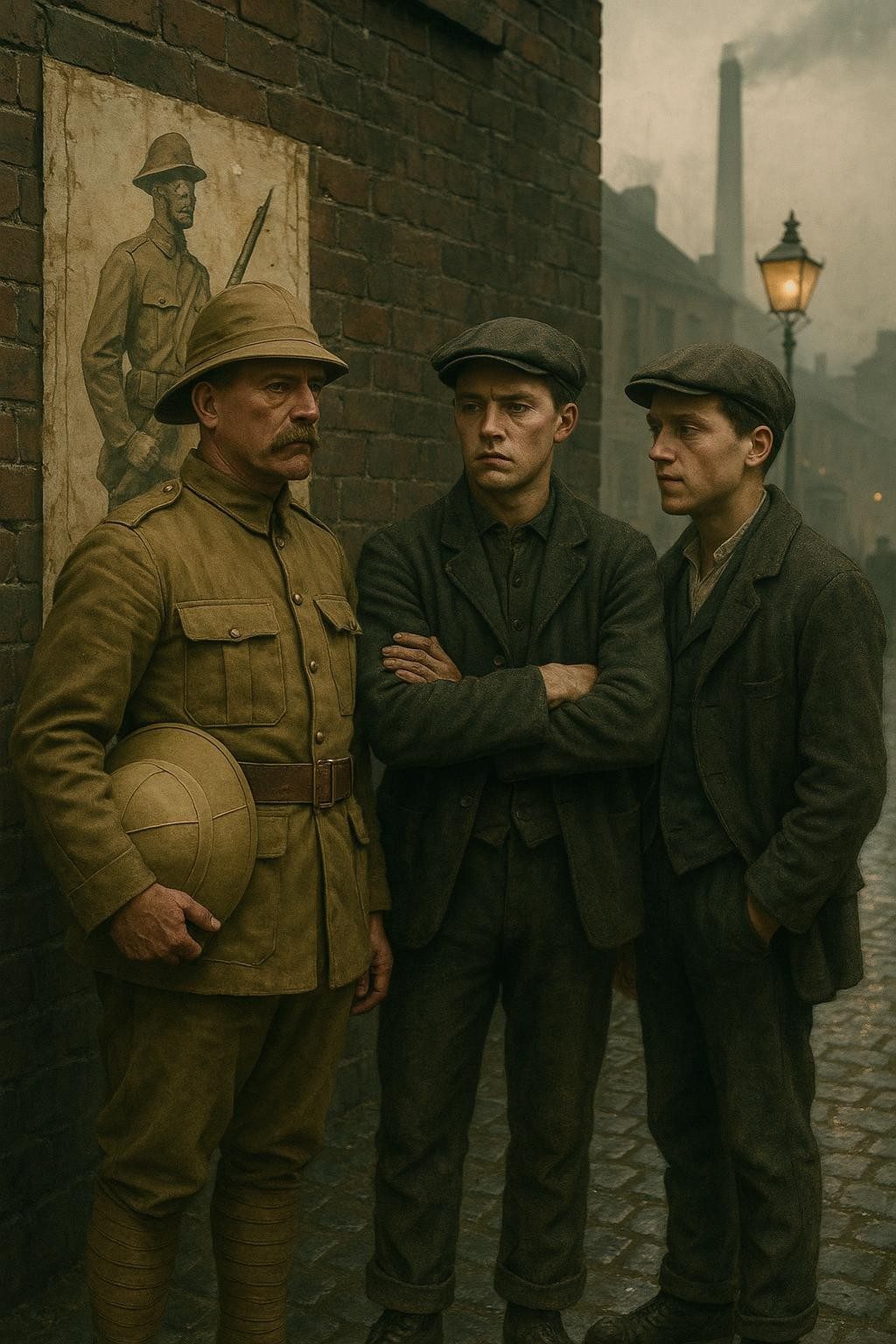
As the first whispers of dawn cast their feeble light across the United Kingdom, a monumental shift was rippling through the island nation. War had been declared against the Boer republics of South Africa. With the announcement still fresh in their ears, Britons faced the cold reality: their Empire needed soldiers. Recruiting offices opened their doors wide, lined with posters emblazoned with bold slogans, beckoning young men to the call of duty—a call many had taken for granted would be eagerly met.
Britain, with its vast empire, had long relied on its colonies for wealth and power. The Boer War, as it would come to be known, was framed as a necessary fight to maintain dominion over precious gold mines and strengthen strategic advantage. Yet, as the days turned into weeks, recruitment numbers painted a startling picture—volunteers trickled in, but many more hung back. For every young man eagerly signing up, another wondered what the Empire had truly done for him.
A Silent Refusal
The war office, accustomed to crowds swelling with patriotic fervor, encountered a generation of young men who hesitated. Lounging in pubs, lingering in squalid alleyways, and hidden behind closed doors, they whispered their doubts in hushed tones. Questions surfaced: Why should they sail halfway across the world to fight in a war that seemed distant both geographically and ideologically? In these questions lay a smoldering skepticism of the Empire, fueled by a growing awareness of the disparity between the pompous imperial rhetoric and the grim reality experienced by many on home soil.
Unskilled laborers in Manchester, dockworkers in Liverpool, and farmhands in the rural reaches of Yorkshire shared a quiet camaraderie of refusal. They saw nothing of the spoils of Empire; instead, they faced unemployment, poor living conditions, and a government that seemed distant and indifferent. These hardships fueled a steady current of reluctance, a resistance not marked by marches or proclamations but by the mere act of staying put.
The Worry in Whitehall
As the lack of volunteers subtly evolved into a full-fledged crisis, the corridors of Whitehall buzzed with anxiety. Politicians, military strategists, and bureaucrats convened in hasty meetings, ruminating over why the nation’s call remained so unheeded. The rhetoric of duty had lost its sheen against the backdrop of economic strife and domestic disillusionment, forcing the powers to reckon with the sobering reality: the Empire’s appeal was fading.
Debates raged behind closed doors. Should conscription be enforced, an unpopular measure that many feared would sow further dissent? Or could new incentives galvanize the youth into action? With options diminishing, the establishment envisaged schemes to sway the ambivalent. Newspaper columns extolled the virtues of service, painting the war as not only noble but inevitable. Yet, despite the propaganda campaign, the allure of South African mines failed to convince men to leave their native shores.
Voices of a New Generation
Amid this backdrop of refusal, a different narrative emerged—a subtle yet potent defiance. Young voices resonated with demands for reform, equality, and justice; they questioned not just the specific call to arms but the very foundations of the imperial project. The seeds sown by reformists, suffragists, and labor movements found fertile ground in these conversations, insinuating the beginnings of a broader questioning of the status quo.
In shadowy corners of English towns, workers held impromptu meetings discussing labor rights, political representation, and social justice. Literary circles, once content to debate poetry, now turned to vehement discussions about democracy and the rights of the common man. The refusal to embark on a distant war became emblematic of a deeper desire for change and a life not dictated by colonial aspirations but domestic dreams.
The Ripple Effect
Though eventually, enough recruits were mustered through renewed efforts and promises, the silent rebellion had left its mark. It was a prelude to the profound transformations that would later shape Britain—a harbinger of a century defined by world wars more justifiable than the Boer War, societal shifts, and the eventual decolonization of the British Empire. The quiet defiance of 1899 served as an early indication of an Empire beginning to understand its own limitations.
In retrospect, the audacity of those young men who refused to leave their hearth and home can be seen as an unlikely catalyst for change. Their decision to question, to resist, and to remain rooted in their skepticism helped plant the seeds of self-awareness within the body politic of Britain. It’s an episode largely absent from textbooks, yet essential in understanding the Empire's long and complicated journey from unquestioned dominion to reflective introspection. As the rain-soaked cobblestones of 1899 Britain bear silent witness, we are reminded of the enduring power of quiet resistance and the moments when a refusal to act speaks louder than action itself.