He buried his first officer on an island in the Caribbean. Long before the events of 1797, Captain Edward Pellew had known the weight of unexpected responsibility. By the time he stood on the deck of HMS Indefatigable, directing her relentless cannonade upon the French frigate Droits de l'Homme, he was a seasoned warrior of the sea, molded by tragedy and triumph alike. But it wasn’t just the battles that defined him; it was his unwavering sense of honor in the heat of conflict.
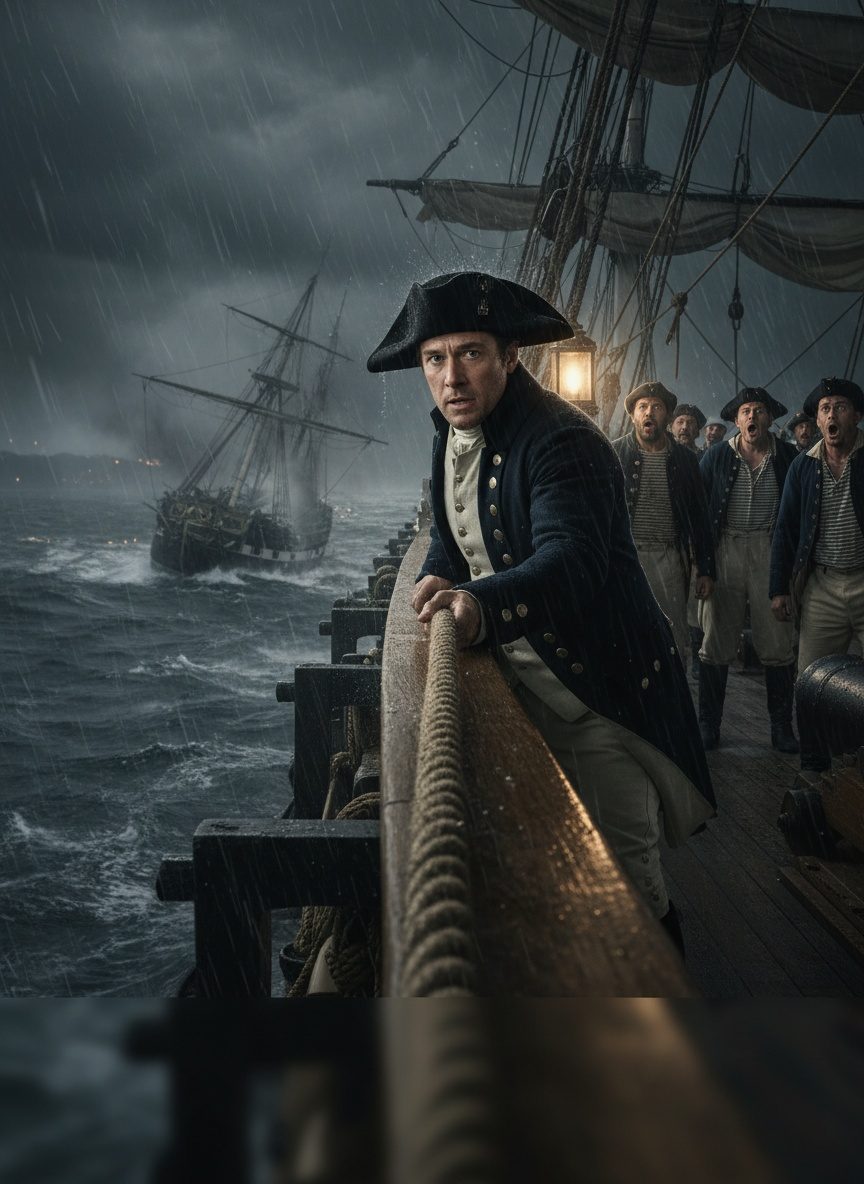
Picture the scene: it's June 1797, amidst the turbulent clashes of the Revolutionary Wars. The English Channel, notorious for its unpredictable gales, was unusually restless that night. Pellew, commanding the Indefatigable, led his men into one of the most savage frigate actions off the Breton coast. The air was thick with gunpowder; each blast a testament to the fierce rivalry between nations. Under the brilliant flashes of cannon fire, the silhouette of Droits de l'Homme wavered—a formidable adversary now struggling against the punishment meted out by the British guns.
The conflict was merciless, every man alive only through the orchestration of luck and skill. The French captain, battered and desperate, found himself and his ship trapped in a dance of terror, one in which survival seemed little more than a distant promise. It was in this maelstrom that the true character of Edward Pellew revealed itself. As irons were clashing and lives hanging by a thread, his eyes caught sight of a singular horror—a French officer, his uniform sodden and heavy, floundered in the unforgiving Atlantic swell.
What must have seemed like an eternity for the French captain was but a brief moment in the chaos for Pellew, yet it was a moment in which humanity overshadowed hostility. Without hesitation, without the slightest pause for judgment on the enemy’s uniform, Pellew threw a line—a simple gesture transcending the brutal realities of war. It is actions like these that separate the myths of gallantry from the thin and fragile veneer of reality. Who among us could claim such purity of conviction while under the harsh scrutiny of survival?
This singular act of saving a drowning enemy spoke volumes about the man who commanded HMS Indefatigable. Despite the grotesque tableau of war that painted the night, Pellew’s actions shone a light on a different kind of battlefield—one where honor and human compassion were the only conquerors. To truly grasp the magnitude of this decision, one must dive into the paradoxical depths of Pellew's character. Known for his aggressive tactics in naval strategy, he had chased his victories with an almost reckless abandon, yet his steadfast adherence to a compassionate code of conduct never wavered.
The aftermath of the battle left Droits de l'Homme crippled, a testament to the tactical prowess of Pellew and his crew. Yet, in the lull following the ferocity, as the sea washed away the acrid smoke, it was not the wreckage but the silent connection between savior and saved that would forever mark this night in history. A captain, devoted to his duty yet refusing to drown the humanity within him, and an enemy who clung to the thin cord of mercy in the storm-tossed Atlantic—that flicker of compassion revealed the inherent dilemmas of a civilized warrior.
Pellew's gesture did not pass unnoticed in naval circles, and it spoke to an age-old ethical imperative that naval officers were expected to uphold. In the age of sail, where close combat was a savage dance of wits and seamanship, such acts seemed to plant a seed of fraternity amidst foes. It was tales like these, whispered in mess halls and recounted over rum, that laid the groundwork for the unwritten rules of decency between adversaries. After all, the sea was impartial; it favored neither ensign nor tricolor, rendering all who sailed upon it equal in vulnerability.
The broader strokes of the Revolutionary Wars often overshadow these quieter moments of nobility, yet they keep alive an ideal that transcends the bloody terror of combat. Such stories have been oft-shared yet rarely commemorated in official accounts, standing as gentle reminders of an era where personal valor held greater sway than mere victory. In the annals of history, the measured gaze of Edward Pellew surveying a dark sea beset with wreckage remains a poignant illustration of how honor can, in fleeting acts, eclipse the rage of war.
Though the winds of time may veil these moments in age and distance, to catch a glimpse of that indomitable spirit urging one to cast a line into the storm is to realize a truth intrinsic to our shared humanity. In the clash of empires and the collision of ideologies, it is such seeds of compassion that enrich the soil of civilization. Edward Pellew did not just secure British naval supremacy that day; he reminded us that sometimes, even the act of saving a single soul can echo far beyond the roar of battle.