He was only twenty-one years old. Most assumed he'd followed a linear path to heroism, yet Edgar "Cobber" Kain's flight trajectory defied expectations even before he ascended into the historic skies over France.
The Young Kiwi in the Skies
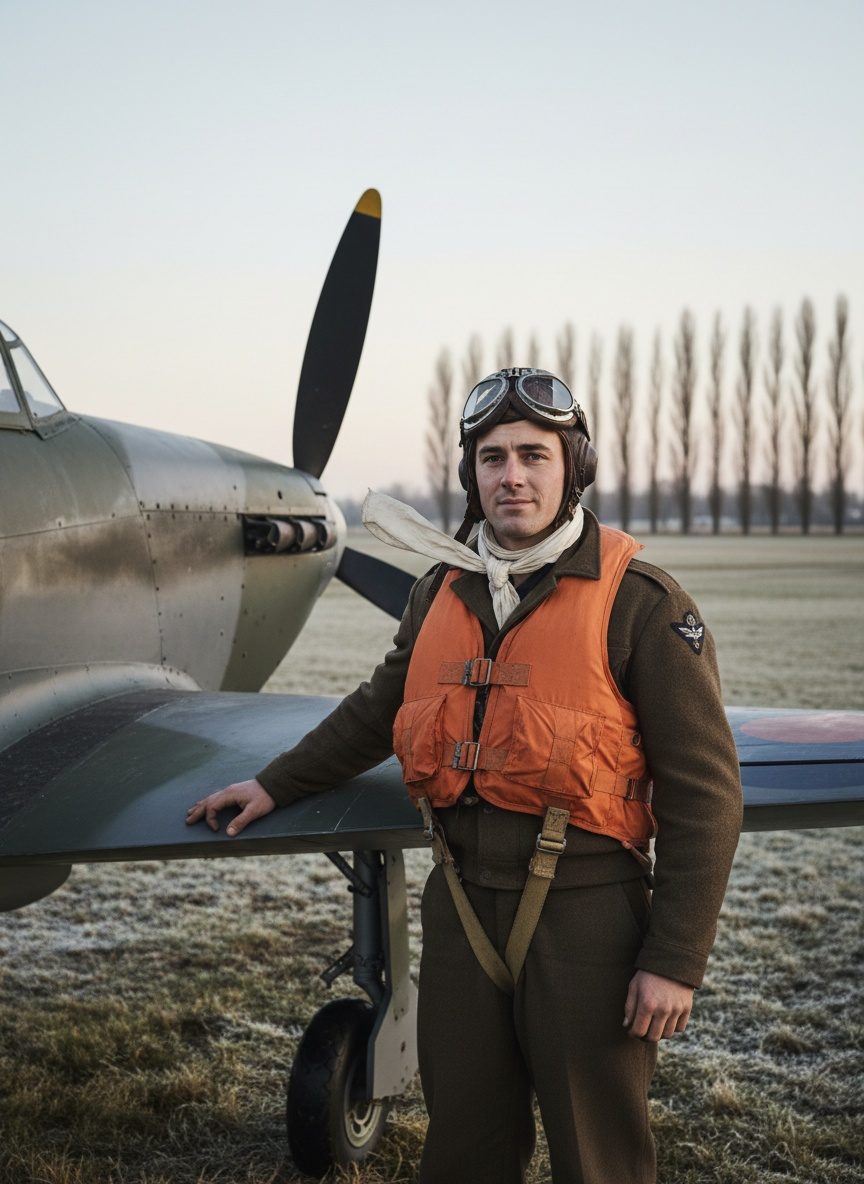
Edgar "Cobber" Kain, a young man hailing from New Zealand, found himself amid a European storm unlike any other — the onset of the Second World War. Beneath the veneer of circumstance lay a natural flair for flying, which eventually saw him join the Royal Air Force with the rank of Pilot Officer. His nickname, "Cobber," an endearing term from his homeland meaning "mate," belied the fierce determination seething beneath his affable demeanor. Flying in the nimble Hawker Hurricane, Kain was quick to embrace the skies over a war-torn France, prepared yet untested by the harsh realities of combat.
November of 1939 marked a critical juncture not just for Kain, but for air warfare itself. The war was still young, less than three months old, a period referred to as the "Phoney War." The calm before the storm, some might say. However, for Kain, his own tempest was brewing. Despite relatively quiet conditions, a single engagement forever tipped the scales of his destiny, thrusting him unwittingly into the annals of military lore. On the 8th of November, the young Kiwi's eyes caught sight of a German aircraft — a Dornier, lurking over the expanse of French terrain.
What came next was a defining moment in air combat history. With steely resolve, Kain opened fire on the German machine, feeling each vibration through the Hurricane’s fuselage as bullets traced their deadly arc. A burst of well-aimed shots found their mark, sending the Dornier spiraling to the fields below, heralding Kain's first victorious kill. But the story of that November day didn’t end there. In a move that would become legendary, Kain descended upon the wreckage, not just to confirm his triumph but to salvage the German plane’s MG15 machine gun. This piece of twisted metal, a trophy clasped in his hand, symbolized his courage—a small token from the high stakes table of war.
Paths Converge: The Making of an Ace
With November 1939's score settled, young Cobber Kain unknowingly stepped into the spotlight as the early days of 1940 rolled on. Seen through the lens of history, what seems like a chapter of rapid success was, for Kain, an era of constant vigilance and skill-honing in the aerial theatre. The French countryside became his backdrop, each sortie a brushstroke painting the portrait of an emerging ace. By early 1940, his tally had risen to five — a feat which awarded him the laurel of the British Empire's first air ace of the Second World War.
Unlike the other established aces of the First World War, who had once featured in the logical spasms of dogfighting, Kain operated in a new age of aerial combat, where technological advances demanded both innovation and adaptability. The Hurricane he piloted was more than a mere machine; it was a symbol of tenacity where engineering met natural talent. Kain treated it as an extension of his own instincts, a partner in his dance of death across the skies. The sound of its mighty Rolls-Royce Merlin engine became a premonition of doom for his enemies.
March of 1940 beckoned with both acclaim and responsibility, yet the weight of newfound celebrity added layers to Kain's shoulders. Now seen as a figure larger than life, his image was an inspirational beacon not just for aspiring pilots of the RAF, but across a beleaguered Europe grasping for its next hope. Surpassing the tactical, his continuance in the skies over France became strategic — both for morale and mastery. War, however, knows no pattern or predictable narrative, continually testing the souls it chooses as its finest storytellers.
A Trophy of Triumph and Tempest
In the annals of aerial warfare, little can symbolize the dogged pursuit of victory like an artifact directly wrested from an opponent. The MG15 machine gun Kain ripped from his fallen adversary was not merely a harbinger of his future exploits but a testament to his raw, unyielding prowess. Its cold, metallic shell bore witness to the countless revolutions of fate and dialogue between man and metal, played out over the French skies. Yet, this talisman of triumph conversely staged a foreboding testimony to the abyss of life and loss at war.
As Kain's reputation surged, so too did the burden of incessant missions that chipped away at the soul. Experience taught him that each day in the cockpit brought both honor and hazard. The symbol of that salvaged MG15 became a reminder — of victories made more potent by the transience of survival. Yet, while this proof of Kain's prowess endures beyond the battlefield, it also remains tethered to historical whispers unheard by the moment-bound ears of its bearer.
The story of Cobber Kain, a young New Zealander’s ascension as an ace of aces, is a legend left out of many textbooks but not out of memory. It bestows upon us reflections of boldness embodied by simplicity. His actions ripple across time, a mosaic of one man's journey amid the vast mechanics of the air war machine. Kain's spring of life met its own conclusion too soon, but the echoes of his MG15 victory tell us that courage is both trophy and prophecy. The skies over France became a crucible, scripting tales that would rally a world in flight, immortalized in the gun that spoke volumes even when left silent.