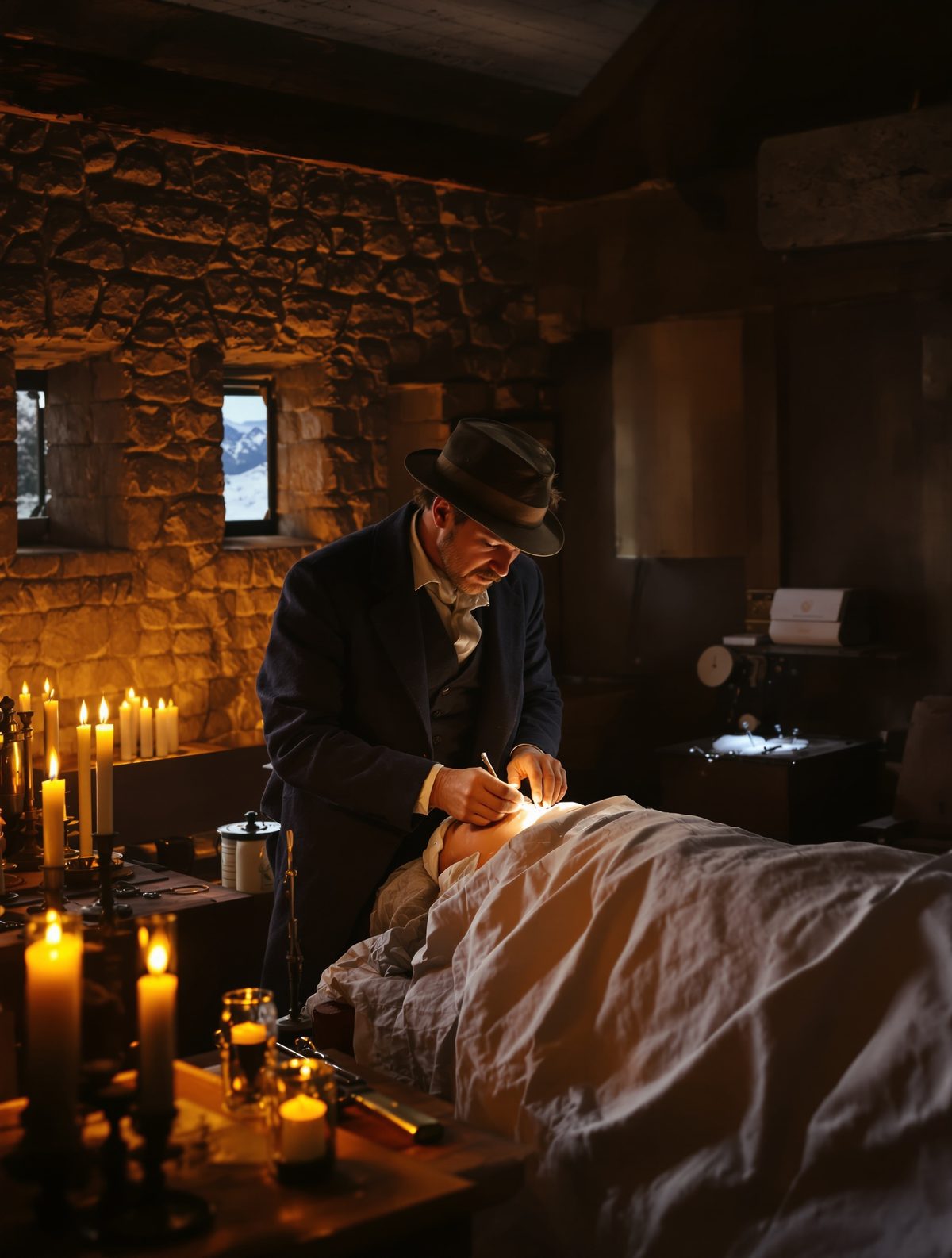
The thermometer in Dr. John Kirk's medical bag read 104 degrees Fahrenheit, but that wasn't the weather—it was the temperature of the delirious Scottish sailor writhing on the deck of the Ma-Robert. Around him, three more members of David Livingstone's Zambezi expedition lay unconscious, their skin yellowed and burning with the telltale signs of tropical fever. It was March 1859, and what had begun as a triumphant mission to open Africa's waterways to civilization was rapidly becoming a floating morgue.
Kirk, barely 27 years old and officially aboard as the expedition's botanist, found himself the only thing standing between the crew and certain death. His portable pharmacy—a leather case packed with quinine, calomel, and laudanum—would prove more valuable than all of Livingstone's maps and journals combined. In the sweltering heat of the African interior, where European mortality rates reached 75% in some seasons, Kirk's medical bag became a lifeline that would determine whether Britain's most ambitious African expedition would succeed or disappear entirely into the continental graveyard.
A Botanist's Bag of Miracles
When Kirk had packed his medical supplies in Edinburgh eighteen months earlier, he thought he'd need them primarily for cuts, bruises, and the occasional bout of dysentery. The Royal Geographic Society had recruited him for his expertise in African flora, not his medical degree from Edinburgh University. His official orders were to catalog new species and assess the commercial potential of African plants. The leather medical case was simply insurance—a precaution that any sensible doctor would take on a foreign expedition.
But Kirk's "insurance policy" contained what would become the most crucial cargo on the entire expedition. His portable pharmacy included eight ounces of pure quinine sulfate, bottles of calomel and blue pill (mercurous chloride compounds), laudanum for pain relief, and Dover's powder—a mixture of opium and ipecac used for fever reduction. Most importantly, he carried detailed notes on tropical disease treatment compiled from his correspondence with doctors who had survived tours in India and the Caribbean.
The contents of that bag would have cost a working-class family six months' wages. Quinine alone sold for more than its weight in silver in mid-Victorian Britain. Kirk's portable laboratory also included a precision scale for measuring dosages, lancets for bloodletting, and thermometers calibrated for body temperature—cutting-edge medical technology for 1858.
When Paradise Became Purgatory
The Zambezi expedition had launched with unprecedented optimism in May 1858. Livingstone, fresh from his celebrity lecture tours following his transcontinental African journey, convinced the British government that the Zambezi River would become the "highway to the interior"—a commercial waterway that would bring Christianity, commerce, and civilization to Central Africa while generating enormous profits for the Empire.
For the first eight months, Kirk's medical skills were barely needed. The expedition made steady progress upriver, and Kirk filled his botanical notebooks with sketches of baobab trees and previously unknown flowering vines. His medical log recorded only minor complaints: one case of dysentery, several thorn punctures, and Livingstone's chronic hemorrhoids.
Then came the rains.
March 1859 brought the start of the wet season, and with it, clouds of anopheles mosquitoes rising from every stagnant pool and riverbank. Within days, the expedition transformed from a confident imperial venture into a desperate fight for survival. The first victim was Thomas Baines, the expedition's artist, who collapsed while sketching a riverside village. By week's end, six of the expedition's fourteen European members were burning with fever.
The symptoms were terrifyingly uniform: sudden chills followed by raging fever, violent headaches, and vomiting that left men too weak to stand. Some victims developed the yellow complexion that gave "yellow fever" its name. Others suffered the cyclical fever patterns of malaria. In 1859, doctors didn't yet understand that both diseases were mosquito-borne, but Kirk recognized the symptoms from his medical training and his growing library of tropical disease case studies.
Forty Days of Fever and Physics
Kirk's medical log, preserved in the Royal Geographic Society archives, reveals the desperate mathematics of tropical medicine. Over forty consecutive days, he treated 47 separate cases of fever among the expedition members and their African crew. His quinine supplies, carefully rationed, had to stretch across cases ranging from mild tertian malaria to life-threatening blackwater fever.
The young doctor developed his own treatment protocols combining traditional European medicine with observations of local African remedies. His standard fever treatment began with a precisely measured dose of quinine—ten grains for an average-sized man, adjusted for body weight and fever intensity. He supplemented this with small doses of calomel to purge the digestive system, and laudanum to manage pain and induce the sleep that his patients desperately needed.
But Kirk's real innovation came from watching local healers treat similar symptoms. He began brewing strong teas from the bark of certain riverside trees, creating what he called "vegetable tonics" to supplement his dwindling pharmaceutical supplies. His combination of European quinine and African herbal treatments proved remarkably effective—his patient mortality rate was less than 15%, extraordinary for tropical fever treatment in the 1850s.
The physical demands were crushing. Kirk often worked eighteen-hour days, moving between patients sprawled across the expedition's boats and makeshift riverside camps. His own diary entries reveal a man pushed to his limits: "March 23rd—Baines much improved, fever broken. Richards worse, fear for his life. My own hands shake from exhaustion. Must sleep."
The Chemist's Gamble That Saved an Empire
By April 1859, Kirk faced a crisis that would have broken a lesser man: his quinine supplies were nearly exhausted, with weeks of travel remaining before they could reach any European settlement. He made a calculated gamble that demonstrated both his medical expertise and his growing understanding of African pharmacology.
Working with local guides, Kirk identified several species of Cinchona-related trees whose bark contained natural quinine compounds. Using his portable chemistry set—another piece of "unnecessary" equipment that proved invaluable—he developed a process for extracting and concentrating the active ingredients. His improvised bush laboratory produced what he called "African quinine," a bitter extract that proved nearly as effective as his imported pharmaceuticals.
This innovation didn't just save the expedition; it provided the British Empire with crucial intelligence about sustainable tropical medicine. Kirk's detailed notes on local medicinal plants would later inform British medical policy across tropical Africa, potentially saving thousands of colonial administrators, soldiers, and settlers in subsequent decades.
The irony wasn't lost on Kirk himself. Years later, he would write: "I came to Africa to study plants, and plants saved Africa's would-be conquerors." His botanical expertise, combined with his medical training, created a unique skill set that proved perfectly suited to the expedition's unexpected needs.
The Aftershock of Survival
When the Zambezi expedition finally returned to Britain in 1864, Kirk's medical achievements were overshadowed by Livingstone's geographical discoveries and the expedition's commercial failures. The Zambezi had proved unnavigable for large vessels, and the hoped-for trade routes never materialized. Official reports focused on mapping achievements and geological surveys, relegating Kirk's life-saving medical work to footnotes in expedition appendices.
But Kirk's real legacy lived on in the survival of his patients. Thomas Baines recovered to complete some of the finest artistic documentation of 19th-century Africa. The expedition's surviving crew members went on to lead subsequent African expeditions, carrying with them Kirk's hard-won knowledge of tropical medicine. Most significantly, Kirk himself became one of Britain's leading experts on African affairs, eventually serving as British Consul in Zanzibar where his medical and botanical knowledge proved invaluable in negotiating the end of the East African slave trade.
The leather medical bag that saved the Zambezi expedition now sits in Edinburgh's Surgeon's Hall Museum, its brass clasps tarnished and its contents long since replaced. But the protocols Kirk developed during those forty fever-stricken days would influence British tropical medicine for generations. His combination of rigorous European pharmaceutical science with careful observation of African traditional medicine pointed toward a more collaborative approach to colonial healthcare—one that recognized indigenous knowledge as valuable rather than primitive.
In our age of global pandemics and international medical cooperation, Kirk's story resonates with surprising relevance. His willingness to combine Western scientific training with local knowledge, his meticulous documentation of treatments and outcomes, and his recognition that survival often depends on adaptive innovation rather than rigid adherence to established protocols—these lessons feel remarkably contemporary. Sometimes the most important discoveries happen not in university laboratories or government planning rooms, but in the field, when dedicated professionals must improvise solutions with whatever tools they have at hand.