
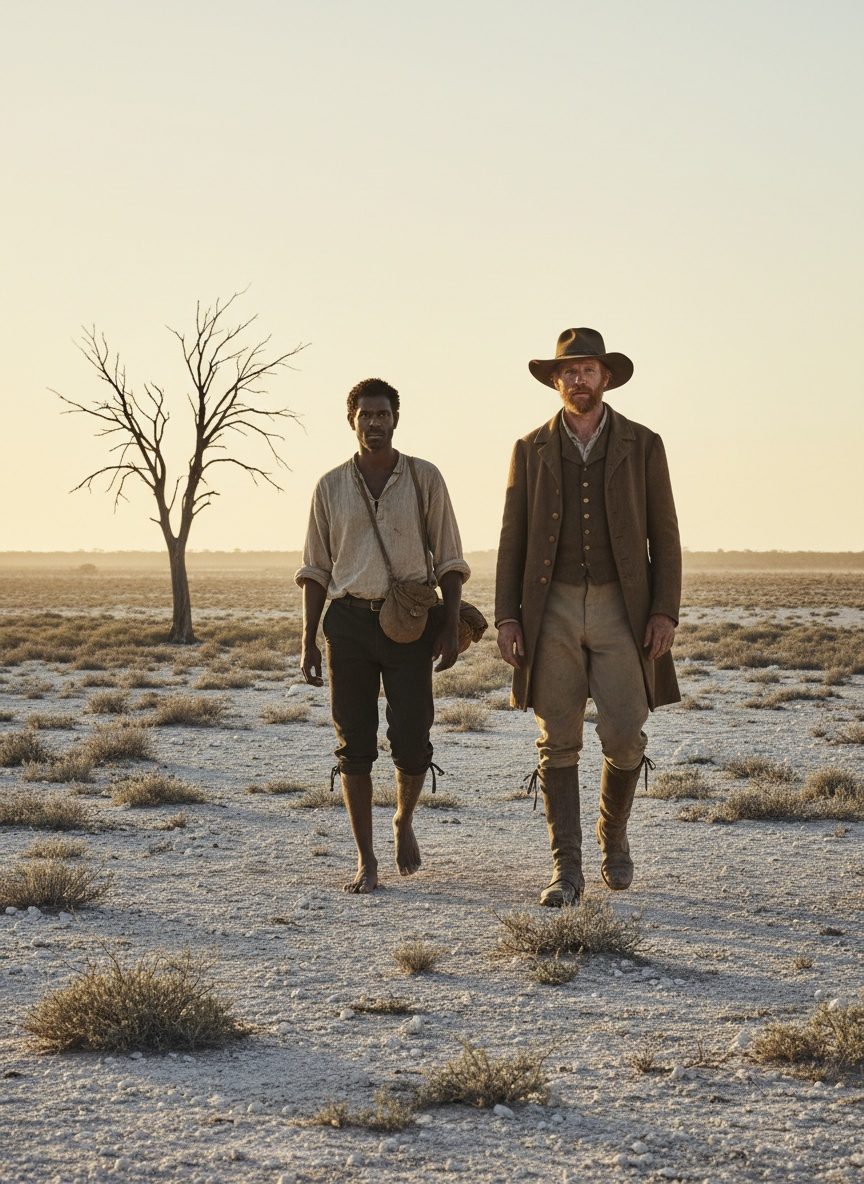
April 1841. The untamed Australian desert sprawled endlessly under a blazing sun.
The Last Stretch of Desolation
There, amidst the great desolation of the continent's arid heart, Edward Eyre and his resilient guide, Wylie, trudged forward. It was an unforgiving landscape, with the scorched earth cracking underfoot and each horizon as unrelentingly barren as the last. Eyre, who had embarked on an ambitious expedition to traverse Australia’s treacherous southern coast, was now a mere shadow of the determined explorer he had once been. Supplies had long since dwindled. There wasn't a fragment of comfort to be found in the endless expanse of sand and scrub.
As their numbers dwindled due to desertion and death, a bond formed between Eyre and Wylie that would defy the racial prejudices of the era. The surroundings were harsh and merciless. But Wylie, Eyre's Aboriginal escort, persevered. His feet were bare, his spirit steadfast. He knew the secrets of this land — its hidden waterholes and its withered signs of life — in ways Eyre could only imagine.
A Journey on the Brink
Born at the margins of two worlds, Wylie carried the traditions of his people alongside the indomitable resolve imparted by the harsh realities of colonial rule. As if the barren wilderness wasn’t enough to contend with, Eyre and his party faced distrust and hostility from those who saw the land not as an obstacle to be overcome but as a sacred entity disturbed by unwelcome invaders. Their journey had become a grim tableau of survival and endurance.
Eyre’s journey across Australia was initially fueled by the ambition of colonial expansion and the allure of uncharted territories. But now, it had turned into a fight for survival. Without Wylie, Eyre knew, the lonely tracks of the Nullarbor might well be his final resting place. Wylie’s knowledge of the terrain was their only hope. Day by day, in a landscape where even the wind seemed indifferent to human plight, Wylie shared his scant provisions — small birds, plants known only to the Aboriginals, anything that might stave off death for one more day.
Wylie's Unwavering Resilience
As other members of the party either perished or disappeared into the desolate wastes, Wylie's determination and loyalty emerged luminously. Each step forward was a deliberate choice to pursue life, each moment a testament to his strength. When Eyre faltered under the oppressive heat, Wylie encouraged him, walking alongside the burdened explorer as an unfaltering companion. His survival skills, honed through generations, were their lifeline.
Wylie’s commitment was not just a matter of responsibility; it was an act of quiet defiance against the very elements that sought to incapacitate them. His knowledge of indigenous flora and fauna offered sustenance that would elude any European. Those small means of survival were shared with torture-like generosity, a testament to a friendship that transcended the veneer of colonial authority.
Onward Through the Harsh Embrace
Every mile covered seemed an impossible feat accomplished. Their relief finally came when they stumbled upon the barest semblance of civilization. It was a deliverance born from sheer endurance and the refusal to succumb to despair. Though it might have appeared that fate had momentarily deigned to smile upon Eyre, it had been Wylie’s unwavering companionship and knowledge that had carried them through.
As they neared the western coast, Eyre reached a British settlement, his expedition account larger than life, perhaps subtracting from Wylie the measure of valor he so richly deserved. The voice of Victorian literature would echo Eyre's name, imprinting it upon maps and scholarly work alike. Wylie, meanwhile, returned to the obscurity from which he emerged, even as his actions continued to ripple through history, whispering tales of unsung heroism.
A Legacy Etched in Desert Sand
The story of Edward Eyre and his traverse of the Australian continent serves as more than just an exploration epic; it is a narrative of human interconnectedness amidst adversity. The triumph over this inhospitable land is not merely Eyre's alone, but a shared monument with Wylie’s uncredited courage carved into it, visible only to those who choose to look beyond the written pages.
In an era where exploration often meant erasure, Wylie’s choice — to guide, to share, to sacrifice — stands in contrast. It prompts us to question the echoes of colonial history, to seek the truths of those whose voices are buried beneath the sands of time. The stark landscapes of the Australian interior are not blank voids but terrains woven with stories like Wylie’s: of knowledge exchanged, of alliances forged, and of the persistence of human spirit when faced with nature’s fury.