The Canadian winter can be breathtakingly beautiful. To Susanna Moodie, it was a relentless adversary.
Trading Silk for Snow
The moment Susanna Moodie set foot on Canadian soil in 1833, the sheer enormity of her decision began to crystallize. Born into a comfortable life in Suffolk, England, where afternoons were spent in the dappled grace of landscaped gardens, she traded silk gowns for the harsh woolen attires suitable for rugged Canadian winters. Her journey to Upper Canada, now modern-day Ontario, was motivated by dreams of greater prosperity, spurred by the enticing tales of the New World—a land rife with opportunity according to the pamphlets circulating in England. But pamphlets stopped short of describing the bone-chilling cold that seeped into bones, or the unyielding isolation of the dense forest.
Much of Moodie’s early days in this new land were a study in stark contrasts. In place of the delicate frost patterns she once admired from her lavish sitting room in England, she faced the harsh frostbite nipping at her toes, a reminder that the Canadian winter was not just picturesque, but punishing. With her husband, John Moodie, often away for weeks seeking military and land-related commissions, the weight of survival fell heavily upon her slender yet determined shoulders.
Battling the Cold and Isolation
Most daunting of all were the long, trying months when her husband was absent. In these times, Susanna Moodie was left as the solitary guardian of their small homestead. The nearest neighbor was not just down the lane, but miles of daunting, snow-laden wilderness away. The silence of the woods—punctuated by the eerie howling of wolves—was oppressive, making her former life in England feel like a distant, almost ethereal dream.
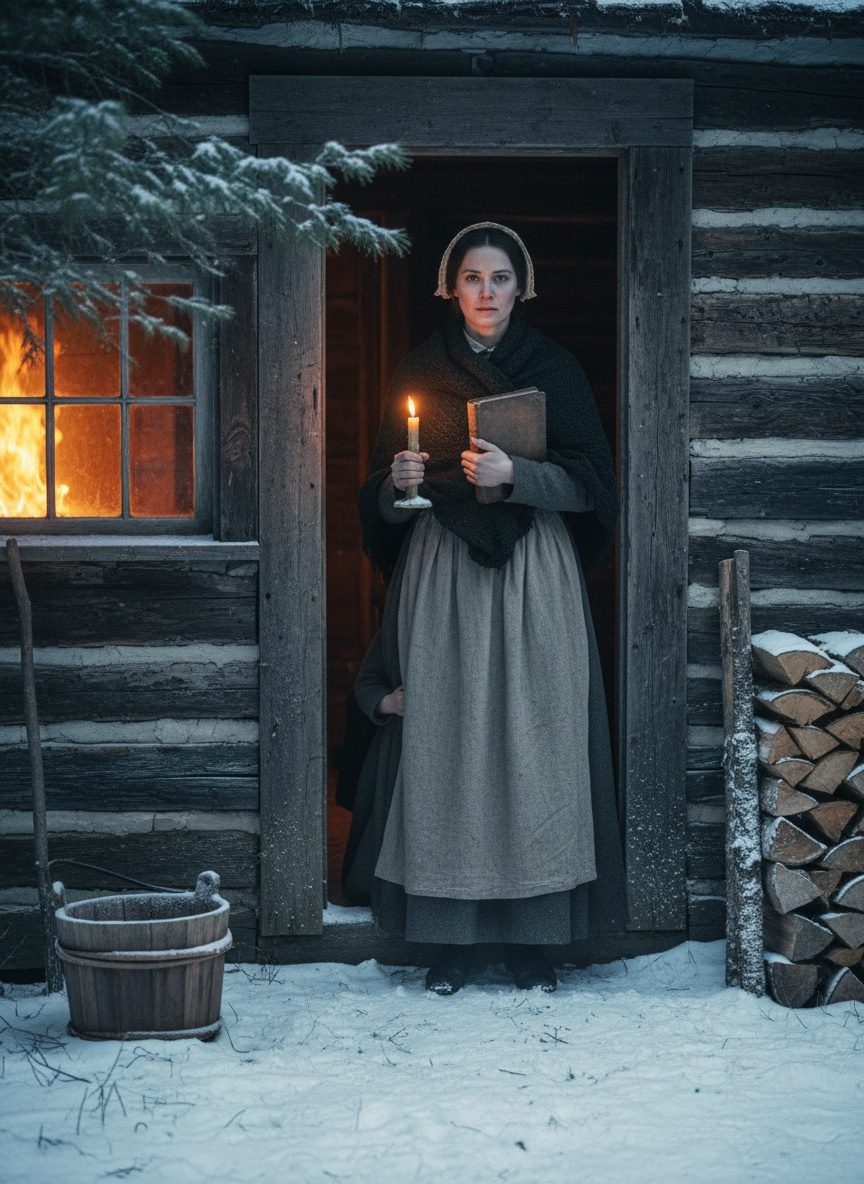
The home she now inhabited was a crude log cabin; its gaps allowed bitter winds to probe every corner. Firewood was a constant necessity, and Moodie became adept at the relentless chore of chopping, stacking, and stoking the fire. Her hands became rough and calloused, evidence of her transformation from genteel English lady to resilient settler. Food scarcity was an ever-present concern, with game and crops often elusive in the unforgiving winter. Yet, somehow, she kept starvation at bay, her resourcefulness visible in the modest yet nourishing meals she concocted for her children.
Yet in these challenges, Susanna found not only hardship but also inspiration. It was during these lengthy periods of isolation that she began to weave her experiences into prose, transforming her struggles into a vivid tapestry of words. Her accounts would later become one of the most illuminating narratives of settler life, a lens into the endurance and adaptability of the human spirit.
A Literary Companion in Isolation
Amidst the turmoil, writing became Moodie’s refuge and a silent confidant. At night, by the dim flickering of candlelight, she put quill to paper, documenting the raw experiences of life on the Canadian frontier. Her journal served dual purposes—as a means to maintain her sanity and as documentation of the harsh realities faced by settlers.
Her writings captured more than the cold; they revealed the psychological toll of isolation. The forest that surrounded her was an enigmatic entity—frightening, yet entrancingly beautiful, it both suffocated and inspired her. Through her words, she attempted to make sense of the strange, new world she inhabited, capturing the surreal landscapes that could inspire awe in equal measure with fear.
The breadth of her work extended beyond mere survival; it delved deep into contemplations about identity and society. Her past life in England often collided with her present reality, leading her to question class distinctions and the roles prescribed to women. These musings resonated beyond her time, offering persistent relevance to any reader who has ever stood at the crossroads of change and tradition.
The Courageous Chronicles
Susanna Moodie's literary contributions, including her seminal work, *Roughing It in the Bush*, stand as one of the most poignant accounts of settler hardship and perseverance. In her chronicles, she dispensed with romanticized visions of pioneer life, instead offering a grounded, often gritty reality that many prospective settlers failed to anticipate.
Yet her words were not purely of despair; they were a testament to human resilience. For every hardship endured, there lay a lesson learned and a strength gathered. Her courage and eloquence in the face of overwhelming adversity inspire as much as they inform. Her experiences illuminated the raw reality of the Canadian wilderness, while also capturing the profound beauty intertwined with its challenges.
Why does Susanna Moodie's story matter today? Beyond the historical insight her writings afford, they serve as a timeless narrative of adaptation and survival. Her ability to distill fraught experiences into powerful prose underscores a universal truth: even in solitude, we find intrinsic strength. As readers, we are reminded that courage often manifests in persistence, and salvation may be found in the stories we choose to tell. Susanna Moodie faced the Canadian winter alone, but through her words, she remains an eternal companion to all who seek to understand the unyielding wild, and themselves within it.