
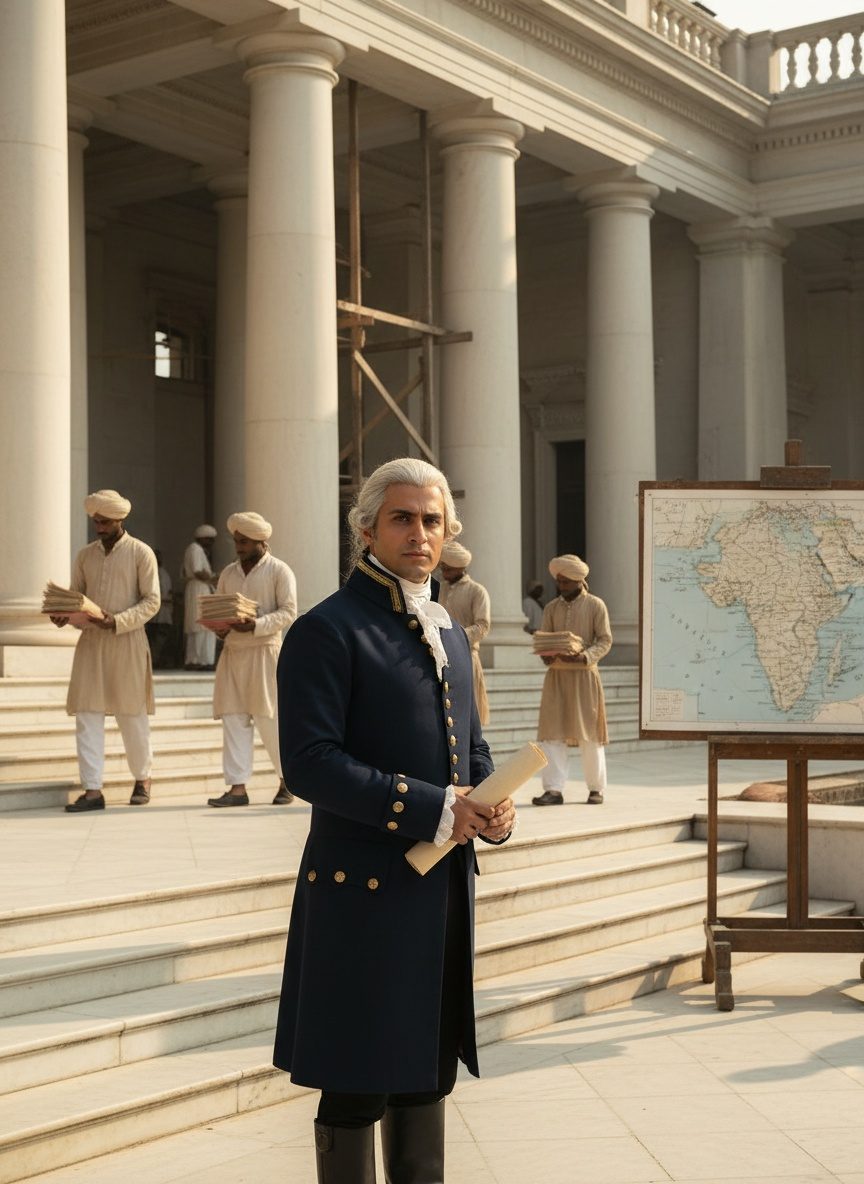
September 8, 1798. The humid air of Calcutta clung to everything it touched.
Welcome to the Siege: Wellesley Arrives
As the tide of the Hooghly River lazily lapped against the hulls of ships, a young and ambitious Marquess Richard Wellesley set foot in bustling Calcutta, a city teetering between its identity as a mere outpost of a trading company and a gleaming capital of imperial dreams. Wellesley, assuming the role of Governor-General of the East India Company, arrived with a singular vision: not to shuffle ledgers and ships as his predecessors had done, but to transform a coastal enterprise into a vast dominion. The ever-pragmatic merchant representatives of the Company watched with a mixture of hope and apprehension. Indeed, their barrels of indigo and tea had attracted pockets of interest in drawing rooms across Europe, but Wellesley carried notions of expansion that seemed to rattle the very foundation of mercantile success.
Recruited at a tender age into public service, Wellesley's ambition failed to be contained by London’s cautious bureaucracy. With the charter of the East India Company in hand, he knew that any delay in communications across the seas gave him significant latitude to act decisively without immediate reproach from his superiors. The challenge of governing India was enormous; intertwining cultures, the complexities of alliances, and a fiercely competitive environment from other European powers painted a harsh backdrop against which Wellesley unfurled his plan.
A New Strategy: The Doctrine of Lapse and Alliance
Unlike the merchants focused solely on profit, Wellesley understood that control over territories translated into power and sustained prosperity. To this end, he crafted the Doctrine of Subsidiary Alliance, a policy through which Indian princely states would accept the permanent stationing of British troops and pay for this protection in exchange for the autonomy London chose to grant. Behind the ostensibly benign offer of friendship, however, lay a ruthless strategy to subsume local power into the British fold.
The arrangement proved an ironclad trap for Indian rulers, many of whom suddenly found themselves in untenable positions, unable to afford the British military presence but equally unable to resist it. Soon, the Company controlled territories extending far beyond its initial remit, often with minimal direct confrontation. This doctrine, brilliantly conceived, allowed Wellesley to annex major swathes of geography while the ink barely dried on agreements signed under both duress and jubilation.
Amidst this policy’s success, one needs to visualise the bustling court of an Indian maharaja suddenly silenced by the heavy boots of foreign soldiers and the rustle of English writs becoming the de facto governance. Wellesley’s innovation was his ability to cloak conquest in the garments of diplomatic strategy.
The Trials of War: Confronting Mysore and Maratha Power
Though alliances expanded his reach, Wellesley was unafraid to test his mettle on the battlefield. Southern India, dominated by the powerful Sultanate of Mysore under Tipu Sultan, presented one of his earliest challenges. Misunderestimating Wellesley could have been fatal; in a determined march, the Governor-General launched a campaign that culminated in the Siege of Seringapatam in 1799. The fall of Tipu Sultan, widely seen as a symbol of resistance against British dominance, was spectacular and swift. It wasn't just a victory over a brawny adversary but a declaration that British presence had evolved into an irrevocable mastery.
The stakes rose further with the mighty Maratha Confederacy whose influence sprawled across central India. Prone to infighting and internal politics, the Marathas presumed the division was their strength until Wellesley pounced between their cracks in the Anglo-Maratha Wars. By the end of this series of conflicts, the British annexed vast tracts of land, and their formal power reached a crescendo unknown to earlier viceroyalties. The battlefields of Assaye and Argaon didn't merely display the military prowess of British forces but acted as the stages on which dreams of an expansive empire turned to reality.
The Price of Ambition: Financial Strains and Ethical Questions
Wellesley's triumphs in India were not without shadows. Balancing budgets became a nightmare as victories back home translated to mounting debts. The same dispatches that carried news of territorial conquests to the British Isles also bore tales of financial ruin. The magnitude of expenditures incurred under Wellesley’s authority threatened to exceed Britain’s own national debt, prompting considerable debate among British elite about the moral and financial boundaries of empire-building.
However, it wasn’t just fiscal concerns that dogged Wellesley. The ethical implications of his actions stirred unease. Stories filtered back of princely treasuries pillaged, forced treaties, and social upheavals that came slithering in behind the Company’s trained men. Critics began to question whether dominion gained through exploitation could ever be justified. Through Wellesley’s lens, the blood spilled was secondary to the greater destiny he perceived—a transformative vision of one flag over diverse lands.
At the heart of Wellesley’s story lies a timeless conundrum. His efforts foreground questions about the pursuit of power and the lengths to which societies will push boundaries in the quest for influence. The legacy of the Marquess of Wellesley, who expanded a mercantile venture into an echoing realm, challenges us to view history not as distant tales tied with neat conclusions but as waves that continue to ripple through time, reshaping the past, present, and future alike.