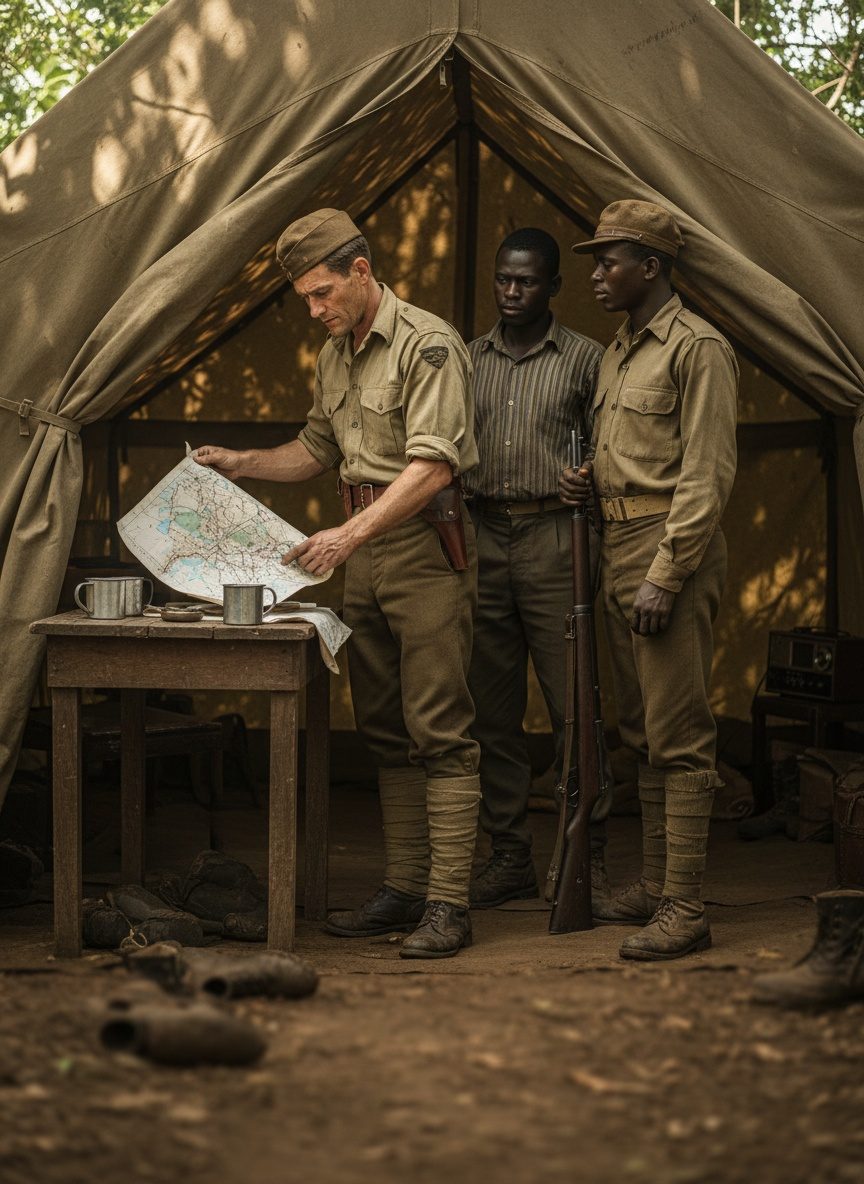
A rustle in the dense Kenyan underbrush called for silence and intense scrutiny. Corporal Dumu was tense, his eyes darting toward every shiver of leaf and broken twig. Beside him, moving with the surety of a leopard, young Lieutenant Frank Kitson signaled for caution. The night was thick with the weight of expectation and fear, the air rich with the scent of wet earth and sweat. Somewhere ahead, beyond the failing light, their quarry awaited — not a beast, but men, dangerous and desperate individuals once comrades of those now hunting them.
This was Kenya in the early 1950s, a time of upheaval and rebellion known as the Mau Mau Uprising. The colonial state, an empire stretched thin after World War II, faced a formidable challenge in the form of native insurgents demanding independence. The Mau Mau were adept at using Kenya's rugged terrain to their advantage, waging a guerrilla war that was as much a struggle for hearts and minds as it was for territory. The British, entrenched in their conventional military strategies, found themselves in unfamiliar territory — not just geographically, but tactically.
The Aberdare Range, its wooded slopes a natural labyrinth, became a stronghold for Mau Mau fighters bent on expelling the British from their homeland. Here, in this dense and hallowed wild, Frank Kitson set upon an audacious path that would redefine counter-insurgency warfare. At just 26, Lieutenant Kitson was unencumbered by the traditionalism that often colored British military tactics. He saw an opportunity in the insurgent defectors, those captured or willing to switch sides, whose intimate knowledge of the Mau Mau operations could be pivotal.
The concept of using 'turned' insurgents wasn't entirely new, but Kitson's approach was unprecedented in its scale and systematic application. He assembled units of pseudo-guerrillas, groups that blended former Mau Mau with loyal Kikuyu tribesmen under the supervision of British officers. These units, donning the guise and tactics of the very rebels they sought to infiltrate, crept silently through the forests. Their mission was simple: sow discord and gather intelligence, turning the fog of war back upon its originators. It was a gamble that promised either stunning success or unmitigated disaster.
Kitson's strategy took root in Operation "Rebel," an initiative aimed at leveraging the deep-seated rivalries and fractures within the Mau Mau ranks. The pseudo-guerrillas operated under high-risk conditions, where their very survival depended on their ability to live convincingly as those they pursued. These transformed fighters, now double-edged swords, carried with them the burden of betrayal and the hope of redemption that only victory could grant. To see one’s former brothers in arms as enemies required a psychological shift as perilous as the bush paths they trod.
The effectiveness of Kitson's initiative soon became undeniable. The pseudo-guerrilla units not only gathered critical intelligence but also executed a series of successful raids that disrupted the cohesive structure of the Mau Mau. They turned the environment against the insurgents, a brilliant reversal of fortune. The startled Mau Mau, once the phantoms of fear, found themselves encircled by silence and suspicion. Every intercepted communique, every night-time scuffle in the undergrowth, at times revealed a treachery that was disconcerting even to hardened veterans.
These psychological tactics extended beyond the battlefield. Kitson understood that combat actions alone wouldn't suffice. Winning the hearts and minds of the local population, wary and weary from years of protracted conflict, was equally crucial. It was a doctrine as old as counter-insurgency itself but reimagined and meticulously applied. Schools, health clinics, and better trading conditions were incentives to foster goodwill and loyalty among the populous. Kitson's vision was holistic, intertwining military rigor with social outreach efforts.
The implications of this counter-revolutionary strategy were profound. Kitson's experiences and the groundwork laid in the Kenyan highlands informed British military doctrine for decades. His later written works, cemented by the ideas conceptualized in the Aberdares, became pillars upon which counter-insurgency operations rested. Kitston's doctrine was viewed as pragmatism over idealism, embracing a fluid hierarchy that favored adaptability and intelligence on the ground rather than rigid, top-down commands.
The lessons from Kenya were later applied, sometimes contentiously, in counter-insurgency efforts around the world, including notable campaigns in Aden and Northern Ireland. The very nature of how unconventional warfare was perceived and executed shifted; loyalty became a mutable commodity, and deception was wielded as an art. Kitson's foresight in utilizing the fractal schisms within enemy ranks revealed new stratagem layers — those shadowed pathways that have defined conflicts since time immemorial, those torn in half by trust and treachery.
Frank Kitson's rather controversial approach raises still-relevant debates about ethics and the morality of warfare strategies that turn brother against brother. At the heart of such discussions lies a fundamental question: Can the ends ever truly justify the means when the means subvert the humanity of those involved? Though strategies and tactics may morph with the times, the human cost remains, etched into the land and its people. Long after the smoke of battle has cleared, the landscapes of those dense Aberdare forests serve as silent witnesses to a time and a strategy that changed everything.