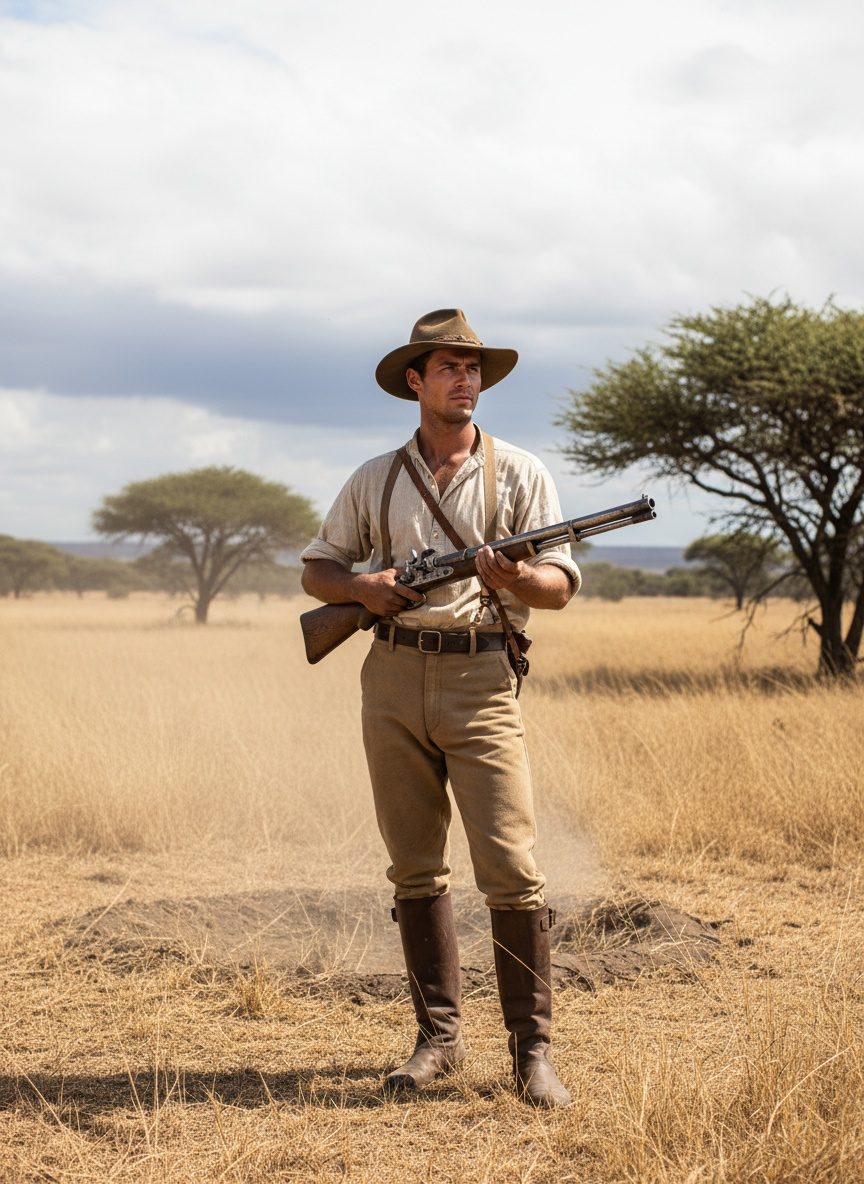
The African sun was unforgiving in Matabeleland, its golden rays piercing through the tall, dry grasses that danced in the hot, swirling wind. The air was thick with the scent of dust and distant rain, mingling with the sweet aroma of wild sage crushed underfoot. The faint rustle of leaves and the distant trumpet of an elephant echoed through the bush, creating a symphony of life. Yet, amidst this natural beauty lay an imminent danger. In 1877, this was a land gripped by the jaws of peril, where the harmony of the wilderness could be shattered in an instant by the roar of a predator.
The Young Adventurer Enters the Fray
Frederick Courteney Selous was no stranger to the dangers of the African landscape. At just twenty-six, he had already earned a reputation as a formidable hunter and explorer. Known for his resilience and deep understanding of the land and its inhabitants, he ventured into the heart of Matabeleland, driven by a thirst for new experiences and untamed challenges. Yet, on this particular day, as the sun hung high in the sky, Selous found himself alone, confronting a situation that could have swiftly ended even his burgeoning legend.
Riding through lion country, Selous expected the unexpected. However, as his horse suddenly bolted, his senses went into overdrive. The tall grasses whipped past him as his heart pounded with the rhythm of hooves against the hard earth. In a split second, his lifeline—his mount—sped away, leaving him grounded in unfamiliar terrain. Without hesitation, Selous reached for his rifle, the cold metal a reassuring weight in his hands. But fate seemed determined to test him, for as he steadied himself to face the unseen threat, the rifle misfired. The click that should have brought solitude instead heralded a new wave of peril.
Most men might have fled or frozen in fear or regret, but not Selous. With steely determination that exemplified his spirit, he stood his ground. This was not his first brush with danger, and he knew the stakes were no less than life and death. The lion’s charge was swift, a mass of muscle and ferocity honed by the harsh laws of survival. Yet, in this tableau of hunter and hunted, it was Selous’ indomitable will that stood between him and a savage end.
A Game of Wits and Will
What transpired in those critical moments is as much about instinct as it is about intellect. Selous, armed with nothing but his wits and an intimate knowledge of the land, had only seconds to react. He quickly scanned his surroundings, searching for an advantage in the flat, sunbaked terrain. Alone, stripped of his horse and his firearm, Selous felt every heartbeat, each one a reminder of his singularity in a vast expanse where life was both bountiful and brutish.
The lion appeared, a blur of tawny fur and sinew closing the distance with terrifying speed. Witnesses to such charges describe it as seeing raw power unleashed, all muscles and menace honing in with predatory precision. Yet, even facing this ultimate challenge, Selous retained his composure. With a calculated assessment that seemed impossible under such duress, he relied on his deep understanding of animal behavior gained through years of exposure and observation.
Retreating was not an option. Instead, Selous used his remaining tools—his voice and his presence. He shouted, loud and commanding, hoping to break the lion's momentum with a tactic as old as man and beast themselves. Survival often depended on roles reversed; the hunter becoming defender, turning predator into pursuer of safer prey. For once, the gamble paid off as the lion halted its charge, confused by the cacophony and the sudden defiance of its quarry. Those tense moments hung in the air, heavy with the tension of primal confrontation.
The Aftermath: A Legend Hardened
In the silence that followed the lion's retreat, the world resumed its relentless pace. Leaves stirred, the bark of a nearby baboon broke the quiet, and life in Matabeleland continued its unending cycle. Selous stood alone, victorious not through might, but through mastery of self and the environment—a testament to the qualities that would later define his enduring legacy as a pioneer of African exploration.
Selous documented these trials in his writings, leaving an indelible mark on the history of British exploration. His accounts offered a glimpse into the raw, uncharted reality of Africa at a time when the continent was both a mystery and a prize in the great Scramble for Africa. It was not just his survival that was remarkable, but the methodical way in which he approached the wilderness, a dance between progress and preservation at a time when both were urgently needed.
Frederick Selous' seemingly miraculous survival in the face of pure wildlife audacity was more than a personal victory. It symbolized a moment in time when the Victorian empire was extending its gaze into the African interior. Selous, with his adroit handling of nature’s fiercest actors, embodied the spirit of discovery tempered with respect. His story beckons us to remember a past that shaped our present interactions with the natural world—offering lessons in courage, adaptability, and the timeless human quest for understanding our place within this vast, untamed tapestry.