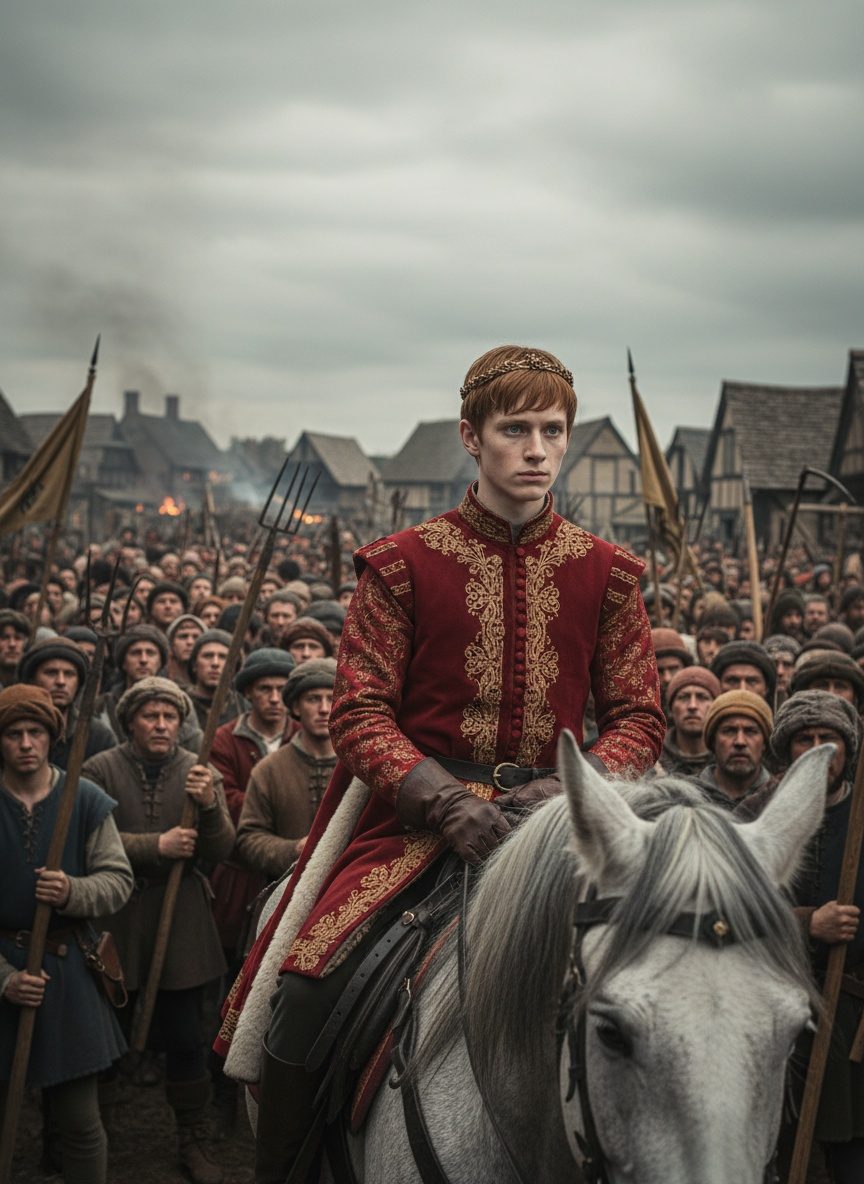
The June sun hung low over the Thames, turning its usual murky brown into a liquid amber that danced across hundreds of rippling waves. The south breeze was gentle, rustling the leaves of the exhausted plane trees along the riverbank, their shade offering scant relief to the sweating throngs massed on the cobbled road. On the banners, faint in the distance but unmistakably those of the peasant rebellion, the rampant boar of Essex and the stag of Kent flapped impatiently. A massive column of smoke rose in the London sky, evidence of the destruction already wrought by the restless multitude. Yet, amidst this tumult, a solitary figure on horseback moved forward, casting an imposing yet oddly vulnerable silhouette against the flaming horizon — King Richard II, barely fourteen, riding out to meet an army forged not from nobles and knights, but from the common bread and blood of England itself.
The Uprising Ignites
The Peasants' Revolt of 1381 was no spur-of-the-moment uprising. It simmered in the bellies of England’s poor, a cauldron of discontent fueled by oppressive taxes and a rigidly stratified society. This was an England still reeling from the catastrophic Black Death, its wounds raw, its threads of social order fraying. The Poll Tax of 1381, its burden great and its enforcement ruthless, was the catalyst that turned festering resentment into open rebellion. From the villages and fields, blackened by years of toil, they came—men and women driven to desperation, seeking justice with pitchforks and plowshares turned to weapons.
They had a champion in Wat Tyler, a name whispered in fear by some, in admiration by far more. He was a craftsman, perhaps, or a farmer; whatever his origin, he was charismatic and consumed with resolve. His call to arms echoed through the Kentish countryside, gathering forces from every corner where the earth was cleaved by the common man. Joined by the fiery preacher John Ball, a radical whose sermons were sparks to the kindling under the old order, Tyler led this motley throng towards London, their hearts as hardened as their soles were worn.
An Audacious Gamble
In the heart of London, the revolt blazed bright. The Tower was sacked; the Archbishop of Canterbury, Simon Sudbury, met a grisly end. The city's streets became rivers of chaos, flowing with outrage and desperation. Chillingly organized for a mass of untrained commoners, the rebels marked out their enemies with grim precision. Their audacity shook the mightiest stones of Plantagenet authority -- yet it was not enough to crumble them.
Word reached young Richard of the tumult and terror ravaging his realm. Though still a boy, destiny demanded he act with the poise of a seasoned king. Deciding to negotiate with the insurgents themselves was an enormous gamble—a gamble with the very crown balanced on the fulcrum. So it was, under all the weight of his advisors' warnings, that Richard rode forth from the safety of the Tower, bereft of any company save a handful of knights, to parlay with the rebellious host at Mile End. Fear did not drag at his heels; instead, a kingly resolve propelled him forward. To face his people, to negotiate in their earnest cries of plea, was his duty. And alone, in the face of a churning sea of simmering anger, he did not shy from it.
A Promise in Peril
As Richard reached the throng, the air was charged with tension, as fragile as spun glass. Thousands thronged about him, their eyes weary but sparking with a desperate hope. He addressed them, his voice steady and clear above the heated murmur of the masses. Here, at Mile End, the king did what no other would: he promised them a change—a release from the bonds of servitude, assurances for the redress of grievances. His pledge, spoken in the earnest tones of youthful authority, was a balm to many ears — a promise issued from royalty felt like a divine decree.
But promises, like mists in the morning, can dissipate without a trace — and not all rebels were as easily sated. The flames of wrath still licked at the hearts of some. Wat Tyler, undeterred by the words of a boy king, pursued more radical action. Thus, the next day, at Smithfield, Tyler demanded further concessions. There, tempers among the king’s disciplined followers flared and Tyler found himself speared by dissent and steel alike, his lone rebellion snuffed out in an instant of violence. Chaos threatened to engulf both sides — until Richard, with extraordinary presence for one so young, rode forth again, his voice a steadying force in the tempest, urging the crowd to disperse peacefully.
A Twisting Path Forward
In the aftermath of the tumult, while the embers cooled upon London's soot-darkened streets, peace resumed its cloak across England. The immediate danger to the crown was quelled, but Richard's promises, so earnestly spoken, were soon unraveled by the same hands that had urged him forward. The socio-political order was deftly restored, and the revolutionary reforms the peasants had dared to dream of faded quickly into the background of history. Prudently or perhaps cynically, the crown shifted away from its pledges, entrenching once more the hierarchies that had kindled the peasants’ ire.
This moment of valiant confrontation between king and subjects was but a blink in the long annals of England's history, yet it remains a testament to the power of the common voice when raised as one. Had the scales tipped another way, England's landscape could have undergone seismic change. Still, the events of 1381 etch a poignant lesson—when those who till the land grow restless, no citadel nor kingdom's heart can long endure. The boy king’s encounter with the mighty spirit of his people serves as a timeless reminder of the delicate dance between power and its sources, rebellion and redemption, promises and their ghosts.