Most people have heard of Mount Everest. Few know the story of the man behind its name.
Through Fire and Jungle: The Quest Begins
In 1830, the British Empire was steadily extending its reach across the Indian subcontinent, but the mysteries of its topography remained largely unsolved. The Himalayas, with their snow-capped peaks scraping the heavens, were daunting giants on the Empire’s periphery. Enter George Everest, a meticulous man driven by a singular purpose—charting the unknown. Everest was appointed as Surveyor General of India, inheriting the vast and arduous task of the Great Trigonometrical Survey, which aimed to map the entire subcontinent. His journey promised no glory; only the satisfaction of science and the lure of uncharted territory.
Unlike the typical adventurer, Everest was a man of precision and detail, often beset by the overpowering conditions of the empire’s diverse terrains. The untamed wilds and the oppressive weather were relentless foes, as he tirelessly pushed forward, dragging his crew through sweltering jungles and forsaken plains. They navigated rivers teeming with danger and scaled plateaus where altitude mocked their instruments. Yet, the obstacles didn’t end with nature. Disease was a constant threat, claiming lives and slowing progress as the expedition fought to plot every inch with unwavering dedication.
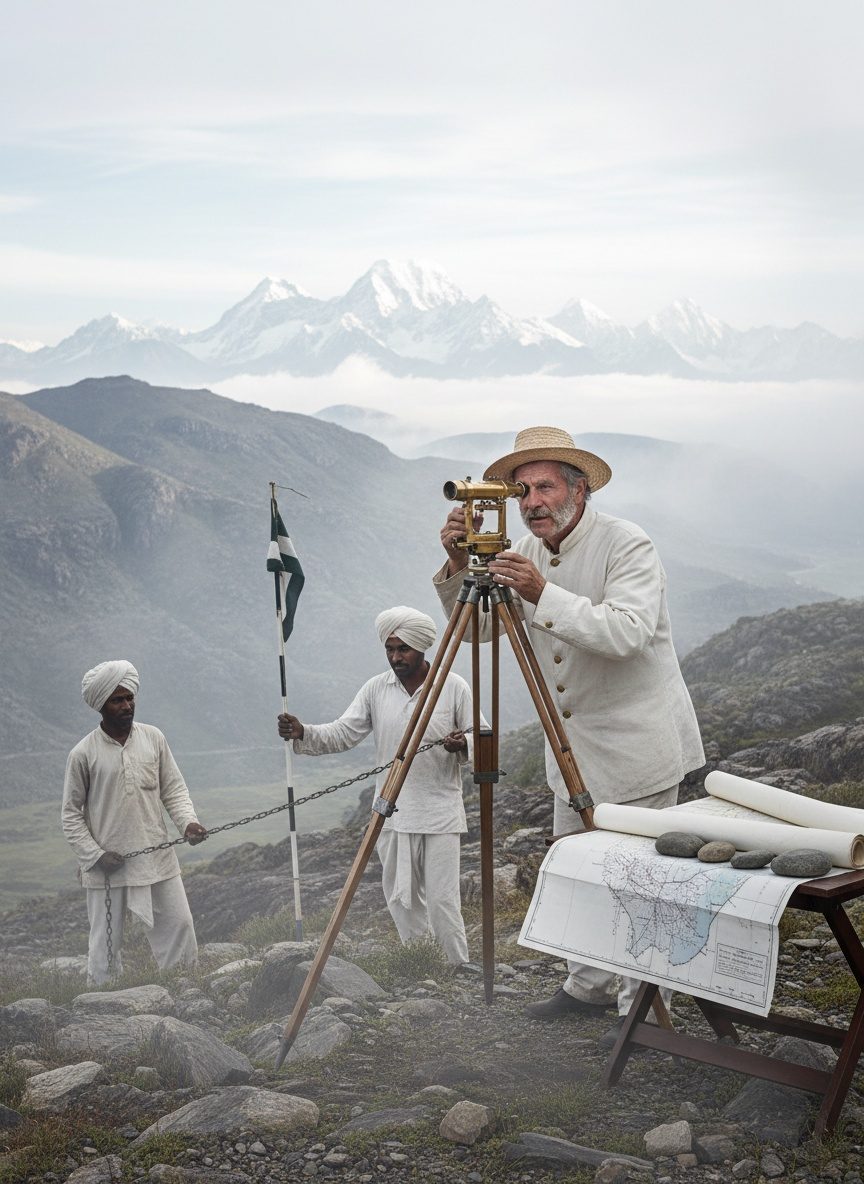
But Everest’s tool of triumph wasn’t a sword or an ax—it was the theodolite. This brass instrument, with its dizzying array of lenses and scales, was the very heart of Everest's mission. Perfected over centuries, the theodolite brought the heavens down to Earth with angles and arcs, translating the sublime into comprehensible numbers. With it, Everest embarked on a monumental journey to triangulate the subcontinent's depths and heights, armed not just with scientific instruments, but an unyielding belief in the power of precision.
Measuring the Giants: A New Frontier
By 1843, as Everest’s efforts stretched into decades, they reached the formidable Himalayas. Until then, no European had stood close enough to even attempt to measure these colossal peaks. While local lore filled in the blanks of these heights, it was Everest’s ambition to quench the thirst for knowledge with geometry and science. His mission was daunting—imagine trying to measure the sky while standing in the clouds, peering through an instrument that demanded precision under grueling conditions.
The stakes were high. Utilizing methods of triangulation, Everest began the painstaking process of calculating the dizzying altitudes. This meant setting up precise baselines and taking measurements across impossible distances, often with only a fleeting view through the receding fog and blinding sun. The work was relentless; every reading needed verification, every angle had to align. It was a battle against probability, with errors lurking at every measure.
Finally, their calculations revealed something astonishing. These remote peaks were perhaps the highest in the world. Amongst them stood what was lovingly called Peak XV—a point so massive, its summit pierced the domain of gods and clouds. Everest and his team couldn’t stand atop it, but they conquered it with numbers, reducing its majesty to figures that could be understood and shared with the world.
The Name in the Clouds: Eternal Recognition
George Everest never climbed the mountains that now bear his name. In fact, he had retired by the time his successor, Andrew Waugh, took the helm and validated the calculations that confirmed Peak XV as the tallest mountain on Earth. Named in Everest’s honor by Waugh, Mount Everest stands as a testament to human tenacity and the relentless pursuit of knowledge. Yet, the man behind the name was of quieter demeanor; he never sought such recognition.
What set Everest apart was not the physical conquering of peaks, but his unfaltering dedication to the rigors of science and exploration. Through his commitment, George Everest etched his legacy into the very fabric of geographical discovery. His work established new standards for precision in surveying and laid the groundwork for the continued exploration of the Earth's many mysteries. The towering mountain was but a marker for a broader tapestry of exploration and scientific achievement.
Today, as climbers from every nation attempt to ascend Mount Everest, leaving behind tales of triumph and tragedy, few reflect upon the history that named the peak. Yet the story of George Everest underscores the power of human curiosity and precision. It challenges us to look beyond the visible horizon and trust in the quiet conquest of the unknown through perseverance and intellect. It’s a reminder that reaching the roof of the world doesn't always require standing atop it—it often begins with triangulating the unthinkable.