
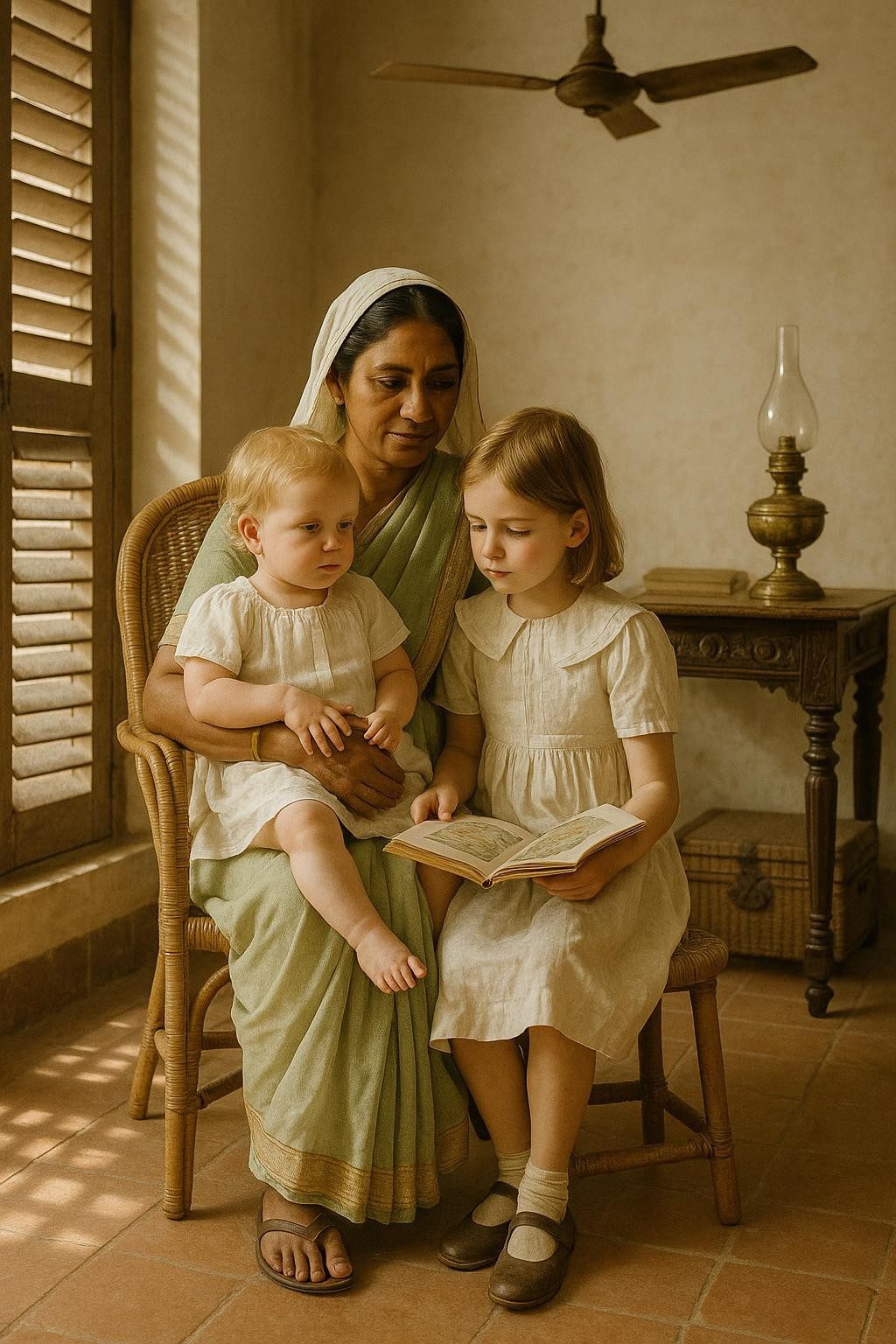
The oppressive sun hung low in the sky of Bombay, casting long shadows that danced like spectres across the dusty veranda. A gentle hum of life filled the warm air — the rustling of palm leaves, the distant clang of a tram, the melodious ring of temple bells echoing in the distance. Inside the bungalow, the slow, rhythmic creak of the ceiling fan provided only modest relief from the unrelenting heat. Amidst this serene yet stifling atmosphere, the true heartbeat of an empire’s domestic life unfolded behind closed doors, in an everyday scene that wove together foreign lands and unfamiliar tongues. This was a sphere where Mary the ayah stood, calming the household with her quiet presence, holding an infant close as she hummed soft lullabies. Her gentle coos were both a comfort and a reminder—while an empire might conquer lands and hearts, the unseen labor and care of women like Mary shaped its future.
The Silent Backbone of the Raj
In the British Raj, where distances stretched vast and cultural chasms yawned wide, the ayah was an essential, yet uncelebrated figure within British households. The term "ayah" applied broadly to local nursemaids, primarily originating from various regions across India, yet bound together in their roles of nurturing and educating the children of expatriate families. Entrusted with the care of children from infancy through adolescence, these women were more than mere support staff; they became linchpins in the seamless operations of a colonial family’s domestic life.
Mary, like her many peers, was an invisible weaver in this intricate tapestry. Her days were shaped by an intricate dance of duties, oscillating between the structured demands of the memsahib — the lady of the house — and the more subtle, intuitive needs of the children she cared for. The youngsters, born to a land of paradoxes, knew two mothers: one, by blood and birthright, whose love often felt terse and distant; the other, by choice and circumstance, whose every touch seemed to whisper of enduring devotion.
As the memsahib succumbed to the inefficiencies of colonial health remedies, often suffering from ailments like malaria or the fatigue of unfamiliar climate, it fell to Mary to provide consistency and gentle guidance. This unique role granted her an indelible imprint upon the minds of the children she reared. In the living history of the Raj, she remained an unsung architect of the empire's future, steering young lives with lullabies lingering in the air long after her charges grew and departed.
Cultural Bridges and Quiet Currents
The ayahs were cultural bridges, guiding young British minds across the vast, often awe-inspiring expanse of Indian life. The British might have imposed their rule over India politically, but in the intimacy of their homes, cultural lines blurred. The nursery might have been a microcosm of an empire, but it also harbored the synthesis of identities — the familiarity of European upbringing interwoven with the subtle scent of jasmine and spice, the gentle sway of regional dialects.
For Mary and her compatriots, each moment spent influencing a child’s life carried both challenges and rewards. They taught these fledgling Britons the local languages and customs, invisibly embedding in them the complexities of the land they were born to rule. They watched as "their" children ran barefoot through the gardens, sang Hindi songs alongside English hymns, and celebrated Diwali with the same fervor as Christmas.
This unique bicultural acquaintance fostered deep connections. Many of these children, upon returning to England, would carry memories of their ayahs as fondly as their earliest recollections of their own parents. Children, unconsciously unprejudiced and openhearted, often became attached to their nursemaids, sometimes speaking of them before they mentioned their own mother or father. While she was officially a servant, in personal realms, Mary was family.
Empire’s Quiet Architect
The presence of the ayah in the British colonial household spoke volumes about the hidden frameworks supporting the edifice of empire. In a male-dominated structure built on military exploits and administrative acumen, the contributions of women — and particularly, women of color like Mary — were seldom acknowledged in the annals of history. Yet, their labor underscored the psychosocial stability of a generation of imperial leaders raised in foreign climes.
Throughout her life, Mary taught the children resilience amid upheaval, love in silence, and strength in patience. When the sun set over Bombay and shadows cooled the land, these lessons remained imprinted upon her charges as they matured into figures of influence. The tenderness of her lullabies lingered long enough to shape the perceptions of rule and the responsibilities of power for those nurtured under her vigilant care.
In the narrative of Britain’s colonial escapade, the ayahs were never inscribed in the official scrolls, but their legacies lived on in the minds of those they molded. They served as a conduit not merely of sustenance but of understanding between worlds. In the warmth of an Indian night under the soft murmur of a fan, as a child’s fear waned under a gentle touch, Mary and her kin quietly carved contours into history’s expansive, and oftentimes, indifferent face. By acknowledging these silent stewards of peculiarly woven lives, we grasp a richer, more intricate truth of the past and the unseen hands that shaped it.