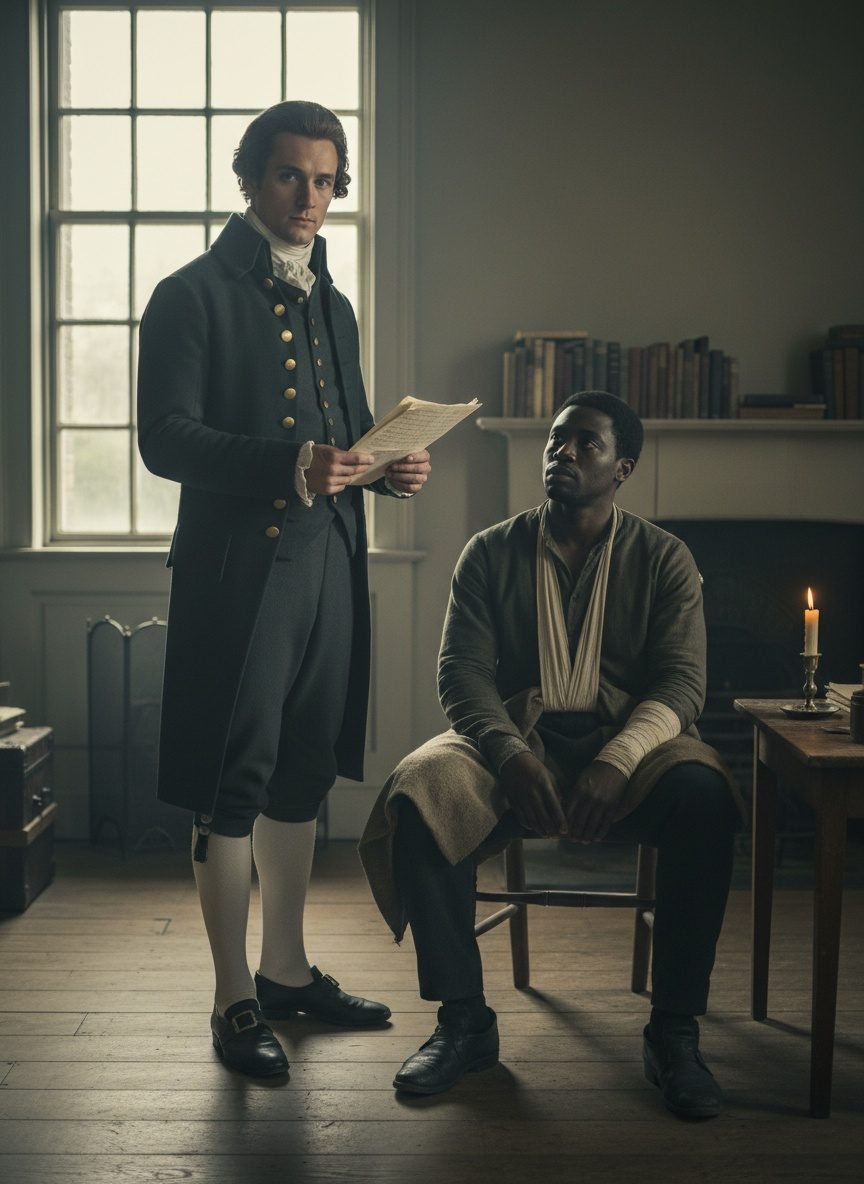
September 22, 1772. The cobbled streets of London echoed with the clatter of carriage wheels and the shouts of vendors. Amidst the chaos, an unexpected event was unfolding that would alter the course of history.
Discovery on the Streets
In the teeming streets of Georgian London, a man lay crumpled—a sight perhaps not uncommon in a city bustling with activity and indifference. Yet, to Granville Sharp, a government clerk whose conscience was as unwavering as his ambition was unassuming, it was a moment of profound significance. Jonathan Strong, a young man of African descent, was the unfortunate soul at Sharp's feet, bearing the brutal scars and bruises of a life enslaved. Granville Sharp wasn't a man of legal prowess or wealth; his battlefield was one of justice born from moral indignation, not from a courtroom, but from the symphony of books filling his modest residence.
Sharp took Strong under his wing, juggling the roles of nurse, benefactor, and friend. Slowly, Strong's physical wounds began to heal, but the scars of bondage lingered. To Sharp's horror, Strong's former owner, a master who had all but discarded him when he became unprofitable, reappeared. He intended to reclaim what he considered his rightful possession. This showdown in London's courts wasn't merely about Strong's fate—it was a confrontation between the cruelty of human bondage and the sacrosanct legal principles that England professed to uphold.
The David and Goliath Case
Sharp, armed only with his extensive readings and a fervor for justice, braced himself for the legal labyrinth ahead. This was no ordinary battle; it was an epic confrontation where the opposing forces were imbalanced. On one side stood Sharp—a solitary figure supported by an inner circle of abolitionist allies. On the other, the formidable machinery of commerce and colonial interest, eager to preserve the status quo of human trafficking for profit. London’s society teetered on the verge of division under the weight of this contentious debate. Would property rights in humans withstand the scrutiny of the courts?
As the case unfolded at Westminster Hall, presided over by the Lord Chief Justice, William Murray, 1st Earl of Mansfield, the cracks in the institution of slavery began to show. The question at its core was whether the laws of England, which professed liberty and justice, could reconcile the existence of slavery within their jurisdiction. Sharp's arguments, though delivered without the polish of a practiced barrister, struck a nerve within the legal system. His conviction pierced through the parchment of statutes and case law, revealing the raw humanity at the heart of the dispute.
The Judgment That Echoed
Lord Mansfield’s ruling on June 22, 1772, sent ripples far beyond the shores of Britain. He decreed that no man could be removed from Britain to become a slave. Though it was a narrow decision, careful to avoid declaring an outright abolition, this judgment effectively shattered the myth that slavery was legally enforceable on English soil. It was a verdict that ignited the fires of reform and boosted the morale of abolitionists embroiled in battles across the empire.
Granville Sharp emerged from this courtroom drama not only as a victor but as a pioneer in the battle against slavery. The case of Jonathan Strong was more than a legal victory; it signaled a seismic shift in moral consciousness, prompting society to confront its contradictions. Granville Sharp, the modest clerk with no vested power, had forced England to reflect on its complicit role in the web of slavery—a reflection that would eventually contribute to the abolishment of the slave trade.
Jonathan Strong’s story, as revealed through this pivotal trial, challenges our understanding of liberty and the power of the individual. In a city where wealth and status dominated, a humble clerk dared to envision a world wherein justice prevailed over commerce. The legal precedent set by Lord Mansfield's ruling became a beacon, gradually illuminating the path toward the eventual worldwide abolition of slavery. It’s a reminder for the ages, an echo calling back to our moral obligations, whispering across time that ordinary people, armed with justice and resolve, can indeed change the world.