He was a painter of vivid hues. But he immortalized an army about to fade into khaki. The man was Harry Payne, a celebrated military artist capturing the British Empire’s soldiers in their last burst of sartorial splendor during the Boer War.
The Vibrant Tapestry of Empire
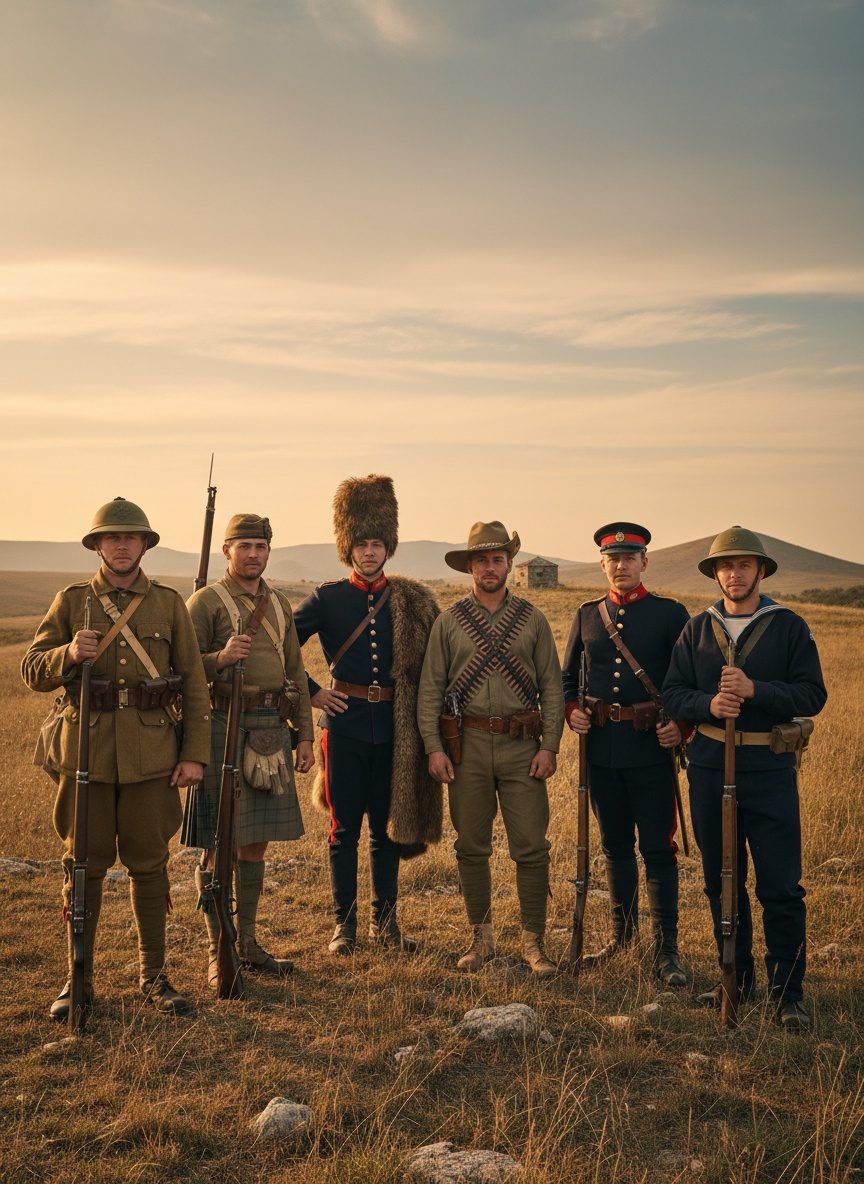
At the dawn of the 20th century, the might and majesty of the British Empire stood mirrored in its resplendent military uniforms. From scarlet-coated cavalrymen to the tartan of kilted Highlanders, the troops were a mosaic of vibrant hues marching beneath the sun-drenched skies of South Africa. British soldiers, each regiment distinct in its attire, formed a dazzling spectacle on the battlefield. Like a living canvas of imperial ambition, they represented the vast reach of an empire on which the sun never set. Yet as the Boer War erupted in 1899, this tradition of color faced an impending eclipse.
The Boers, with their guerrilla tactics and earthy camouflage, posed a new kind of challenge. In the golden grasslands of the South African veldt, it was not the resplendence of one’s uniform that brought victories but the ability to remain unseen. The war demanded practicality over pageantry. Enter Harry Payne, whose sketches and watercolors preserved the flamboyant vestiges of an old military order standing at the threshold of modern warfare.
The Artist's Eye
The work of Harry Payne stands out for its meticulous detail and brilliant color. Born into a military family, Payne had an innate appreciation for the pomp and circumstance that marked British military tradition. As everyone else's focus shifted firmly towards practicality, Payne's gaze remained fixed on the pride and spirit embodied in those colorful uniforms. He was an artist at a transformative moment, painting with an urgency brought about by the knowledge that he was documenting the dying moments of an era.
Payne's meticulous art went beyond simple likenesses. He captured the spirit and the stories within each uniform, each splash of dye symbolizing a part of the soldier's identity and the military’s storied history. The combinations of cloth and color told of battles won and lost, of territories defended, and of imperial adventures - from the lurid reds of the British infantry to the blues and greens of the colonial regiments. While Payne worked fervently in 1899, many of his subjects prepared to make their own swan song in these outfits, as new khaki attire gradually took precedence.
Khaki: The New Conqueror
Khaki, a drab, brownish-yellow fabric, was born of necessity. Derived from the Hindi word for "dusty," it reflected a pragmatic shift in military attire, acknowledging the realities of modern warfare where visibility became a deadly disadvantage. The British Army had long excelled in parade-ground perfection, a tool of intimidation and morale on the plains of India and the deserts of the Suez. But it was on the scorched landscapes of South Africa that such grandeur had its first reckoning.
The Boer War compelled a tactical rethinking, and with it, a change in fabric. The khaki uniform allowed soldiers to blend seamlessly into the parched veldt, a stark contrast to the Boers, who had always chosen practicality over tradition. Yet, while practical, khaki's dullness was an aesthetic admission of the end of an era. With each brushstroke, Harry Payne preserved the rich declaration of identity that characterized the military before its descent into monotone functionality.
Cementing a Legacy Amidst Change
Harry Payne's works suddenly became a crucial historical resource. Faced with a Britain in transition, both in its realms and regimentals, these paintings offered more than just solace to those who mourned the old style; they served as a meticulous study of the last full-dress uniforms of a world conjuring the might of the Empire. Audiences then and now could almost hear the crackle of crisp serge, imagine the burnished glint off polished brass, and visualize the surge of color rolling across foreign lands under the Union Jack.
The Boer War, while a grinding conflict for the British, was also a major catalyst in their military's evolution. Harry Payne's paintings captured the twilight of one of the Empire's most stirring spectacles, ensuring that the regalia of a regiment was not entirely eclipsed by a more somber militaristic necessity.
A Palette That Outlasted the Khaki
The uniforms Payne painted now serve as a vibrant touchstone to an imperial past, reminding modern audiences of the costs and colors of an empire. Britain's military transition to khaki-clad service members paralleled its larger imperial transformation in the face of a new century—one where colonial entanglements demanded a more adaptable and efficient force. The soldiers Payne immortalized were both dreamlike and tangible, stationed at a crossroads of history where empires began questioning the cost of their bright threads as they battled new foes.
As dull khaki uniforms became the global military norm, Harry Payne's vibrant work remains an evocative reminder of a bygone era, architecturally bold yet practically stout, magnificently ornate yet inevitably functional. In Payne's artwork, the clashing sounds of warfare are muted by the echo of history’s brush strokes, urging us to consider what splendor and sacrifice mean in times of change.