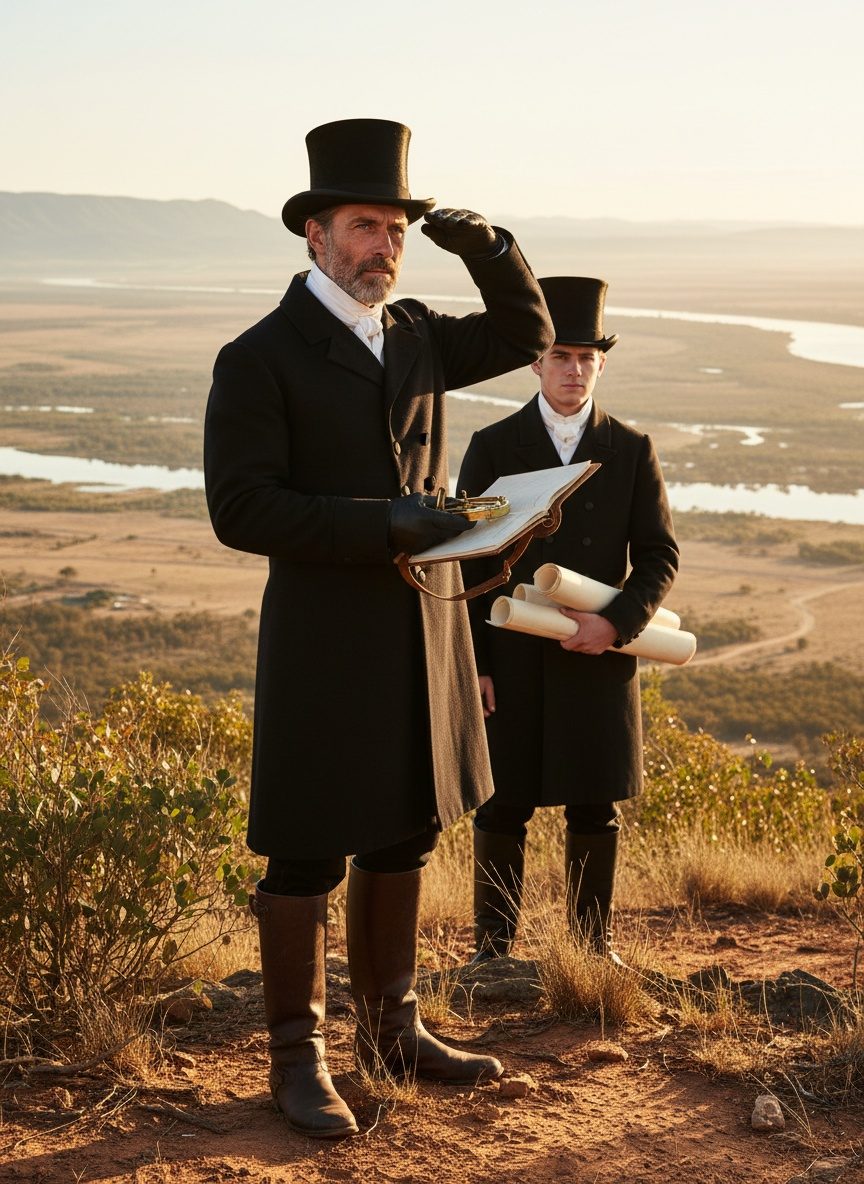
The Southern Hemisphere sun blazed down in unforgiving brilliance, casting long shadows across the undulating terrain of South Australia's nascent land. The coastal winds carried whispers from the expansive ocean, weaving through the tufts of native grasses and creating an omnipresent symphony of nature's own making. It was a landscape both raw and promising, where the air seemed to thrum with the potential of a thousand untold stories waiting to be written. It was on this ground that Colonel William Light, with a resolute heart and a visionary eye, would chart the future of a city born from imagination and dispute.
The Lone Visionary
In 1836, the task set before Colonel William Light felt almost Herculean. Given the directive to establish a settlement in South Australia and tasked with selecting its location, Light was to set the foundation for what would become Adelaide. A man of both artistic flair and pragmatic insight, Light viewed the landscape as a blank canvas, its open expanses calling for strokes of vision where many saw only the challenges of the unknown.
The responsibility bestowed upon him was fraught with contention. Numerous voices buzzed around him — government officials, surveyors, settlers — each wielding their vision, each itching to make their mark. But Light stood firm, unyielded by the pressures of conflicting opinions. His choice would not just determine the success of an entire venture but define the legacy of a generation upon this uncharted territory. It was an era when the British Empire sought to expand its influence, and the establishment of a new settlement was as much a political move as it was a geographical, economic, and social one.
Light climbed a lonely hill — today known as Montefiore Hill — where the landscape unfolded before him like a detailed map. The majestic view laid out a swath of gently sloping plains embraced by undulating hills on one side and, on the other, the whispering coastlines kissing the sea. It was here, with the panoramic vista fanning out beneath the expansive sun-drenched sky, that Light found clarity amidst the prevailing discord. His requirements were precise: fertile land for cultivation, access to fresh water, and proximity to a safe harbor. The tableau fulfilled all these with grace.
Blueprint of Dreams
Light's vision did not rest on mere geography; it was underpinned by an ideology that wrestled against the dictates of conformity. The plan he laid on paper emerged not merely as a grid of streets and structures but as a living entity, one that balanced the demands of the empire with the dreams of its inhabitants. He envisaged a city cradled within parks and gardens, a haven melding urban life with the rejuvenating embrace of nature. At a time when European cities were cramped and grimy, Light's embrace of open space was both radical and refreshing.
The precise measurements and careful alignments of Light's plan were set with an artist's eye, his vision reflecting a singular dedication to aesthetics and function. His blueprint was imbued with symmetry and balance, a deliberate stand against the seduction of immediate practicality. Public squares were nestled among the streets, designed to encourage gathering and community. Trees would line the avenues, and gardens would dot the city's expanse, a nod to both European sensibilities and the untamed beauty of the Australian landscape.
Yet, Light's dream was not easily shared. Disputes flared with the South Australian Company, which prioritized economic pursuits over Light's idealism. An air of skepticism hung over the venture, with many considering his ideas as lofty musings unfit for the pragmatism required in taming new lands.
A City Born of Time and Tenacity
Despite the voices of dissent, the Adelaide Light envisioned began to take shape. The city's structure mirrored his original plan, an urban tapestry woven from the motifs of both European and indigenous designs. It was a study in coexistence, ingeniously folding the past into a forward-looking blueprint. In the subsequent years, Adelaide's growth reflected Light's foundational ethos: a strong skeleton of organized streets with a heart that beat to the rhythm of its parks, gardens, and public spaces.
Colonel Light's contribution to the Australian landscape is not merely physical; it is an allegory of perseverance over insistent discord. His actions underscored the importance of vision in empire-building, the audacity required to carve out a piece of civilization amid the sprawling wilds, not through force but through thoughtful design and a harmonious respect for the land. Beyond the plans and landscapes, Light's legacy lies in standing as a testament to the power of solitary conviction amidst the clamor of conformity.
Today, Adelaide is lauded for its exceptional urban planning and quality of life — a city tethered to nature through its arteries of green, a cosmopolitan heart that hums with history. It serves as a tangible reminder of the power held within the hands of a lone dreamer willing to withstand the storms of doubt. In a world shaped by mighty empires, William Light dared to map futures not etched by force or imposing will but through imagination, ensuring the future bore the echo of his dreams. His narrative pushes us to ponder the silent yet profound power of a vision — etched not in rigid lines but in the patient, enduring strokes of the land itself.