The British Empire never gives up its jewels. Except when it does.
The Calm Before the Midnight
In the sultry night air of Accra in March 1957, the Union Jack fluttered one last time over a land that had generated rivers of wealth for the British Empire. Below it, an expectant crowd gathered, waiting to witness a moment that would etch itself into the annals of history. It was the end of an era and, simultaneously, the birth of something unprecedented. There was a potent silence before the roar — a calm before the clock would strike twelve, giving rise to something both magnificent and revolutionary.
While the colonial march out of Africa was often noisy, blood-stained, and fraught with violence, the scene in Accra that evening was strikingly different. This moment did not come on the heels of a hard-fought rebellion nor as a surrender in the face of defiance. It was a transition wrought by careful negotiation, respect, and fortitude. For Britain, this was a graceful bowing-out, not a retreat driven by a misstep or miscalculation. The Empire, for once, was leaving with dignity.
Speeches Under Starlit Skies
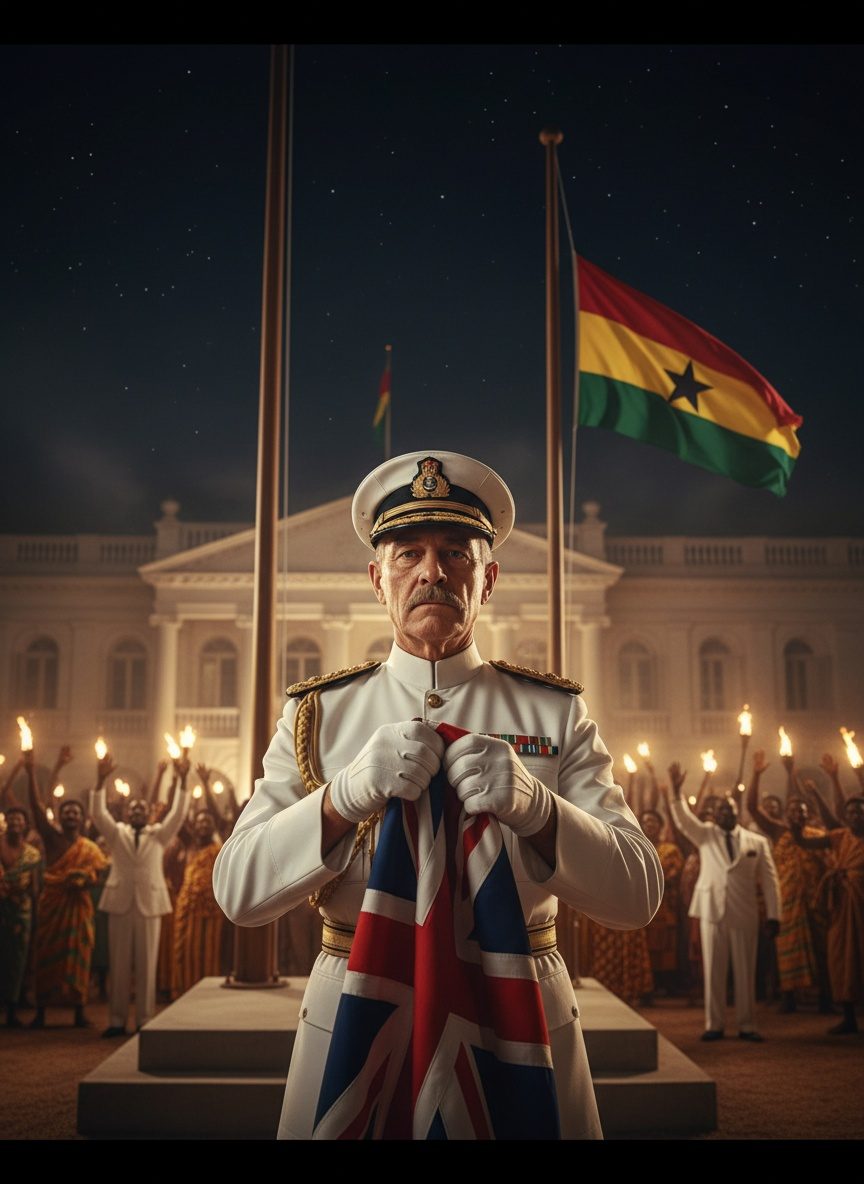
As the stars began to twinkle over Independence Square, the British Governor-General, tasked with overseeing the monumental transition, took his place on the ceremonial platform. His presence symbolized Britain's last vestige of authority over the region, yet his demeanor resonated not with command, but with sincere concession. He stood not as a ruler but as a guest, momentarily delaying his departure from a colonial chapter that Britain had long dictated.
The air was thick with anticipation as Ghanaian leaders took the stage to articulate the path that lay ahead. The crowd, a blend of hope, anxiety, and cheer, watched as their leaders boldly envisaged a future unhindered by foreign governance. These were not the bombastic speeches of belligerence that often accompany independence struggles, but words carefully chosen to strike a balance between celebration and acknowledgment of a shared history.
The young nation's leaders were reminding the world that diplomacy, in the face of desire for freedom, could triumph over divisive conflict. This would become Ghana's first lesson to the post-colonial world: transitions could both honor the past and embrace the future.
The Final Lowering
As the clock approached midnight, attention shifted to the flagpole where the Union Jack awaited its descent — a simple act that carried immense symbolic weight. The crowd fell into a hush, and the significance of this moment reached into the heart of every individual present.
With the precision of a choreographed dance, a lone British officer began lowering the flag, folding it with meticulous care. This act, somber and ceremonious, was a nod to the solemn treaty that wove through the margins of this transition. In this single motion, the era of British dominance in sub-Saharan Africa began to recede into history.
The flag swayed, almost reluctanctly, bidding farewell to a land reflecting both the resources extracted and the resistance it nurtured. A ripple of realization spread through the crowd, a poignant reminder of the decades spent under foreign rule, juxtaposed against the liberation now within arm's reach.
The Birth at Midnight
As the British standard was tucked away, the new flag of Ghana was raised to jubilant cheers that seemed to reverberate through the annals of colonial history. It was no mere piece of cloth but a symbol of sovereignty, solidarity, and an indestructible spirit. Evoking the resilience of the Gold Coast's people, the flag represented a new dawn.
The precise strokes of midnight triggered an exuberant celebration. Thousands roared in unity, their voices harmonizing with the beating drums and celebratory fireworks painting the night sky. As the world watched, Ghana became a beacon of hope and a testament to the possibility of peaceful independence.
For Britain, this was more than just the withdrawal from a colony; it was a calculated decision to honor commitments made. Ghana's unyielding path to self-governance without falling into the abyss of conflict marked a new approach to decolonization.
The New Day Dawns
The story of that midnight ceremony is more than a historical anecdote; it is a blueprint for the future. It mirrored the potential for earnest dialogue, the power of respectful negotiation, and the importance of courage in the face of irrevocable change. The world took note, not merely of Ghana's independence, but of the manner in which it was achieved.
This was a chapter neither written in conquest nor in chaos. Rather, it was penned with the ideals of trust and promise, crucial elements often amiss in tales of empire collapse. What transpired in Accra was a narrative reshaped by wisdom — a reminder for all nations that independence need not emerge from the crucible of warfare but through the embrace of justice and self-determination.
As we reflect on this pivotal moment over sixty years later, we recognize its resonance in today’s geopolitics. It compels us to question how nations might resolve current struggles in the spirit of mutual respect and peaceful transition. The Gold Coast's midnight rendezvous with independence continues to remind us that even at the perceived end of an empire, the door to a brighter beginning remains open.