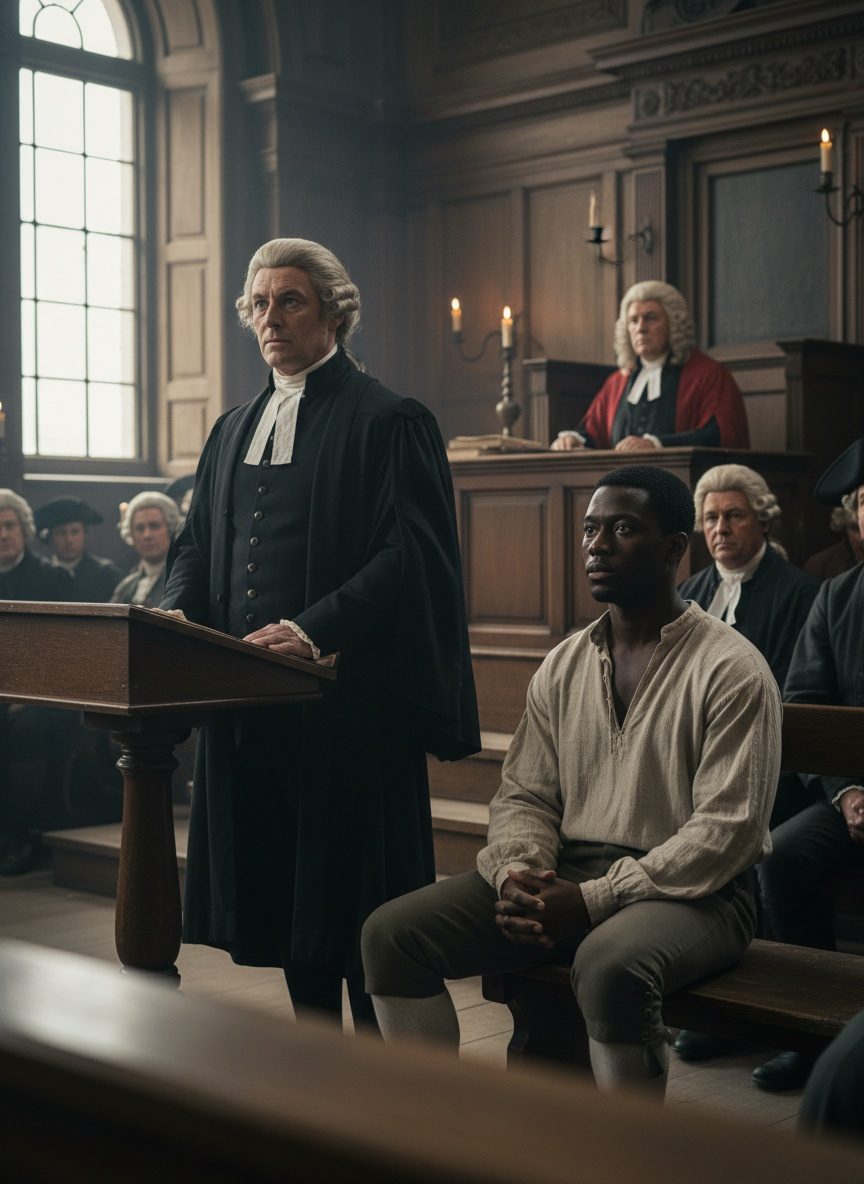
The heavy oak door creaked open as James Somerset, his wrists chafed by chains, shuffled into the dimly lit courtroom. The air was thick with tension, as all eyes zeroed in on this pivotal scene unfolding in the heart of London, 1772. Somerset's heart thudded in his chest, a rhythm echoed by those gathered to witness what they hoped would be a momentous turning point in the struggle for human dignity. Granville Sharp, the resolute English lawyer who had spent countless restless nights preparing for this moment, stood poised, ready to challenge the very foundations of a society reliant on the chains now weighing Somerset down.
At that time, Somerset was not merely a man; he was the embodiment of an idea restrained by the steel grip of history. He was a Black man transported from the New World, his life reduced to the property owned by Charles Stewart, an affluent merchant. Yet, in this room, it was not just Somerset's liberty hanging in the balance, but the very notion of freedom itself — a concept sharp enough to pierce the conscience of an empire spanning continents.
The presiding judge, Lord Chief Justice Mansfield, carried the weighty mantle of British law on his shoulders as he entered the room. His presence imposed a solemn serenity, one that contrasted sharply with the electric mix of hope and anxiety swirling through the chamber. Mansfield's reputation was that of a logical and cautious jurist, a man versed in the intricacies of commercial law but now thrust into a moral quandary that transcended his usual realm.
As the proceedings began, the arguments were laid bare. Granville Sharp's voice, filled with an unyielding resolve, probed the legal and ethical underpinnings of slavery. His arguments resounded beyond mere legal technicalities, tapping into the growing unease with the institution of slavery even among those who’d prospered under its dark auspices. It was a battle of ideology, locked in the trappings of procedure and precedent, yet Sharp’s passion lit up the discourse, injecting life into dusty legal scrolls with the vitality of modern human rights discourse.
Lord Mansfield cast a discerning gaze over the proceedings, aware that his ruling would ripple far beyond Somerset or even across Britain itself. The crux of the case not only married legality with morality but also questioned the very essence of humanity's right to freedom. Could the law, with its rigid formalities, truly condemn a man to live as less than human? Could one nation’s soil serve as the final sanctuary for a people’s inherent rights? These were the questions Mansfield had to weigh, with a gavel that seemed infinitely heavier for the decision it awaited.
The decision came as a legal earthquake, shaking to its core an establishment hitherto accustomed to the opulent comforts maintained by the suffering of others. Lord Mansfield pronounced that no master could forcibly carry a slave out of England, thrusting a quill through the fabric of an institution threadbare of compassion. Though he stopped short of attacking slavery in totality, his verdict was a crack in the edifice, a fissure through which the light of freedom might further creep into the shadows of exploitation.
News of the ruling coursed through London’s cobbled streets, carried on the words of innkeepers, merchants, and ordinary citizens swelling with whispers of change. For thousands, this was a moment of rebirth. Enslaved individuals residing in England glimpsed the light of an existence unshackled, even if just symbolically for now. It was a victory that, while incomplete, allowed for an inward reflection across the Atlantic and beyond, prodding other societies to question the morality of the foundations upon which they stood.
The decision reverberated throughout the Americas, where slaveholders watched from across the ocean, aware that the waves of reform would inevitably crash upon their shores. Somerset's case set a precedent that fed a burgeoning dialogue, one that would fuel abolitionist fervor and eventually ignite the fires of emancipation movements worldwide. The courtroom had become more than a stage of legal strategy; it had transformed into a crucible where the ideal of liberty was reforged, stronger and unyielding.
This episode is scarcely mentioned in conventional textbooks, yet its echoes have sculpted societal landscapes long since Somerset and his brave legal ally faced Lord Mansfield. It's a history soaked in tenacity and conscience, illustrative of the power individuals have to contest the seemingly unassailable. Through the depth of their character and the precision of their cause, Sharp and Mansfield demonstrated that even centuries-old institutions could not withstand the onslaught of collective humanity’s drive toward justice.
As we reflect on the Somerset case, it's crucial to recognize the depths of its impact and the enduring struggle entwined with it. For every moment like this, in the quietude of chambers far removed from public eyes, history shifts on a fulcrum crafted from courage and conviction. It should remind us, ever abruptly, that liberty is an ever-evolving voyage, one contingent as much on present actions as it is informed by past victories. An understanding of moments like these compels us to continue the journey toward a freer, more equitable world for all.