Few figures are as revered in Indian history as Lakshmi Bai. Yet, many don't realize the audacity and defiance that marked her final act of resistance.
The Queen Who Would Not Yield
It was June 1858, and the skies over northern India hung heavy with the dust of rebellion. The Indian Rebellion of 1857, a series of loosely coordinated uprisings against British East India Company rule, had reached a fever pitch. Intrinsically tied to this struggle was Lakshmi Bai, the Rani of Jhansi, whose name sparked fear and admiration alike. Her kingdom had been reduced to a precarious seat of resistance, her enemies closing in as she stood ready to engrave her legacy in history.
Lakshmi Bai's story unfolds with the annexation policies of the British, their tentacles stretching across princely states like suffocating vines. The Doctrine of Lapse, an insidious policy, decreed that any princely state without a biological male heir would be annexed. Jhansi was one such victim, and despite having adopted a son, Lakshmi Bai found her kingdom seized following her husband’s death. But instead of resigning to this fate, she transformed into the visage of resolve and resistance. As colonial troops bore down on Jhansi, she mustered her forces, training and rallying her people—not just to defend her lands, but to strike a blow against injustice.
The Rani's reputation preceded her; tales of her courage were whispered in hushed conversations along the Ganges. With a tactical mind and a spirit unyielding even under siege, she led the defense of her fort with valor that would have inspired myths. Yet, as the rebellion waned and the British tightened their grip, Lakshmi Bai found herself facing the convergence of her foes once more. Her kingdom lost, she chose to carve a final stance into the chronicles of defiance outside the walls of Gwalior.
The Ride into Legend
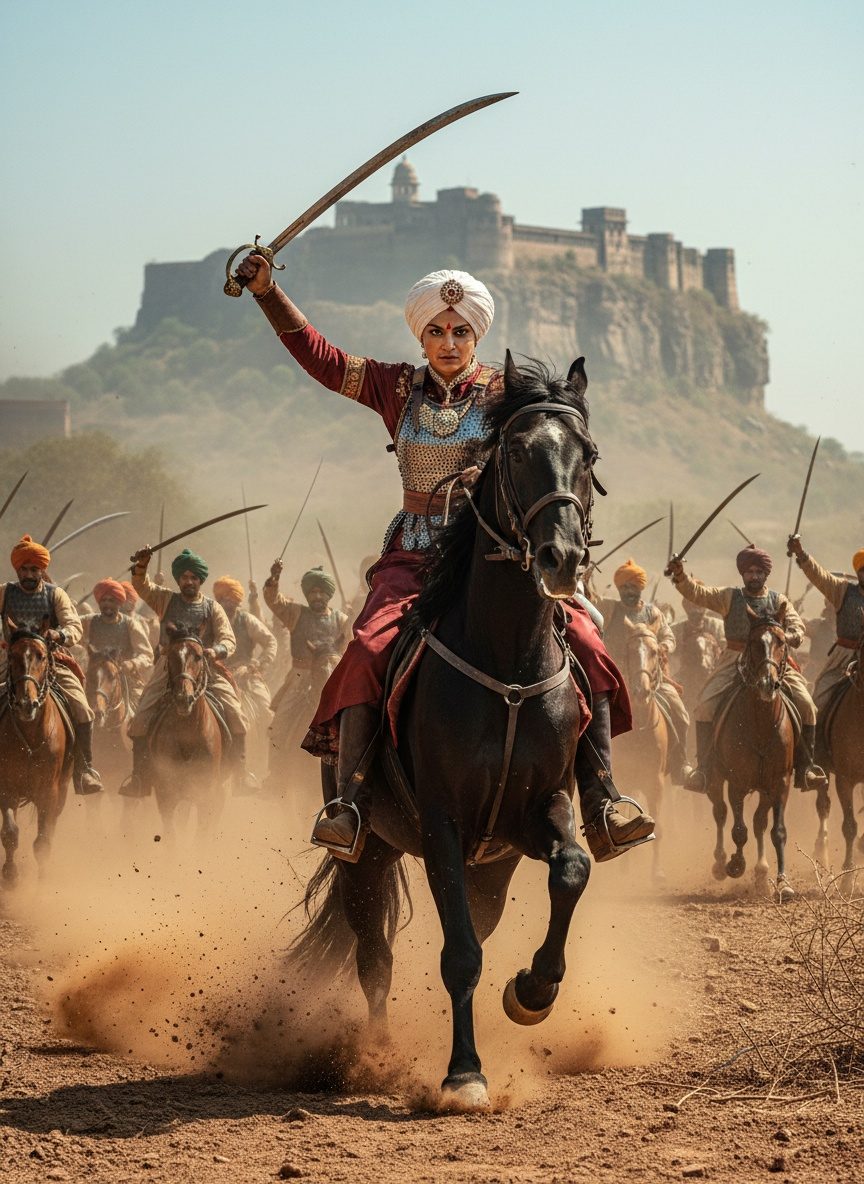
On the battlefield, the sun-baked earth trembled beneath the cannonades, echoing the determined heart of the Rani who rode forth with grand resolve. A vision of astounding bravery, she donned her armor, a glint of steel drawing a line across the dusty horizon. Lakshmi Bai exemplified the poet's words—her head unbowed, her spirit unfettered by the restraints of a colonizer’s aggression. Her son strapped securely to her back, she commanded her steed with a purpose that made even the most battle-hardened soldiers question the cost of their allegiance to the distant Queen of England.
Against the disciplined ranks of redcoats, her solitary charge was not merely an act of war but a declaration. Her sword, a gleaming challenge, carved the air as she cleaved towards Gwalior, where the guns awaited her. Witnesses recount the symphony of chaos—a lone warrior silhouetted against a backdrop of smoke and carnage, becoming both force and fury as she broke through station and stratagems, her presence as much wildfire as flesh.
The British were taken aback; the sight of a woman leading troops was unprecedented, confronting their own notions of warfare and valor. Sir Hugh Rose, the British General who squared off against her, declared her their "most dangerous" foe. When she fell, it was in a flurry of combat, her blade ever unsheathed, as indelible as her spirit on her country’s history. Her loss was felt in tremors across the hearts of those who dared to rise, a blaze quenched but not extinguished by their grief.
The Lasting Embers of Defiance
In the heart of a reclaimed Gwalior, the dust settled over a battlefield that had become her pyre—a solemn tribute to a queen who, even in death, defied the world's attempt to relegate her courage to shadows. Lakshmi Bai did not fight for glory; she fought for dignity, for the indomitable right to cast one’s own destiny. Her legacy, drawn more vividly in India’s annals than any British scribe cared to retell, speaks not only of a life heightened by resistance but of a resonant call to arms that transcends the boundaries of time and empire.
To many, Lakshmi Bai became emblematic of resistance, a symbol of India’s pulse against subjugation. Her story, a tapestry of courage and sacrifice, left footprints in the sands of time that continue to evoke reverence and reflection. On these battlefields, where the clash between an imperial power and those who would not be conquered reverberated, she sowed seeds of an undying spirit that has time and again risen to greet dawn's new challenges.
Today, the image of Lakshmi Bai stands not just as a relic of a bygone rebellion but as an enduring inspiration. In a world still grappling with questions of power, identity, and autonomy, her story ignites the imagination, compelling us to consider what it truly means to stand unflinchingly against overwhelming odds. The dust at Gwalior, mingled with echoes of her name, carries her legacy forward—illustrating the kind of courage that textbooks may omit but history will never forget.