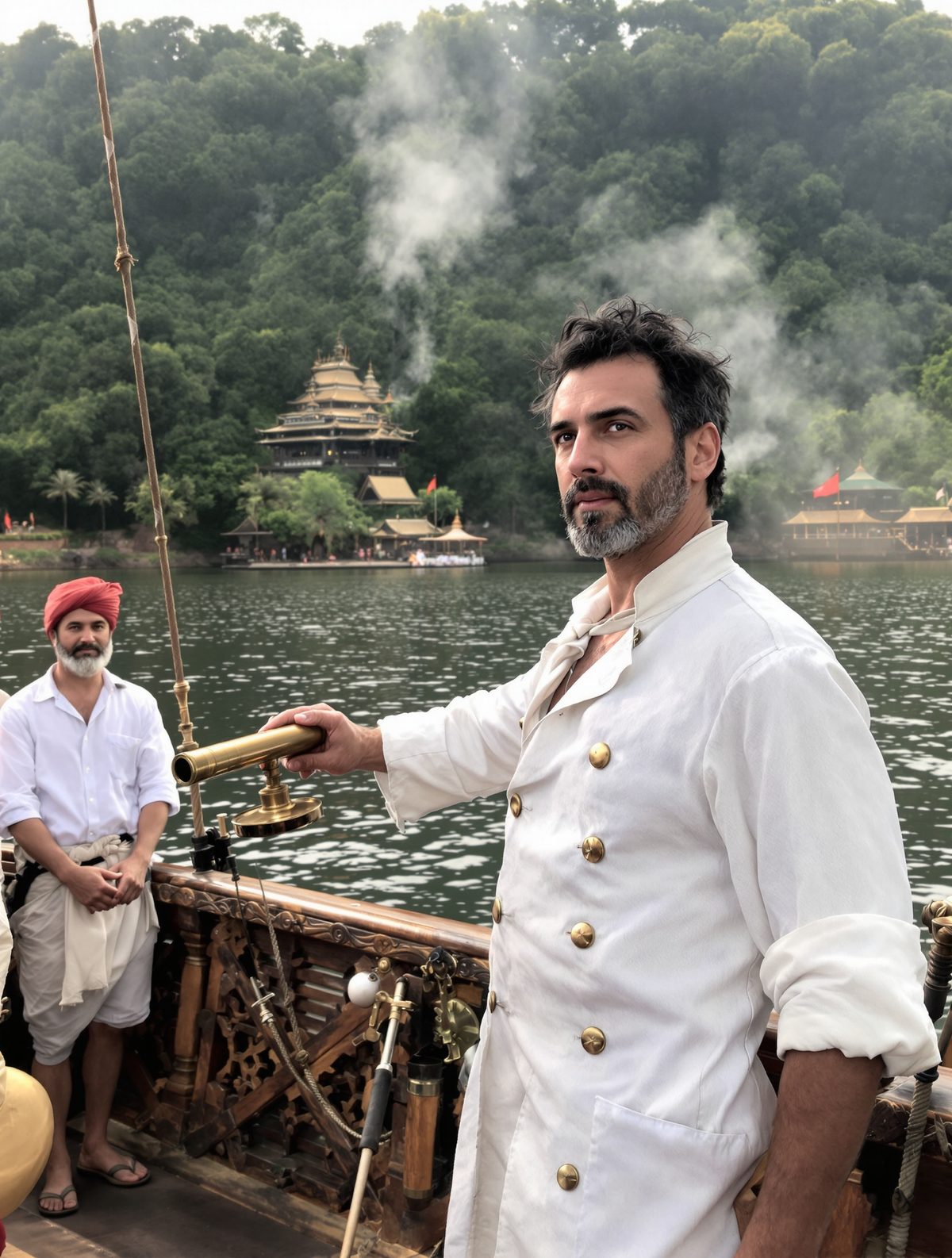
In 1841, against the majestic backdrop of the tangled jungles and swirling rivers of Borneo, a ship cut through the water like a wanderer with a purpose. Its prow slicing the surf, it carried not a conquering army but a single man with a vision yet unyielded to history. This man was James Brooke, an adventurer with a twinkle in his eye and the weight of the Victorian Age's restless spirit in his heart. What was about to unfold led to one of the unlikeliest tales of empire — the saga of the White Rajah of Sarawak.
The Winds of Fortune
The year was 1839 when Brooke set sail for Borneo aboard the schooner Royalist. A former officer of the British East India Company, Brooke was at that time nothing more than a merchant adventurer, possessing ambition as vast as the seas he traversed. Born in 1803 in India, he was raised in Bath, England, where tales of grandeur whispered through his childhood, urging him toward the exotic.
As he arrived at the chaotic village of Kuching, capital of the Sultanate of Brunei, he discovered a land on the brink. The Sultanate was wrought with internal conflict; tribes clashed under the sultan's tenuous grip, threatening to unravel his domain. With an instinct for opportunity, Brooke saw not chaos but an opening — an unexpected path to power.
A Rebel’s Crossroad
The Maharaja of Sarawak, Pengiran Indera Mahkota, struggled against a raucous insurgency. Datu Patinggi Ali and his allies resisted against what they saw as oppressive rulers, their cries echoing through the dense foliage. Sultan Omar Ali Saifuddin II found himself unable to quell the unrest alone. Enter Brooke, the stranger with a proposition.
With a combination of diplomacy and armed prowess of just a single ship, Brooke devised a strategy in which cunning and courage interplayed with local politics. His endeavors to suppress the resistance were swift and effective, earning him an unlikely alliance. The Sultan, seeing potential in Brooke’s approach, turned an exceptional idea over and again in his mind — to grant not merely land but governance to this foreign ally. With a stroke of a quill, Brooke became the Rajah of Sarawak, marking December 24, 1841, as the date when an Englishman was granted dominion over a kingdom.
Ruling by Inspiration
James Brooke adopted his new role not as a conqueror but as an idealist determined to rule effectively. His reign of 27 years was characterized by a blend of Western and Eastern mores. Brooke wielded power like a patrician and yet operated largely through the native system, his understanding of local customs admirable to some, suspect to others.
He entrenched himself not just as a leader but as a reformer and architect of Sarawak's transformation. The old hostilities Brooke had inherited were mitigated by his fair laws — a rudimentary justice system that gave local leaders respect and autonomy. His methods were progressive for the time, opposing slavery and piratical activities with a fierce resolve.
Surprisingly, despite being a benefactor to Britain, Brooke resisted British annexation of Sarawak. An empire within an empire, its autonomy remained intact — a string of pearls in an imperial world not yet defined by strings of steel.
Brooke the Legend
While Brooke's rule may seem like the stuff of legends, his legacy wasn’t without complexities. The path was marred by intrigue, as allegations of improprieties and overreach arose both locally and internationally. Admirers pointed to his ennobling missions — educational developments and infrastructural growth. Critics, however, scrutinized his sometimes authoritarian grasp and the legacy of the 'kutching' boys, young Malay and Dayak men he recruited, sparking controversy far beyond Sarawak's shores.
Yet, Brooke's influence flowed beyond mere governance. His connection with local chieftains, such as Pangiran Anak Abdul Wahab and the fabled warriors of the Iban people, imbued tales of mutual respect and cross-cultural bonds. The White Rajah's court in Kuching became a tiny melting pot where values and visions from differing worlds mingled.
The Legacy’s Embers
James Brooke passed away in 1868, leaving Sarawak a region of relative peace in an otherwise tumultuous island. His legacy was perpetuated by his nephew Charles Brooke, who continued the Brooke Dynasty, each succeeding Rajah painting new strokes on the canvas James began.
Today, Brooke is remembered as a woodcut against the historical silhouette of British imperial aspiration — an example of personal empire-building in an age of sprawling dominions. His story resonates as a unique narrative of globalization's early actors and a precursor to modern debates about local governance versus external influence.
Why Does This Matter?
In an age torn between international diplomacy and neo-colonial undertones, the tale of James Brooke echoes as a historical case study — a reminder of the complex layers of leadership, cultural interplay, and seemingly paradoxical legacies left by renowned figures. Brooke's story offers us conscious introspection on the allure of power, the power of the individual in shaping history, and the moral complexities entangled within.
In the dense jungles of Borneo lay the path not just for men like Brooke, but for understanding the paradoxes of human endeavor and empire that weave through history in shades of gray. His adventure as the White Rajah leaves us questioning, ever so subtly, what it means to rule, to be ruled, and the narratives we craft in-between.