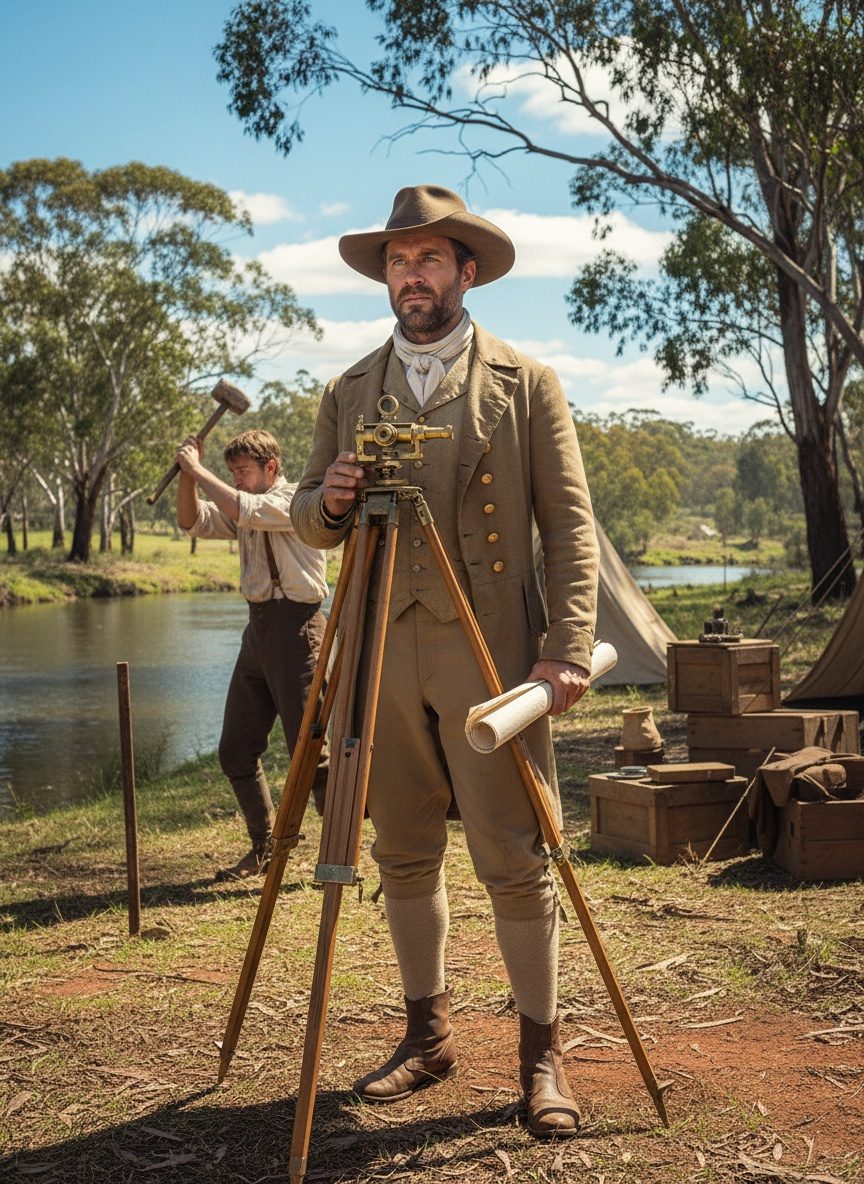
The rough-hewn bark of an ancient gum creaked ominously as Robert Hoddle thrust his surveying pole into the tangling underbrush of Port Phillip Bay, the seemingly infinite wilderness of early colonial Australia. The sun was blistering overhead, casting harsh shadows across the dusty landscape and etching the opening acts of a new world — a new city — onto the land. With each deliberate step, the swishing of tall grasses resounded against the solitary rhythm of his heart, each beat a testament to the audacity of planning a metropolis from nothing more than raw earth and ambition.
It was 1836, and the air was thick with the scent of eucalypt and the promise of change. Just a year prior, John Batman, an enterprising pioneer, had forged an unlikely pact with the Wurundjeri people, laying ancestral lands open to an uncertain future. His vision was grand, but it was Hoddle who now stood with compass in hand, tasked with transforming Batman's dreams into definitive lines drawn amidst the wild untamed bush.
The creek gurgled serenely, oblivious to the historical tapestry being woven upon its banks. Hoddle squinted, envisioning the regimented order of civilized society where wild nature sprawled before him. This was a land of paradoxes: an ancient terrain newly christened, where kangaroo tracks would soon cede to cobbled streets, and the quiet night calls of the bush would be joined by the hum of city life.
Hoddle’s surveying was rigorous, the precision ingrained from years of training in a burgeoning empire determined to replicate its authority across the globe. The Colonial Office’s instructions were clear and uncompromising, echoing the strategic grid patterns favoured in cities like New York and Philadelphia. As he crisscrossed the land, laying chains and pegs, the sharp angles of his grid began to form the city of Melbourne, though at this time, little more than an ambitious idea moored in the unsettled minds of a pioneering few.
These early days were marked by tension between visionaries, each keen to shape the fledgling colony in their image. John Batman’s discovery and negotiation had been controversial. His bold claim over 600,000 acres invited the scrutiny of government officials and settlers alike, who questioned the legality and morality of such transactions. Yet it was Hoddle whose methodical calculations would etch a permanent footprint into the land of the Kulin nation, the complex weave of disputes temporarily set aside as lines on a map sketched a future metropolis.
His camp was a fragile refuge amidst the enveloping silence, where crackling fires warded off the chill of night. Around such flickering flames, stories spun of England and the generations who would follow, enriching this soil with commerce and culture. The dispossession of the Wurundjeri, however, hung over these tales like a spectral presence, a reality that would carve deep divides into the soul of the emerging settlement.
Melbourne’s streets, etched with the assured precision of Hoddle’s hand, invited a flood of migrants drawn by whispers of prosperity. The disciplined grid fashioned by his vision accommodated ambition, with its wide avenues and ample allotments. His plan outpaced its earliest critics, predicting the rise of a grand city that would serve as the linchpin of trade and politics in the burgeoning Australian colonies. It demonstrated the balance between impassioned human yearning and pragmatic engineering, each intersection a nexus of possibility.
Yet, Hoddle himself noted the challenges of marrying raw landscape with refined intent. His was a city founded upon potential rather than pretense; where squatters once grabbed at open fields, cultivated spaces now sprawled, and nascent industry edged against pastoral tranquility. From this dynamic tension emerged Melbourne, nt immediate grandeur but enduring tenacity.
Amidst the encroaching bustle, diverse populations stitched together the cultural fabric of a new city. It was a mosaic of desiring voices: convicts yearning for redemption, immigrants dreaming of opportunity, and indigenous peoples grappling with displacement. Hoddle’s gridlines, initially marks in the soil, transformed into thoroughfares of thriving enterprise, where wagons trundled and traders bartered beneath the Australian sun.
The foundation of Melbourne is not merely a tale of city planning; it epitomizes the confrontation between colonial ambition and colonial consequence. As Hoddle’s vision unfurled, Australia’s narrative unfurled alongside it, enduring through the dual legacy of innovation and inequity. Even now, the streets bear silent witness to the complexities of history, threading stories both told and untold through their very cobblestones.
The work of Robert Hoddle invites reflection on the deceptive simplicity of straight lines amid the chaos of reality. His is a story of creation and transformation, of land both claimed and contested. In the tales of early Melbourne, the traces of surveying lines continue to echo, urging us to consider the possibilities and perils inherent in creating something entirely new. As the sun sets in hues of orange over the skyline it birthed, the whispers of its foundations remind us of the enduring interplay between the dreams we dream and the actions we take to realize them.