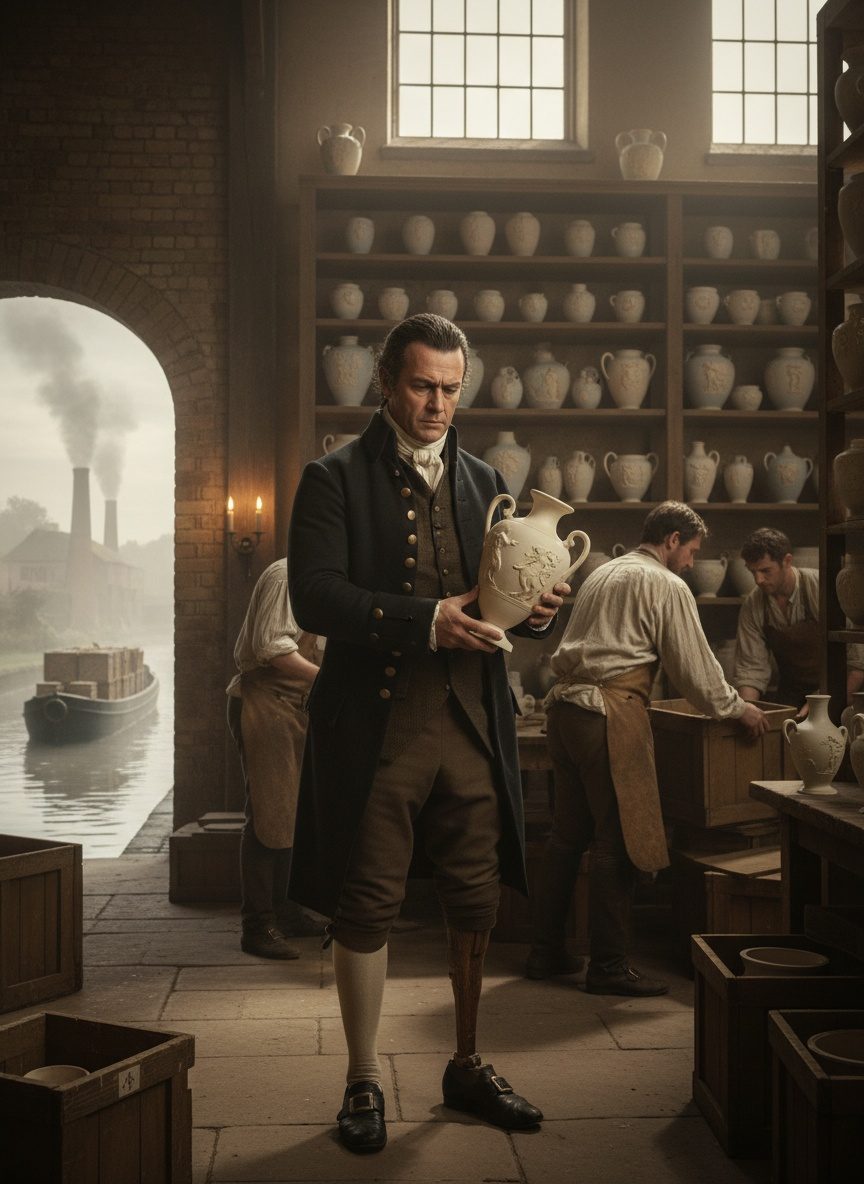
Picture this: it's the summer of 1765, and a one-legged potter with more ambition than clay sits amid the rolling hills of Staffordshire. His name is Josiah Wedgwood, and he's studying a map that might just contain the secret to Britain's future. Where others see land and water, Wedgwood sees opportunity. Little did anyone know, this audacious craftsman was about to lay the groundwork for a commercial revolution. Welcome to the forgotten story of how a brittle piece of china and a fearless dream forever changed British trade.
The Potter's Quandary
In the mid-18th century, the roads of England were at best unreliable and at worst treacherous. For Josiah Wedgwood, whose spotless and fragile china was prone to cracking and chipping in transit, this was a nearly insurmountable problem. The journey from his pottery works in Staffordshire to the bustling markets of London was fraught with obstacles, turning commerce into a game of chance. A pothole could wipe out an entire shipment and an entire month's work.
Determined not to let the imperfect infrastructure stunt his ambitious output, Wedgwood sought alternatives. Picture him, intrepid and determined, charting out ideas with the single-mindedness for which he would become known. The solution he arrived at seemed improbable to many at the time: water transportation. By leveraging Britain's network of natural waterways, he believed he could more safely and efficiently get his products to market. Yet the rivers alone wouldn’t suffice. What Britain needed was an expanded system of canals.
Parliament and Potholes
In 1765, Wedgwood did what few potters would ever dream of: he entered the world of politics and lobbying. He was instrumental in bringing together a consortium of businessmen and landowners, effectively transforming competitors into allies for the shared goal of canal construction. Among them was the Duke of Bridgewater, whose own successful canal just northwest of Manchester had set a promising precedent.
By summer of 1766, Wedgwood and his allies presented their case in Parliament with the deftness of seasoned statesmen, urging approval for the construction of the Trent and Mersey Canal, also playfully dubbed the "Grand Trunk Canal." The proposal was far-reaching. At 93 miles long and with 76 locks to manage a rise of 500 feet, this canal would connect the River Trent at Derwent Mouth in Derbyshire to the River Mersey on the outskirts of Liverpool.
The audacity of the plan, along with Wedgwood’s fervor, paid off. Parliament sanctioned the project, not because a potter wanted his wares delivered unscathed, but because the canal promised vast economic benefits to the nation. The canal was set to unlock trade opportunities beyond even Wedgwood’s rosy forecasts. Indeed, Britain's burgeoning Industrial Revolution relied on just such infrastructural innovations.
Etruria: A Kingdom by the Canal
Realizing the dream required more than routes and political finesse. Josiah's next stroke of genius was founding Etruria in 1769, named after the ancient Etruscan civilization renowned for its pottery. Constructed right beside the newly authorized canal, this factory-city became a utopia for industrial activity and worker welfare alike.
Seldom do we learn how Wedgwood not only built a factory but a community, with worker housing, shops, and schools enveloping the site. Etruria was as much an innovation in social planning as it was in manufacturing. There even stands a report suggesting the Etruria works could produce a startling 500,000 pottery pieces per year, a number that astonished contemporaries and still captures the imagination today.
Ceramic to Commodity
With the advent of the canal, Wedgwood’s exquisite ceramic ware made its way to London, opening up an entire palette of markets previously out of reach. By 1773, Wedgwood had displayed his wares to none other than Queen Charlotte, earning his titles of "Potter to Her Majesty" and a subsequent flood of orders from the British elite. Wedgwood china became a status symbol not just at home, but globally in short order, thanks in no small part to the ease with which canals made shipping across oceans feasible.
Canals became the circulatory system of the industrializing nation, vital arteries through which the lifeblood of commerce flowed. The Trent and Mersey Canal was often called the start of the "Canal Mania" period, which spurred the construction of some 4,000 miles of canals by 1830 across Britain.
The Ripple Effect Across History
The legacy of Wedgwood, the Trent and Mersey Canal, and Etruria remain etched upon the landscape of British history. This bold endeavor not only enabled a single potter to reshape his destiny; it spearheaded Britain's evolution into a modern economic powerhouse. Wedgwood demonstrated how one man's pursuit of a better, safer path to market could set into motion transcendent shifts in transport, trade, and industrialization.
Today, as we navigate our own global supply chains, Wedgwood’s foresight serves as a poignant reminder that innovation often sits at the intersection of necessity and vision. In rethinking how we move goods and services, his enduring legacy challenges us to innovate and aspire just as boldly in our pursuit of progress. Who could imagine just how much a single canal could change the flow of history?