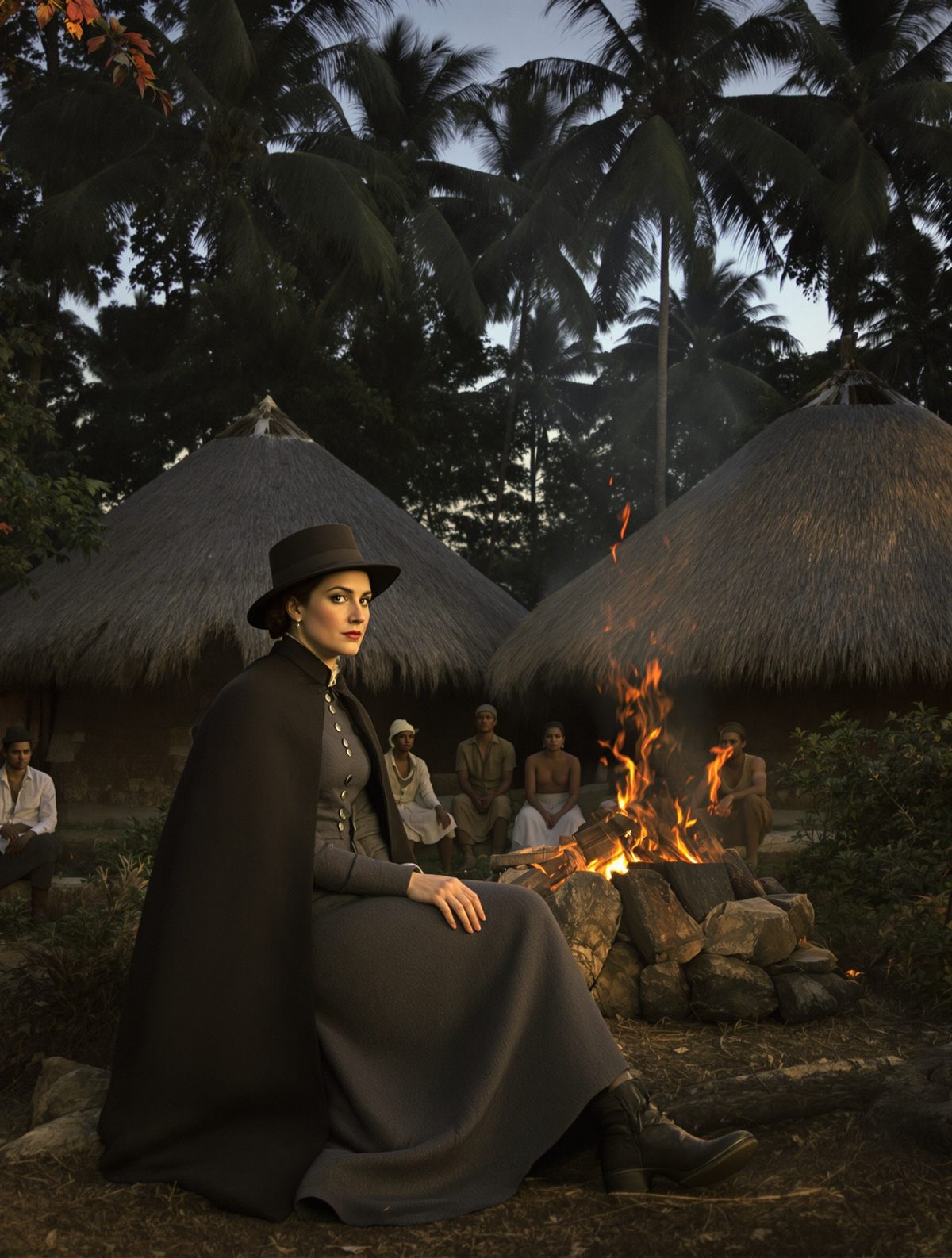
The drums had fallen silent. In the suffocating heat of a Calabar evening in 1888, two newborn infants lay in a crude basket, their tiny chests rising and falling with innocent breath. Around them, the Efik elders stood in a tight circle, their faces carved from stone and tradition. The babies' crime was simple: they had been born together. Their sentence was death.
Into this circle stepped a red-haired Scottish woman barely five feet tall, her calloused hands still bearing the scars of fourteen years working the jute mills of Dundee. Mary Mitchell Slessor had no army behind her, no colonial authority at her back, no weapon save her unwavering conviction. What happened next would echo through the fever swamps of West Africa for generations to come.
The Devil's Bargain of the Twin Curse
To understand the magnitude of Mary Slessor's intervention, one must first grasp the iron grip that the twin taboo held over Efik society. For centuries, the birth of twins had been considered an abomination—a sign that evil spirits had infiltrated the womb. The Efik people believed that no mortal man could father two children simultaneously; therefore, twins could only be the offspring of demons.
The ritual that followed twin births was as swift as it was merciless. The infants would be placed in earthenware pots and left to die in the evil forest—the ndem ufok—where spirits were said to roam. The mother, considered cursed and contaminated, faced exile or death. Her husband could abandon her without consequence, taking their other children and leaving her with nothing but shame and superstition's bitter judgment.
The British colonial authorities, established in the region since the 1840s, had outlawed the practice on paper. But in the dense mangrove swamps and isolated villages of the Cross River region, paper meant little. Traditional law ran deeper than any foreign decree, and the Efik chiefs maintained their authority through a complex web of secret societies and ancestral obligations that stretched back centuries.
The Mill Girl Who Walked Into Darkness
Mary Slessor's journey to this moment had begun not in missionary school or comfortable parsonage, but in the grinding poverty of industrial Scotland. Born in 1848 in the tenements of Aberdeen, she had been thrust into factory work at age eleven when her alcoholic father abandoned the family. For fourteen brutal years, she worked twelve-hour shifts in the Baxter Brothers' jute mill, her small fingers flying over the dangerous machinery that claimed limbs and lives with casual regularity.
Yet in the brief hours between exhaustion and sleep, young Mary devoured accounts of missionary work in Africa. When David Livingstone died in 1873, she felt what she later described as "a hand upon my shoulder." At twenty-seven, she abandoned the only security she had ever known and sailed for Calabar with the United Presbyterian Church Mission.
What she found in West Africa would have broken a lesser spirit. The mission station at Duke Town was a small island of European order surrounded by practices that seemed to mock every Christian principle. Beyond the twin killings, she witnessed trial by ordeal with boiling oil, human sacrifice at chiefs' funerals, and the casual brutality of a slave-trading society only recently forced to abandon its most profitable enterprise.
The Night That Changed Everything
The confrontation that would define Slessor's legacy began with a message that arrived at her mission station on a rain-soaked evening in late 1888. A woman in the nearby village of Okoyong had given birth to twins. The chiefs were preparing the death ritual. Mary had perhaps two hours before the infants would be beyond saving.
She set out immediately through the treacherous swampland, following palm oil-slicked paths that could swallow an unwary traveler whole. Local Christians had begged her not to go—the chiefs had made clear that interference with their customs would not be tolerated, even from the white woman who had earned grudging respect for her medical work.
When she arrived at the village, the scene was already set for execution. The twin boys, born perhaps six hours earlier, lay in the ceremonial pot while the mother crouched nearby, her head shaved and her body smeared with white chalk—the markings of the condemned. The assembled crowd of perhaps fifty villagers watched in tense silence as their spiritual leaders prepared to fulfill ancient obligations.
Without hesitation, Mary Slessor walked into the center of the circle and lifted both infants from their earthenware coffin. The crowd's intake of breath was audible—no one, not even colonial officials, had ever dared such direct interference with the sacred ritual.
"These Children Live Under British Protection Now"
What followed was perhaps the most crucial conversation in the history of Efik-European relations. Speaking fluent Efik—she had mastered the language within two years of her arrival—Slessor addressed the chiefs directly. Her words, recorded years later by the missionary Thomas Lewis, were simple but revolutionary: "These children live under British protection now. Any harm that comes to them will be answered by the government in Calabar."
It was a magnificent bluff. Slessor had no authority to speak for the British government, no promise of military support, no legal standing beyond her position as a missionary. But she delivered the words with such conviction that even she seemed to believe them. Her hands, witnesses later recalled, trembled as she held the infants against her chest. But her voice never wavered.
The chief priest, a man named Edem who had presided over dozens of twin executions, stepped forward. The crowd held its breath. In that moment, centuries of tradition hung in the balance against the unwavering will of a Scottish mill girl who had already sacrificed everything for her convictions.
For nearly an hour, the debate raged in rapid Efik. Slessor argued not just from Christian principle, but from Efik concepts of justice and protection. She invoked the authority of Okon, the supreme deity, and challenged the priests to show her where in traditional law it was written that twins must die. She spoke of the British desire for friendship with the Efik people, and how twin killing endangered that relationship.
Finally, as the first light of dawn began to penetrate the forest canopy, Chief Edem raised his hand for silence. "The white woman may take them," he declared. "But the mother is still cursed. She cannot remain here."
Building a New World from Broken Pieces
What Mary Slessor achieved that night was only the beginning. Over the following decades, she would rescue dozens of twin children, creating what amounted to an informal orphanage at her mission station. She adopted many of them herself—by the time of her death in 1915, she was caring for eleven children she considered her own sons and daughters.
But more significantly, her confrontation with the chiefs had created a precedent that gradually undermined the entire structure of twin murder in the region. Word of the incident spread through the intricate network of Efik trade relationships. Other missionaries, emboldened by her example, began their own interventions. Traditional rulers, faced with the reality of British support for the twin rescue efforts, began to quietly allow the practice to lapse.
Slessor herself evolved from missionary to unofficial magistrate, becoming the first woman to serve as a British vice-consul anywhere in the world. The Colonial Office, recognizing her unique authority among the Efik people, granted her legal powers that allowed her to formalize her protection of twins and their mothers. By 1910, twin murder had virtually disappeared from the Cross River region.
The Legend They Left Out
Today, Mary Slessor's face graces the ten-pound note issued by the Clydesdale Bank, but her story remains largely unknown beyond Scotland and Nigeria. Her confrontation with the Efik chiefs represented something far more complex than simple colonial intervention—it was a moment when personal conviction transcended cultural boundaries and created space for genuine transformation.
The children she saved that night in 1888 grew up to become teachers, traders, and community leaders. Their descendants today number in the thousands throughout southeastern Nigeria. They carry with them not just the gift of life, but the memory of a woman who believed that some principles transcended cultural difference—that the innocent deserved protection regardless of the traditions that condemned them.
In our own era of cultural conflict and moral uncertainty, Mary Slessor's legacy poses uncomfortable questions. When does respect for tradition become complicity in cruelty? How do we balance cultural sensitivity with human rights? And perhaps most challenging: would we have the courage to stand alone in the circle, to pick up the condemned children, and face down centuries of belief with nothing but our own shaking hands and unwavering voice?