He was a surgeon, not a soldier. Neville Howse saved a life under fire with nothing but his hands and courage.
A Surgeon with the Heart of a Hero
The Anglo-Boer War, or simply the Boer War, was a conflict that tested everyone involved—not just the professional soldiers but also those who were initially seen as auxiliary personnel. Born in England and moving to Australia when he was young, Captain Neville Howse was a man who found himself thrown into the tumultuous battlefields of South Africa in 1900. Though trained as a surgeon, his actions would soon prove that he was much more than a medical practitioner. In the otherwise conventional roles expected of him, clarity of purpose and unfaltering bravery would transform him into a living legend.
As skirmishes erupted through the hills and fields of South Africa, the countryside became a dangerously unpredictable landscape. Bursts of rifle fire punctuated the arid air, creating a constant state of alarm. Officers debated strategies and shifted responsibility as failures mounted and frustrations grew. Amidst the cacophony of blame, orders became nothing but echoes fading into chaos. Yet while the air was loud with confusion, a hauntingly clear vision formed in one man’s mind—a vision of duty manifesting as action rather than words.
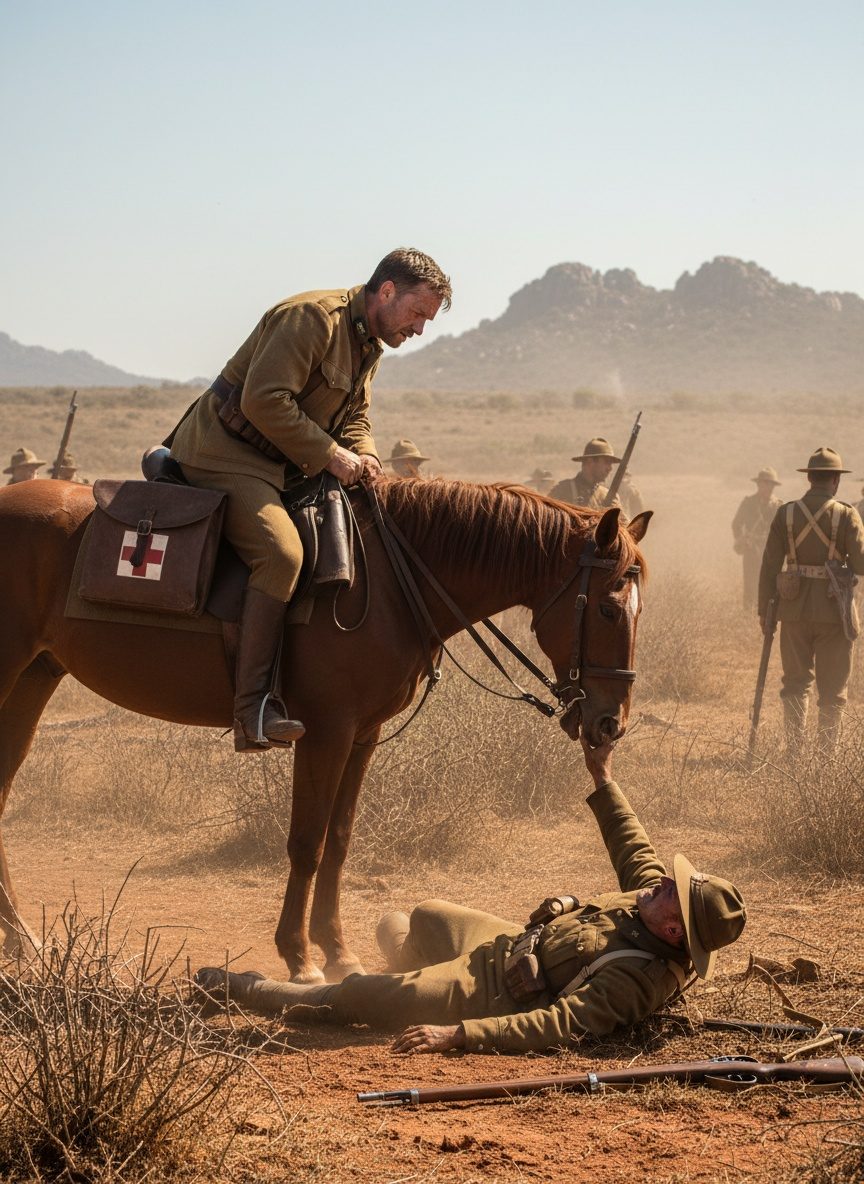
In a defining moment that would etch his name into the annals of bravery, Captain Howse made a decision that was as unorthodox as it was audacious. Seeing a wounded trooper lying in the open, mercilessly exposed to enemy fire, Howse mounted his horse and rode directly into the line of fire. The grassy fields provided no cover, only a green canvas for death’s hand to paint its somber hues. Yet there he was, defying logic and every instinct for self-preservation, charging forward without hesitation.
The Defiant Charge
The act of pulling a wounded man to safety is not just a feat of physical strength; it requires a superhuman measure of resolve, especially when bullets carve scorching paths around you. Witnesses to this act would later find it difficult to describe the strange alchemy of anxiety and awe that filled them. There was nothing rash or glory-seeking about Howse’s actions; he was singularly focused, as if driven by an invisible force that only some deeply understand—a refusal to let death decree the fate of a fellow soldier under his watch.
Drawing nearer to the fallen man, Howse was acutely aware that his medical skills had primed him for this moment more than any battle strategy ever could. A patient must be saved, and what better encapsulation of his life's mission was there? The odds were dire, yet that didn’t deter him. Not only did he reach the wounded man, but he also assessed his conditions swiftly, knowing that time was both enemy and ally here. In a turbulent maelstrom of adversity, he exemplified a lesson many would do well to adapt: The courage to act often relies heavily on the simplicity of intention.
Once beside the wounded trooper, Howse stoically ignored the whiz of bullets overhead and the growing shouts behind him. Using sheer force of will and determined muscle, he began the near-exhaustive task of pulling the man to relative safety. Those who watched saw not just a single act of bravery, but a symphony of intent—the tempo dictated by the relentless thudding of rifle fire. Questions about what drove him became moot; what mattered was the truth unfolding before their eyes: a surgeon with the soul of a hero had just profoundly redefined the scope of his duties, altering how courage was measured in the theatre of war.
An Act Beyond the Uniform
The story of Neville Howse in the Boer War transcends the uniform he wore or the rank he held. Achievements in the realm of military actions are often memorialized with epic tales of strategic brilliance or large-scale battles, but here is a reminder that some of history’s biggest acts of courage happen on a smaller stage. After successfully carrying the wounded soldier back to safety, Howse was decorated with the Victoria Cross—the first Australian to receive it—for his unparalleled bravery. Though no orders directed him to that field, and no commanding shout propelled him into action, Howse pursued a calling that went beyond any soldering or medical service. His heart recognized an essential truth: that sometimes, human decency must take precedence over adherence to strict conventional orders.
This moment became emblematic of more than just raw courage under fire; it symbolized the marriage of duty and compassion, of human empathy meeting military need in a rarely seen humanitarian dance. Howse’s act refocused what it meant to be a soldier, particularly against the backdrop of a war remembered for its mix-ups and blunders. While strategy floundered under the weight of institutional failings, acts such as these illuminated the enduring human spirit. It's a lesson echoing through history, stating unequivocally that, more than medals or rank, it’s often the selfless choices made in moments of darkness that leave the most impactful legacies.
As we look back on the chaos and the quiet heroism that marked the Boer War, and indeed many wars after, we are reminded why stories like those of Neville Howse matter. They illustrate that in the relentless grind of battle, where humanity is often tested and sometimes discarded, the power of a single unwavering act can resonate louder than the combined noises of warfare. In an era when divisions delineate power and rank, and where courage is often quantified, Captain Howse reminds us that the noblest form of strength lies simply in doing what must be done when no one else dares.