November 1893. The smoke mingled with the dusty red African earth as it rose into a sky painted in hues of fire and ash.
The Flames of Matabeleland
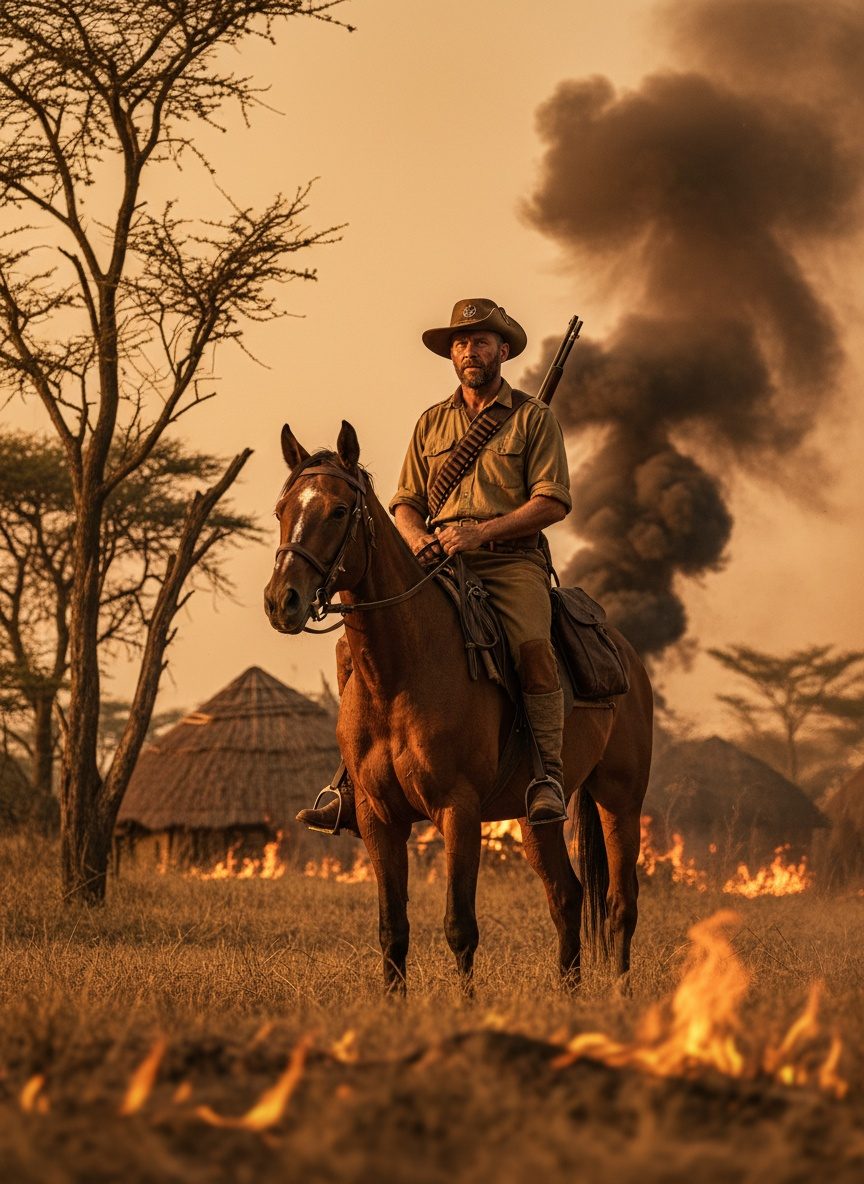
The flames were visible for miles around as the British South Africa Company's column moved tentatively through the harsh terrain of Matabeleland. As the kin of the earth, the Matabele had an intimate knowledge of the land they defended fervently against foreign invaders. The kraals, once vibrant hubs of culture and life, were reduced to pyres, their destruction a defiant act of resistance by the retreating armies of King Lobengula.
Amidst this chaos, Major Patrick Forbes found himself facing a war fought not only over territories but also ideologies. The British quest to expand their empire under the guise of the civilizing mission brought them into conflict with the indigenous kingdoms of Africa. Forbes' column, determined yet beleaguered by inhospitable landscapes and fierce warriors, was at a stalemate. They desperately needed information to tilt the scales in their favor.
A Lone Rider's Mission
Forbes turned to his chief scout, Frederick Burnham, a man whose reputation preceded him. Known for his instincts and uncanny ability to navigate perilous situations, Burnham was the embodiment of the explorer spirit that fueled the Victorian Empire's expansionist ambitions. But this mission required more than courage—it demanded audacity.
Armed with nothing more than a horse, his resourcefulness, and the trust of his commanding officer, Burnham set off alone into the unknown. His objective was simple yet perilous: locate the fleeing King Lobengula and discern the intentions of the fragmented Matabele warriors.
Cloaked by smoke and shadow, Burnham ventured forward, his senses honed to the tumult about him. Behind enemy lines, he saw life amid the wreckage—a testament to the indomitable spirit of the Matabele—a people too proud, too resolute to be crushed by imperious colonizers. Yet Burnham pressed on, a lone figure riding through the embers of a war-torn realm.
The Art of Negotiation
The task before Burnham was daunting. He had to navigate the complex social hierarchies and the simmering tensions that shaped Matabeleland’s intricate network of loyalties. The fear of capture loomed large, but with instinct and tact, he approached scattered Matabele groups. Here, he had to rely not just on language but on the more nuanced dialect of trust.
Burnham's engagement with Matabele leaders was anchored in the delicate art of negotiation—not with force, but with words and gestures that bespoke respect and understanding. His success lay in his ability to discern the sentiments of a people at war. Where lesser men might have seen adversaries, Burnham saw potential allies, wary but open to the possibility of dialogue.
A Report That Changed the War
When Burnham returned to Forbes, he carried more than a report. His mission was a hinge upon which the entire campaign turned. He brought insight into the whereabouts and strategy of the Matabele forces. But more importantly, his interactions had sown the seeds of possibility—opportunities for communication where none had existed before.
This intelligence was pivotal. Armed with a renewed sense of direction and a strategic edge, Forbes' column could finally gain ground. The eventual fall of the Matabele marked a seminal moment, not only in the campaign but in the broader context of the Scramble for Africa. While the British Empire expanded further, the Matabele's resistance would echo as a story of valor against overwhelming odds.
Reflections in the Ashes
The story of Frederick Burnham's mission into the heart of a burning Matabeleland bears more than just military significance. It serves as a window into the complex tapestry of human interaction in colonial contexts, where conflicts were often fraught with misunderstandings and cultural dissonance yet occasionally bridged by individual acts of courage and empathy.
Burnham's ride reminds us of the thin line between heroics and hubris, where the actions of a single person can sway the destinies of many. It challenges the notion of empire, offering a narrative that veers away from the glorification of conquest to spotlight the intricate human stories often overlooked in textbooks. In revisiting the embers of Matabeleland, we find not just an episode of imperial history, but a reflection on the enduring qualities of resilience and understanding in the face of adversity. These lessons, no less relevant today than they were in 1893, compel us to see history as a canvas of intertwined fates and shared humanity.