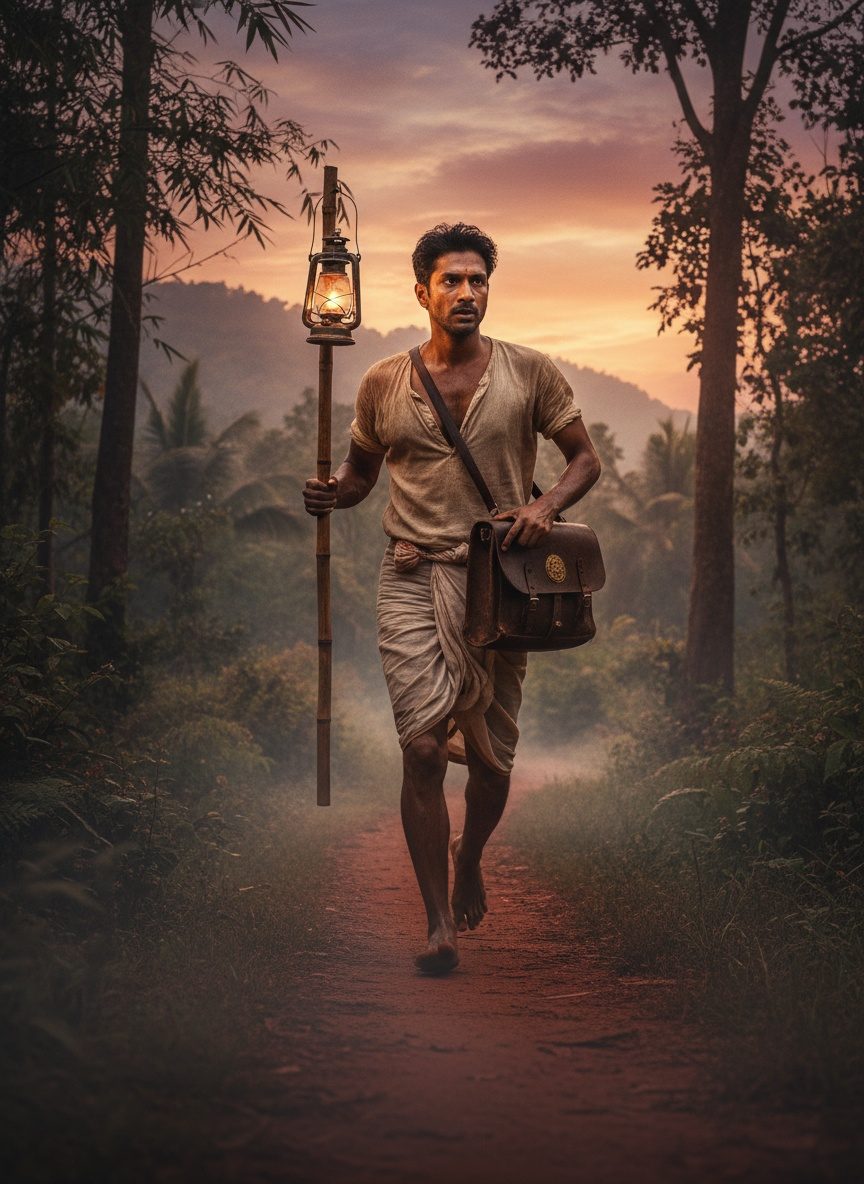
The jungle air lay thick and stifling as the last hints of daylight yielded to the shadows creeping across the landscape. The occasional rustle of leaves whispered secrets of creatures moving unseen, and the call of cicadas echoed under the dense canopy above. It was in this lively setting, a spectacle of nature untouched by time, that a lone figure could be seen, pushing through the humidity and darkness. This man, burdened not by the weight of weaponry but by the empire's trust in a weathered leather satchel, was one of the unseen veins that kept the heart of Victorian India’s colonial machinery beating—an imperial dak runner.
Tasked with carrying vital communications across treacherous landscapes, dak runners were silent champions of a bygone era, often darting through paths marked by more paw prints than footsteps. The British Raj, sprawling and ambitious, stretched across a vastness that often defied the immediacy of the era's nascent telegraphy. Villages and military outposts, perched precariously at civilization's edge, depended on the steady cadence of these runners. The thick forests teemed not only with the moist breath of monsoons but with the feline grace and lethal precision of Bengal tigers, an ever-present reminder of peril on these shadowed trails.
In the 1880s, when India was a mosaic of princely states under the watchful eyes of colonial administrators, communication was not just a method of conveying news; it was the lifeline of the empire. Without roads chiseling paths through rugged terrains or electric wires humming messages across distances, it was upon the sinews and stamina of these runners that the empire functioned. They were entrusted with personal letters, secretive military orders, and administrative documentation—all so crucial that their delivery was a matter of necessity, not convenience.
Each morning, as the sun summoned its burning mantle over the distant hills, a relay of runners would set forth. Despite the simple attire—light tunics and the odd cloth turban—their steps were determined, an unacknowledged marathon of endurance and skill. The distance they covered each day was wide and wild, often extending far beyond the comfort map of those waiting on the other end. Yet, the meeting of these paths and destinies resulted in tales that have since shimmered at the edges of our historical consciousness.
Nightfall, a symphony of chirps and distant howls, brought forth its own set of challenges. As silence blanketed the world, the sense of isolation was rarely more profound than in the moments before one heard the distinctive flap of a tiger’s tail against the brush. Yet the runners, undeterred by the monochrome tapestry of threats painted by moonlight and fear, pressed forward. Native lore often spoke of how some runners swore they could sense the presence of their feline observers, as if the weight of unseen eyes quickened their steps beyond human capacity.
Without the comfort of company or conversation, their minds were their most constant companions. Routes were memorized like ancestral songs, each twist in the path a note, each landmark a chorus, guiding them through valleys draped in moonlit mystery. Elevation changes were felt in the bite of muscles, winds changed with omnipresent scents of the flora, and often, the path’s inherent danger was signaled by the abrupt cessation of cicada calls. Despite all this, traversing these treacherous landscapes was not an occupation born of desperation but of dedication—the physical manifestation of commitment to a realm that demanded queen and crowns in correspondence.
Training began young, undertaken with an unspoken reverence. Villages stood by these runners, their arrival as much an event as their departure, and with each successful journey, the respect for such bravery deepened. In many ways, the runners were walking relics, carrying centuries of storytelling within their swift feet. They knew the land with an intimacy unearned by maps, relying on the intuition only the inseparable bond between a runner and his terrain could provide.
But what of the fate of these postal warriors as the telegraph wires slowly cut their paths through the subcontinent’s wild heart? Technology, with its relentless march and unyielding promise of a more connected world, signaled the twilight of the dak runners’ prime. Yet, during this transition, they remained unyielding, ensuring one leg of the empire’s communication chain was unwavering until the last node connected. The fingers that once grasped the precious-proof envelopes of the British Raj evolved into a collective. As onset civilization dawned on even the remotest of corners, their knowledge of the land transferred quietly to those who controlled telegraphic fiefdoms—a bridge from past to future, ink to impulse.
The legacy of the dak runner lies in the depths of time—hidden beneath the sands of colonial history like artifacts meant to be discovered by those who dig deep enough. Their stories are threads in a tapestry woven with human endurance, racial complexities, and the ceaseless pursuit of order in an unwieldy realm. They taught us that communication binds us, and that heroism may go unsung but is never unfelt. In the quiet hours, as we scroll and swipe through our modern labyrinths of information, perhaps sparing a thought for those who ran the same dirt paths as predators is a reminder of those quiet heroes. For without the endurance of a dak runner, the empire's silent heartbeat might have faltered, altering the story of history itself.