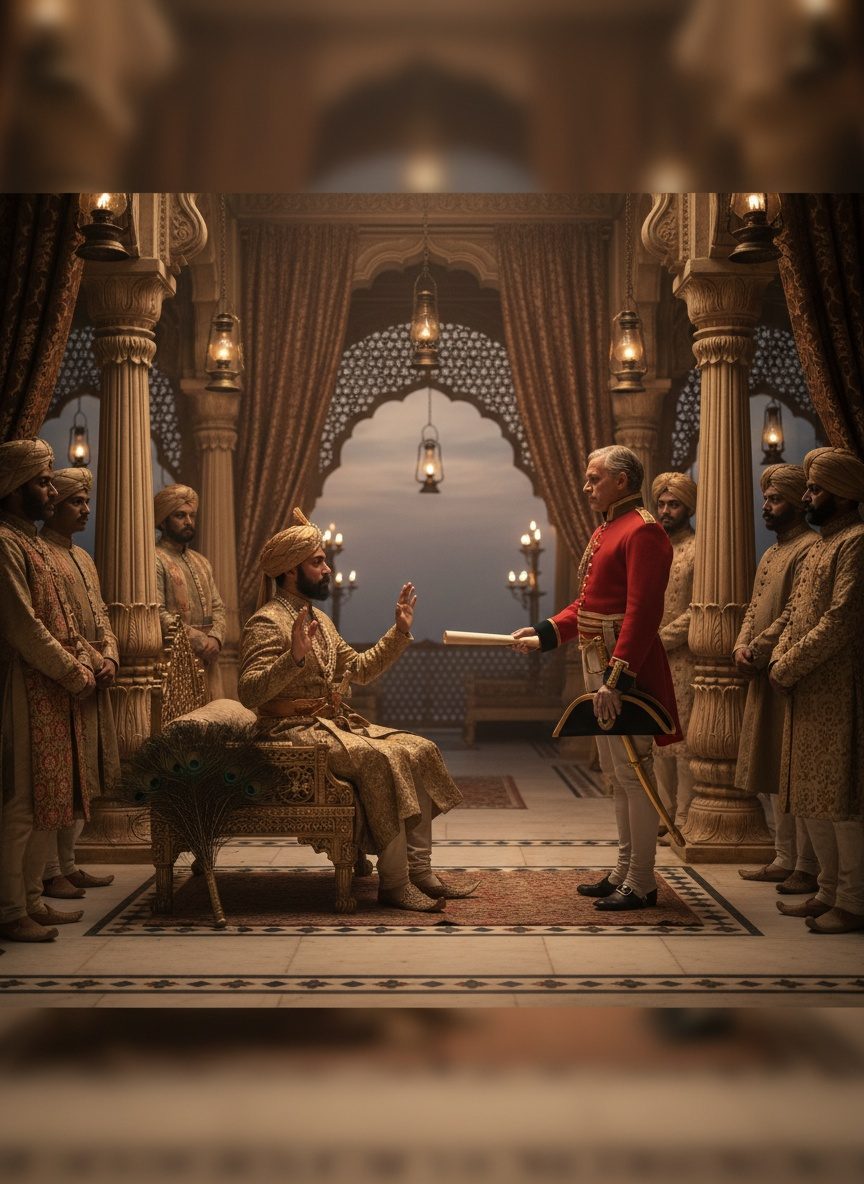
The audience in the opulent Darbar Hall of the Qaisar Bagh Palace fell silent. The flickering light from countless chandeliers danced across the stunned faces of those gathered. The air, thick with the scent of jasmine and rose petals, was pierced by the sound of a royal turban hitting the polished marble floor. Wajid Ali Shah, the last King of Oudh, stood before his astonished court, his crown cast aside, refusing to capitulate to British demands.
Unfolding Elegance, Crumbling Power
Wajid Ali Shah was no ordinary monarch. Known more for his artistic endeavors than military prowess, he embraced the cultural and artistic heritage of Lucknow with unparalleled fervor. His court, a vibrant mosaic of poets, dancers, and musicians, was the epitome of grace and sophistication. Yet beneath this facade of indulgence and culture, the looming shadow of British colonial ambition steadily crept forward.
Arriving at the gates of Oudh, the British East India Company sought a new prize. Under the guise of administrative reform, they accused the kingdom of mismanagement and financial insolvency. For Wajid Ali Shah, the writing was on the wall. The annexation of his beloved kingdom appeared inevitable. But even then, surrendering to foreign powers was an intolerable notion, one that stung at the roots of his being.
The Ultimatum That Broke a Dynasty
On a fateful day in February 1856, a British officer entered the grand halls of Lucknow with a document that would seal Oudh's fate. The ultimatum was unambiguous: sign away your kingdom or see it taken by force. For Wajid Ali Shah, it was more than just a political maneuver—it was a deep betrayal of trust and sovereignty.
With trembling hands, the king held the paper that promised the end of a dynasty stretching back centuries. But even when stripped of options, he remained resolute. Rather than add his name to the document, signifying an ignoble surrender, Shah took the only action he felt truly befitting a grieving monarch. He removed his turban—a potent symbol of his kingship—and laid it at the feet of the invaders. A gesture of submission intertwined with dignity, it was a refusal to endorse the calculated dismantling of his kingdom.
Ripples of Resistance
The news of Shah's defiance rippled swiftly through the subcontinent. The stark image of a dethroned king, turban at his feet, became a symbol of quiet rebellion against colonial encroachment. Though physically displaced from power, Wajid Ali Shah's actions inspired many. His refusal to bow completely signaled to Indians that the imperial designs of the British were not an unstoppable fate.
Within months, the fabric of British control in India would begin to fray as long-standing tensions erupted into the Indian Rebellion of 1857. Stories of resistance like Shah's fueled the fire of discontent, resonating with others who felt the oppressive weight of British rule bearing down upon their lives and lands.
The Lament of a Cultural Legacy
Exiled from his own realm, Wajid Ali Shah took up residence in Matia Burj, a suburb of Calcutta. Here, he endeavored to recreate the grandeur of Lucknow, immersing himself in the arts and refusing to let his spirit be shackled by the chains of exile. Even in his diminished state, he nurtured the cultural heritage that defined his reign.
His life in exile was not without tribulation. Stripped of political power, Shah found solace in his enduring love for the arts and spirituality, which continued to be a source of unyielding strength. The vibrant expression of Lucknow's cultural landscape, once threatened by annihilation, lived on in the songs, poetry, and dance that emanated from his new home. It was as if every note and verse were a defiant whisper against the injustice done to him.
Why the Turban Matters
Wajid Ali Shah's story is a poignant reminder of the complex interplay between power and culture. It underscores a moment where dignity transcended authority—a king who surrendered his crown but retained the essence of his identity. By laying down his turban, Shah not only repudiated the British but also upheld the dignity of a people whose spirit could never be fully subjugated.
More than a historical footnote, this episode illuminates the resilience that characterized India's struggle against colonial domination. It invites us to consider how actions, even when deemed as capitulations, can carry enduring significance. Through Wajid Ali Shah's poignant act, we glimpse the unyielding spirit of a nation on the brink of uprising—a legacy that echoes the timeless dance between subjugation and sovereignty.