The 2nd Lancashire Fusiliers knew what it meant to fight. Ironically, their final battle would be a ride.
Breaking Through the Gothic Line
The Gothic Line, stretching across the mountains of northern Italy, was meant to be the ultimate German defense in the final months of World War II. As winter turned to spring in 1945, the wall of fortifications had been battered, but not beaten. The men who had clawed their way through Italy from the beaches of Sicily to the rubble of Monte Cassino were seasoned soldiers, hardened by two years of relentless combat. It was here, in this harsh terrain, that the 2nd Lancashire Fusiliers were ordered into one last desperate charge.
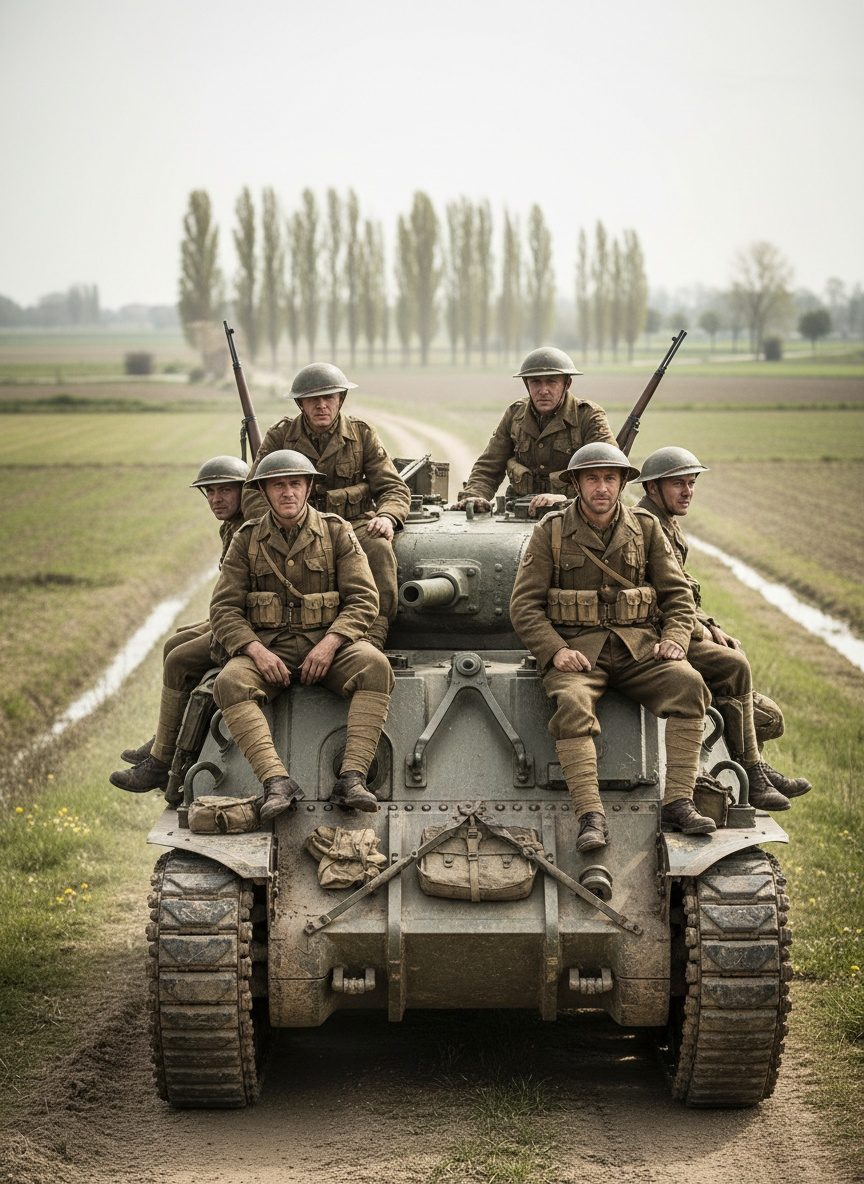
In an unorthodox strategy, they mounted Sherman tanks, abandoning the traditional foot-slogged advance. The sight of infantry draped over the sturdy, rumbling beasts encapsulated the chaos and innovation of late-war tactics. With their khaki uniforms contrasting sharply against the iron giants beneath them, they looked more like an invading horde from a bygone era, ready to race towards destiny rather than plod cautiously along.
Speed, agility, and surprise were their weapons. Each soldier aboard the tanks was keenly aware of the precariousness of their position. The Shermans offered mobility but scant protection from the German 88mm gun that had earned its grim reputation as a tank killer. But this was a gamble the Allied commanders were willing to take. It was a high-stakes race against collapsing Axis defenses — and time.
The Road to Ferrara
As April days grew longer, the roads north of Florence became the lifelines of the advancing army. Ferrara lay ahead, an ancient city of brick and water, its origins tracing back to medieval times. Now, it was emblematic of the faltering Axis hold on Italy. The city was a strategic prize: its capture would slice through the remnants of German resistance, inching ever closer to the heart of the crumbling Third Reich.
The 2nd Lancashire Fusiliers, riding their metallic steeds, faced mercurial adversities. Patched roads and unpredictable weather turned the journey into a harrowing ordeal. Rain turned fields into mud baths, threatening to maroon the tanks. Yet, even nature's challenges could not dull their resolve.
The ride was not without bloodshed. Ambushes by pockets of die-hard German soldiers and their fanatical counterparts in the Italian Social Republic peppered their progress with peril. Machine gun fire crackled through the air like sinister applause, and artillery shells punctuated the journey with lethal punctuation marks. But the persistence of the Fusiliers and the rumble of the advancing war machine forged an unstoppable momentum.
Clinging to Armor
For those who fought in battles dominated by trench warfare, like those in France decades earlier, the image of infantry sprawled atop tanks might seem absurd. Yet the practice was born out of necessity and opportunity: the ability to cover ground quickly was an undeniable advantage. Riding exposed, a sight bone-chilling for the uninitiated, they held fast to steel and one another. Their hands — once used to the feel of mud and earth — now grasped metal handholds as their Shermans sped towards battle.
The symbiotic relationship between man and machine was rarely more evident. Those soldiers, who had been craftsmen of their harsh trade, became riders in a new kind of cavalry. The trust between the tank operators and their comrades was absolute. Each tank crew, buttoned up beneath, was acutely aware that any misstep could mean leaving their brethren vulnerable. In turn, the infantry were watchful eyes, defenders of the tank's blind spots.
The mix of old and new methods culminated in an assault that was neither traditional cavalry charge nor mechanized warfare. It was a dance where steel and flesh moved in tandem, a vivid illustration of the ingenuity driven by war's terrible urgency.
The Echo of Collapse
As May 1945 approached, the fruits of their bold advance ripened. The German lines crumbled, and Ferrara fell. But as the echoes of surrender reverberated through the shattered European landscape, the cost of such relentless forward thrust was keenly felt. For the 2nd Lancashire Fusiliers, it was a bittersweet victory — stained by the loss of comrades and the somber realization that their job was nearly complete.
Their daring dash, marked by bravery and sacrifice, speaks to an era of transition in military tactics and the final stands of a weary army bridging old and new. The charging Fusiliers, atop their armored mounts, symbolize a turning point when speed and innovation became the new watchwords of warfare.
While history often highlights battles defined by static fronts and entrenched lines, the events in northern Italy remind us of the adaptability and resilience of those who fought in the final months of World War II. As the world teetered on the brink of peace, one last daring gamble encapsulated the paradox of war: that sometimes, the most profound achievements lie not just in victory, but in the courage to face uncertainty headlong.