A Moment of Revelation or a Buried Legacy?
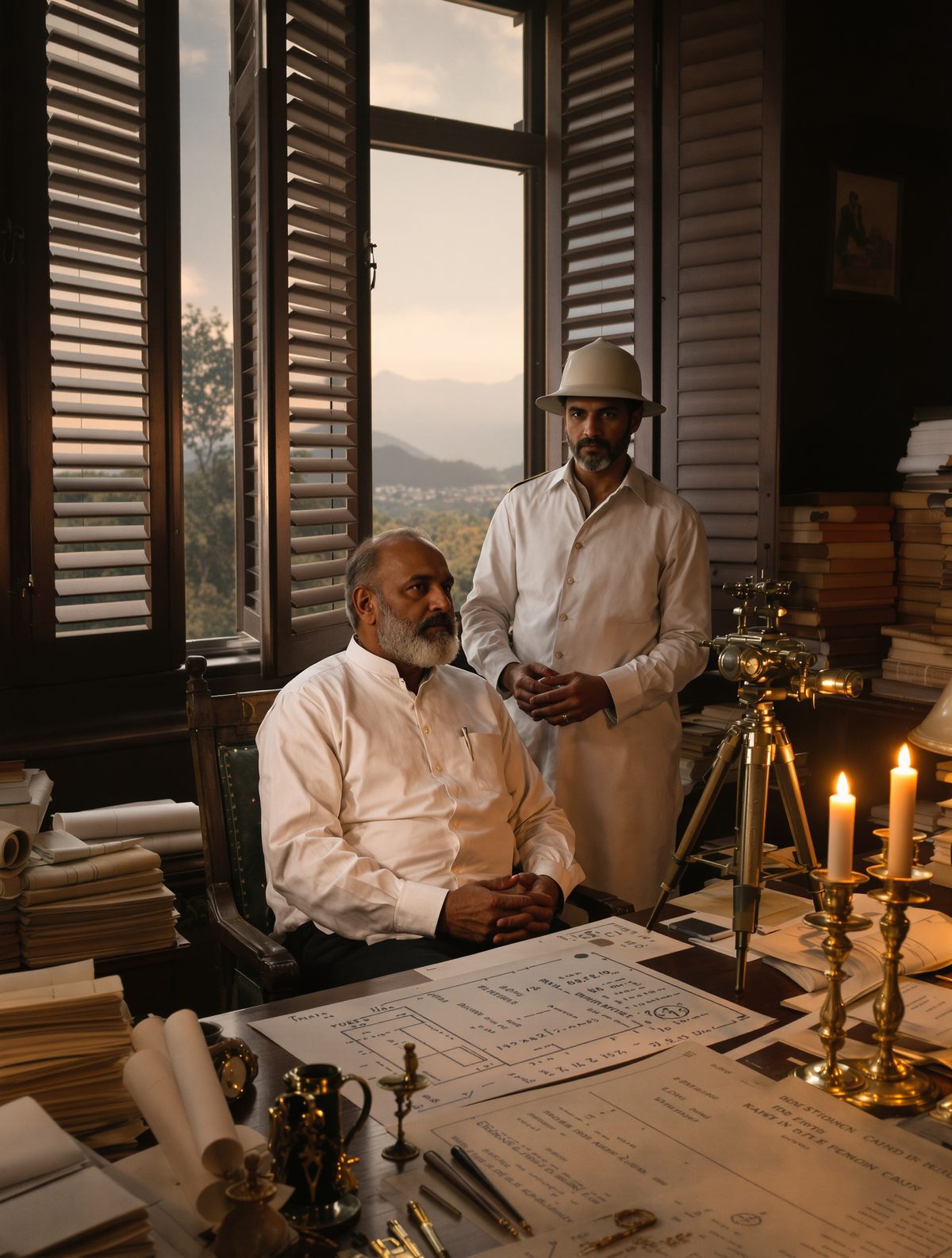
Picture the scene: Calcutta, 1852. The clamor of the bustling, sun-drenched streets outside contrasts sharply with the somber gravity inside the Survey General's Office. Papers rustle, clerks murmur softly over log tables, and the air is thick with the curious mix of intellectual pursuit and colonial administration. But amid this quiet hum, a sudden burst of astonishment momentarily halts the academic monotony. Radhanath Sikdar, a bright and driven Bengali mathematician, dashes into the office of his boss, Andrew Waugh, his face lit with the fervor of discovery.
The Steely-eyed Surveyor
Radhanath Sikdar was a man of numbers. Born in 1813 in the province of Bengal, he was one of the first graduates of the Hindu College in Calcutta. He held an enduring passion for mathematics, which he expertly wielded in his work within the Great Trigonometrical Survey of India—an ambitious, decades-long British endeavor to map the Indian subcontinent with precision. Yet, by 1852, this formidable operation had run into the spine-tingling heights of the Himalayas, which seemed to pierce the sky itself.
The year marked a turning point in the annals of geographical discovery. Sikdar, stationed in the survey offices in Dehradun, had been painstakingly calculating the elevation of the towering Himalayan peaks through the use of the latest theodolites and complex trigonometric calculations. It was no small feat, considering the team often braved harsh weather, treacherous landscapes, and limited technology.
An Astounding Calculation
On a fateful day in 1852, Sikdar's calculations revealed something extraordinary about a previously uncharted summit, then known only as Peak XV. His figures suggested it was the tallest mountain on Earth, standing at an estimated 29,002 feet. Today, we know this prodigious peak as Mount Everest, its height more precisely recorded at 29,032 feet. But back then, Sikdar's calculation was so astoundingly precise, so implausibly perfect, that even he struggled to believe his own arithmetic.
Rushing to his superior, Andrew Waugh, Sikdar bore his discovery not as mere data but a profound claim, one that challenged existing perceptions of the world's geography. However, unlike the exhilarating discovery of the unknown, the aftermath was anything but triumphant for Sikdar.
Credit and Colonial Oversight
Andrew Waugh, the Surveyor General of India, ensured that the findings received official recognition. However, in the Victorian age of empire, stories of scientific discovery and exploration from the colonies were often routed through the lens of colonial title. Waugh forwarded Sikdar’s results to the Royal Geographical Society in London, proposing that Peak XV be named in honor of his predecessor, Sir George Everest, the previous Surveyor General who partly orchestrated the grand survey from which Sikdar worked.
It is a peculiar quirk of history that the highest mountain be named after a man who had never glimpsed it, rather than the brilliant mathematician who unveiled its grandeur. Sikdar’s pivotal role was subsumed within the broader machinery of the empire, leaving his name absent from textbooks for generations, overshadowed by the legacy of European nomenclature.
The Man Behind the Numbers
Sikdar was more than a mathematician; he was a pioneer of his kind. His deftness with numbers and instruments allowed an unparalleled peek into the mystique of the Himalayas. He was a force behind the advancing frontier of the known world, yet remained a humble presence in the shadows of his superiors—a pattern all too common for colonial intellectuals whose brilliance became a footnote beneath their British counterparts.
And the intrigue does not end with Everest. Sikdar was also an advocate for science education in India, championing its development at a time when colonial powers dictated educational pathways. His work undoubtedly inspired future generations of Indian scientists and mathematicians, even if his legacy remained understated in the public eye.
Why Radhanath Sikdar’s Story Matters Today
As we navigate a contemporary world striving for historical rectification and equitable recognition, Radhanath Sikdar’s story is both a cautionary tale and a beacon. It reminds us of the innumerable voices from the past that faced inadvertent neglect due to institutionalized biases and systemic inequalities. In Sikdar's calculations lies a testament not just to mathematical mastery, but to the resilience of intellect across borders and eras.
Revisiting Sikdar’s groundbreaking work urges us to reflect on who gets to record history and whose achievements rise to the heights of international acknowledgment. As the "Legends They Left Out of the Textbooks" reminds us, the celebration of these untold histories enriches our collective understanding of human fascination and discovery—perhaps inspiring writers, educators, and students to question and explore the stories woven into the fabric of our world.