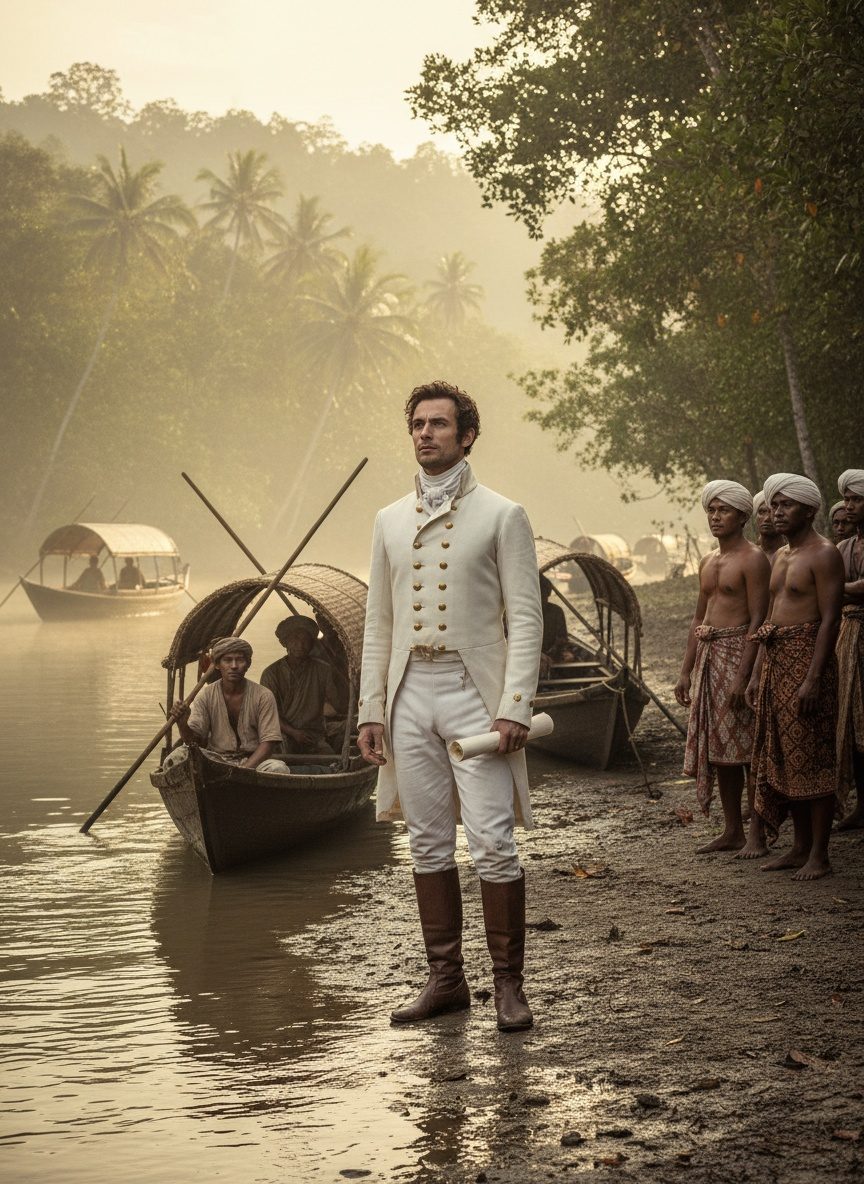
The air was thick with humidity, hanging heavily on the small crew that had just disembarked from a British ship onto a seemingly forgotten piece of earth. Gentle waves lapped against the boat, their whispers interrupted only by the calls of distant birds. In the oppressive January heat of 1819, Sir Stamford Raffles stood resolute, scanning the lush green belt of dense jungle before him on an island at the tip of the Malay Peninsula. Here lay the edge of the British Empire's ambitions, beyond the sprawling shadows of the Georgian Empire.
The Scene of Anomaly: Arrival at Temasek
As Raffles made his way onto the mucky shore, the sun hung low in the sky, casting long shadows that danced across the seemingly uninhabited land. Yet, to Raffles — a man with an uncanny knack for recognizing potential within obscurity — this island, known to locals as Temasek, was a blank canvas ready to be transformed into a bustling hub of commerce. Today, we know it as Singapore.
Despite his keen intellect and ambitious vision, Sir Stamford Raffles arrived on this isolated island not as a conqueror with a grand entourage or military might, but with minimal resources, deteriorating health, and an audacious plan. At 37 years old, acting without direct orders from London, he was willing to gamble on the future of a place many had overlooked. Why here, one might ask, out of all places? Simply put, it was a gospel of geography. This location was a strategic goldmine, perched on the lucrative sea-faring route between India and China, offering a perfect vantage to establish British influence against the growing Dutch interests in the region.
The Game of Diplomacy: One Week to Change the World
The calendar unfurled to Monday, the first day on land, and Raffles, with a thin veneer of respectability, began what would become his most audacious diplomatic coup. Armed with nothing more than his charm, intellect, and a few devoted men, he sought out local leaders, keen on entwining their fates with his British compatriots.
There were moments of uncertainty, where thick jungle shadows seemed to swallow their hopes whole. Yet Raffles played the diplomatic game with the precision of a seasoned artisan, leveraging his understanding of both local customs and imperial strategy to forge an unprecedented deal. He negotiated tirelessly, employing interpreters to bridge cultural gaps and surmounting each language barrier with the persistence of a man who knew he had but seven days to forever alter this tiny part of the world.
By the seventh day, words transcribed into vellum and ink, a treaty was sealed. This document granted the British a foothold on Singapore's soil, marking the inception of its colonial chapter and setting the course for it to evolve into a prominent trade center.
A City From Swamp: Building Futures
Standing amidst all-consuming greenery, it was almost inconceivable to envision what lay ahead — but Raffles did. In his mind's eye, bustling docks took shape, where vessels from distant lands would eagerly unload treasures and livelihoods. Though built fast, like a house of cards that had to withstand the test of time, this settlement would become home to merchants, laborers, and settlers. Their lives would intermingle, threading together a rich tapestry of cultures and traditions.
Raffles, known for his aspirations rather than adherence to anything mundane, laid the foundations of what would become the Singaporean ethos. His policies encouraged trade but fostered competition, opening doors to traders who would enrich the civic life of this fledgling outpost. Mirroring the growth of Singapore, the story of Raffles' people swelled in the pages of history, each entry echoing their founder's blend of courage and tenacity.
A Legacy Beyond Empire: The Significance Then and Now
The island at the tip of the Malay Peninsula is no longer the swampy land that humbled even those with defiant spirits. It stands now as a titan among cities, with a diverse population of millions, epitomizing globalization before it even had a name. What was accomplished in those crucial seven days is not merely the story of a treaty or the establishment of a cultural mecca. It's a narrative about the power of vision and the audacity that fueled a single man to defy the odds.
In an era defined by imperial greed and geopolitical rifts, the chapters etched by Stamford Raffles have perpetuated Singapore's journey across two centuries. Today, its bustling harbors, towering skyscrapers, and vibrant communities serve as a testament to the transformational possibilities when ambition meets purpose, challenging not only the testament of empires but igniting a resolve that shapes futures. It's a reminder that while one man's vision founded Singapore in just seven days, it is the enduring spirit of its people that continues to write its tale.