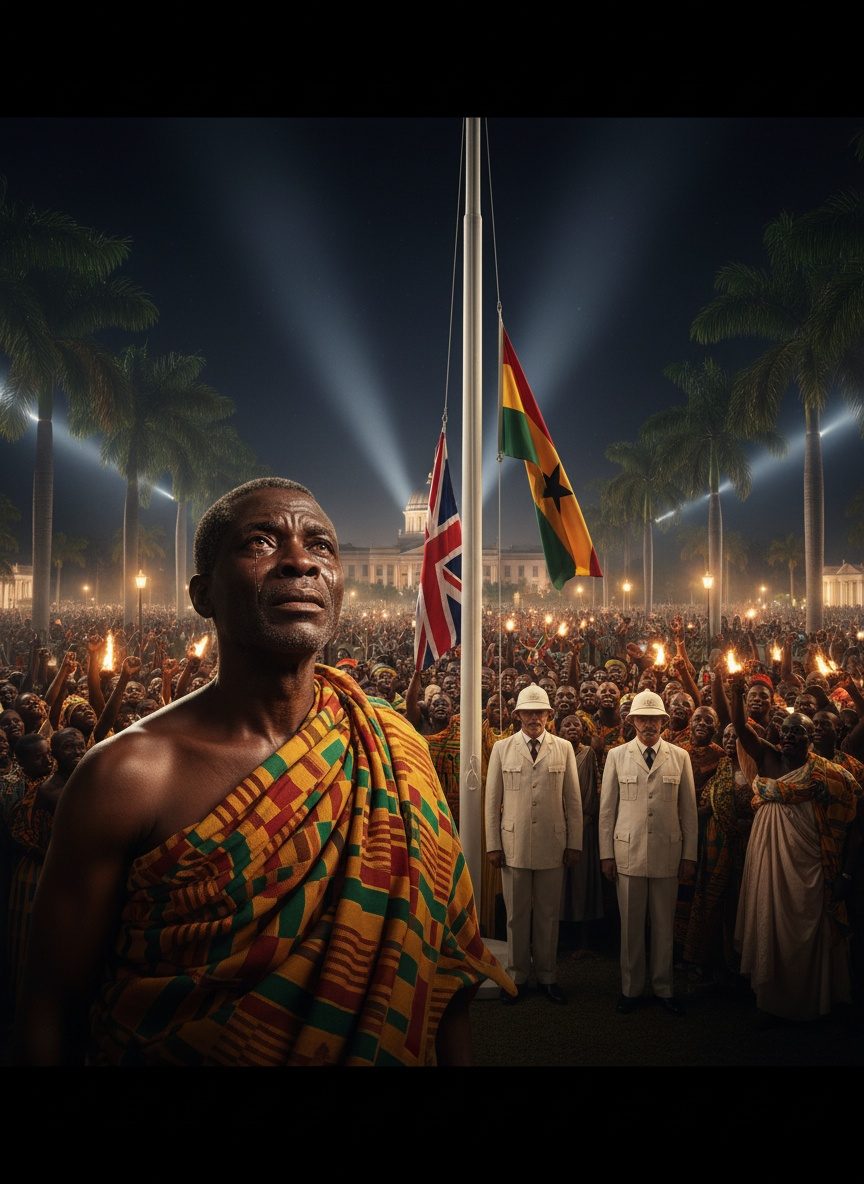
He was supposed to be jubilant. Yet tears streamed down his face at the moment of triumph. As the Union Jack descended for the final time in Accra, this man felt both elation and the weight of immense responsibility. The truth was, Ghana's first hours were built on the shoulders of hope and anxiety, and the man at its helm understood the delicate balance required to chart a fresh course.
The Midnight Transformation
The night air was rich with anticipation. On March 6, 1957, the clock struck midnight in Accra, and an eagerly waiting crowd of 100,000 stood breathless in the polo ground. At that precise moment, the Union Jack, a symbol of British dominion, was lowered. In its stead, the vibrant new flag of Ghana rose against the night sky, a beacon of a nascent independence. The silence that preceded this moment was filled with the collective breath of a people standing at the precipice of history.
As the silence broke into a thunderous roar, echoing across continents, it signaled not just the end of colonial rule but the dawn of a new era. Accra had become the epicenter of a revolution that was not only political but deeply cultural and ideological. The crowd's cheers weren't just of joy; they were cries of liberation, yearning for self-determination, and excitement edged with uncertainty.
The Emblem of Freedom
The significance of Ghana's independence was immense. It marked the first occurrence of a black African nation successfully breaking free from colonial shackles—a monumental shift in a continent long dominated by foreign powers. It unleashed a surge of optimism that rippled across Africa; a continent that had been partitioned and parceled out now had a vanguard in the quest for sovereignty and self-rule.
The new flag of Ghana wasn’t just a national emblem—it was an embodiment of this fervent aspiration. Symbolizing unity, strength, and the rich heritage of its people, its colors spoke a universal language of liberty and promise. Meanwhile, the adjoining anthem offered a melody of hope, forged from the rhythms and aspirations of the land it represented and catalyzing an identity that was proudly African.
A Complex Legacy
For many, March 1957 was an emotional whirlwind. The event was an amalgamation of joy and reflection, a realization that achieving independence was only the first step in a larger, more challenging journey. Grappling with the responsibilities of nation-building, the task of forging a cohesive national identity from the multiplicity of ethnicities and languages still loomed large.
The man who wept amidst the jubilant cries bore the understanding that while much had been gained, the path ahead was fraught with challenges. Balancing the dreams of his countrymen with the stark realities of political, economic, and social transformation would be no easy task. The tears of that night were, in part, acknowledgment of the trials that would undoubtedly accompany the triumph.
Why It Matters
Ghana's success in gaining independence reverberated far beyond its borders, igniting the winds of change across Africa and beyond. This bold act of self-determination was a clarion call to nations under colonial rule, demonstrating the power of unity, resilience, and the unyielding quest for freedom. It paved the way for subsequent movements that sought similar autonomy, inspiring a domino effect that would reshape political landscapes worldwide.
The night's resonant echoes continue to be felt today. Ghana's path offered a blueprint, albeit imperfect, for emerging nations navigating similar struggles for identity and self-governance in a post-colonial world. In this sense, the weight of that night in Accra carries on—a constant reminder of what can be achieved when a people dare to reclaim their destiny, faced by the undeniable truth that their dreams, once deferred, became theirs to mold.