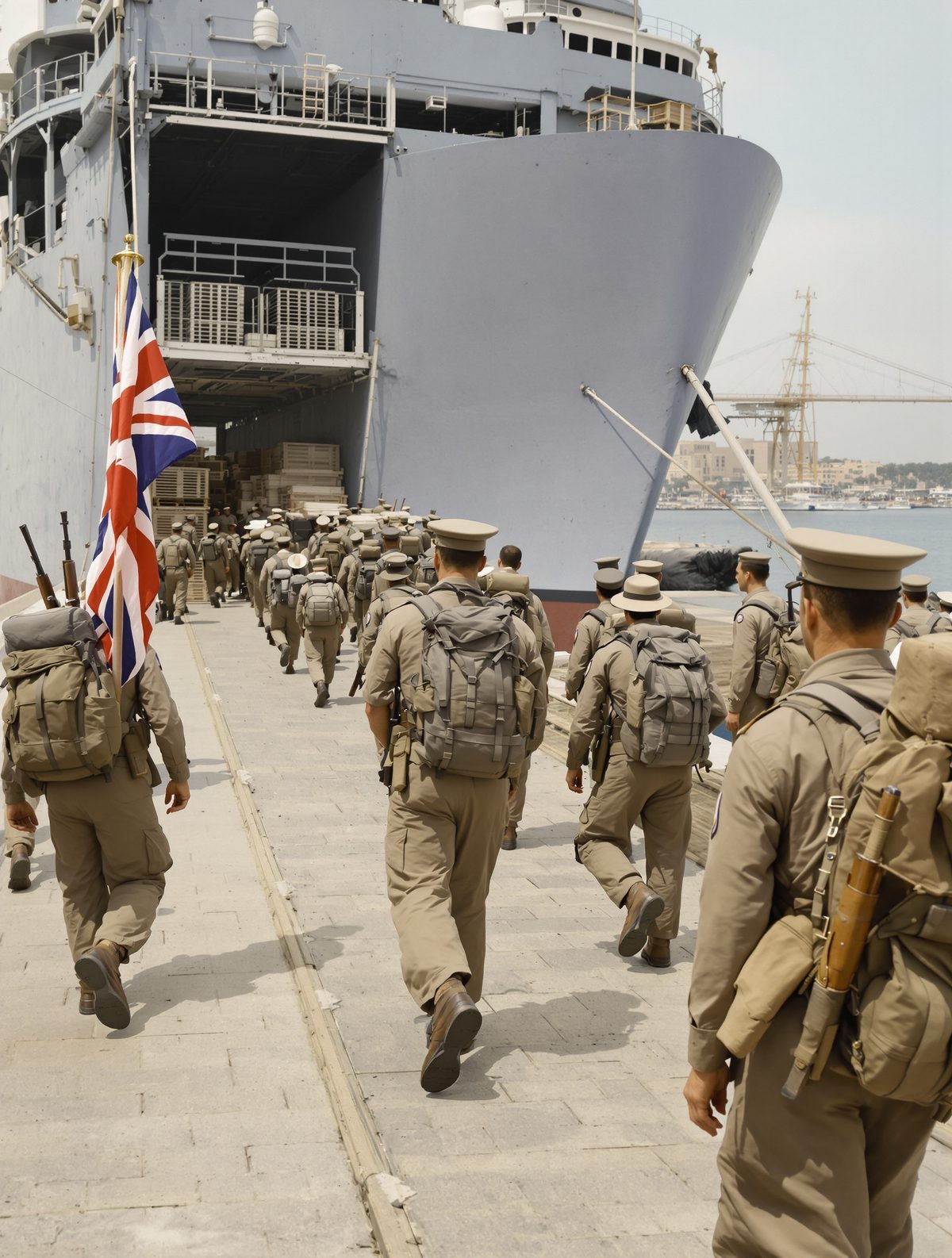
The city of Haifa, cradled between the shimmering Mediterranean Sea and the rocky slopes of Mount Carmel, had become a portal of departure, quietly monumental as the final British soldiers prepared to leave behind a land imbued with both biblical promise and contemporary conflict. It was May 15, 1948, and as the sun rose over the ancient harbor, it gilded the departing troops with a poignant glow—a nod from history as they tethered their hopes to the decks of departing ships. The British mandate in Palestine was ending, unraveling along lines stitched together by empire, war, and diplomacy-gone-awry. Ahead loomed uncertainties as vast as the sea; behind lay tensions about to ignite a firestorm in the Middle East.
The Mandate: A Crown Heavy with Discord
After World War I, the League of Nations entrusting Britain with the mandate to govern Palestine in 1920 seemed like another jewel in the crown of a global empire. Emerging from the ratified Treaty of Sèvres in 1920, the mandate aimed to manage a land where Jewish historical aspirations clashed with Arab nationalism. This act effectively took an ancient land of 27,000 square kilometers and branded it with imperial oversight.
For three decades, the British shuffled policies trying to arbitrate between the Arabs and the burgeoning Zionist movement, whose aspirations had been galvanized by the Balfour Declaration of 1917. The document had promised a national home for the Jewish people, setting off waves of immigration that further intensified local grievances. Numbers tell a tale of rapid change: the Jewish population, an estimated 83,790 in 1922 according to a British census, soared to 608,225 by 1945.
Haifa: The Unheralded Stage of Departure
As the last contingent of 36,000 British soldiers prepared to board ships in Haifa in May 1948, the harbor witnessed history in the making. Despite the political tempest, theirs was a departure marked by silence. The Royal Navy cruiser HMS Euryalus watched over the exodus from the waters, its majestic metallic form exuding an aura of protective strength. Less known is the fact that while soldiers loaded their kit bags and boarded dark sea-green vessels, Palestinian dockworkers, many unaware that this moment would echo across generations, assisted in what was no more than a chore for the day.
The absence of ceremony was a resounding testament to the complexities that had confounded policy makers. Unlike India or Egypt, where the British departure was marked by pomp or public acknowledgment, in Palestine, there was only the sound of boots on cobbled stone merging with the cries of seagulls overhead. It was as if history hesitated to intrude upon the solitude of their exit.
The Invisible War: Behind Headlines and History
The soldiers left with memories of a covert war fought in shadows. Few knew of the secretive "Night Squads," the brainchild of British captain Orde Wingate in the late 1930s. Wingate, fervently Zionist, recruited Jewish fighters to counter Arab insurgents during the Arab Revolt from 1936-39. These joint patrols fostered nascent alliances between Jewish militias and the British military, though many such relationships would sour as Jewish paramilitary groups demanded British withdrawal.
Equally less known is the agony in corridors of British power, as the cost of maintaining order skyrocketed—over £100 million spent annually by the mid-1940s. The wear of two global wars and mounting unrest across the empire left the British clutching at shadows of former might. Lindenhill, a senior officer in the British Arab Legion, described their dilemma in a private letter: "We have engineered chaos and it costs us dearly."
A Conflict Unearthed: Seeds of Future Wars
The final departure left behind a tapestry of conflict waiting to unravel. Less than a day following the British withdrawal, David Ben-Gurion would proclaim the independence of Israel. Within hours, armies from Egypt, Transjordan, Syria, and Iraq converged, igniting the first Arab-Israeli War. A fact often overlooked was the remarkable disbelief expressed by observers such as Ahmad Shukeiri, who would later co-found the Palestine Liberation Organization. In notes written then, he conceded, "Never did I think that an international retreat could so galvanize brothers to war."
What the British departure underscored was a paradox: that the absence of a colonial power could unleash seismic change. The mandates left unchecked prejudices to root deep, their tendrils intertwining with ancient enmities nurtured in the sands. The British, now distinctly outsiders, would soon watch from beyond their shores as armistice lines ebbed and flowed across battlefields and as the seeds of a protracted conflict took root.
Reflections on an Enduring Legacy
The silent goodbye at Haifa port echoes resoundingly in today’s world. The British withdrawal may have been unceremonious, yet it provoked the kind of change that textbooks too often obscure in favor of linear narratives. As recent decades have seen renewed strife in Palestine, debates surrounding colonial responsibility often invoke that May morning, questioning whether the British could have done more, earlier. As today’s Middle Eastern leaders grapple with legacies of toiled lands and tortured fidelities, historians peer into the gray mists of that era for wisdom.
In reflection, the void left by departing empires draws not just eventual geopolitical consequences but also questions about sovereignty, autonomy, and identity in a tangled world. As we look back at the British soldiers who left Palestine in 1948, we are prompted to ask in a fresh light: at what cost do definitions of borders collapse into fragments of human experience?
History may judge the silent departure differently with each passing era, but it remains a testament to untold stories and unheeded lessons woven through the very seams of the Middle East and, perhaps, the world at large.