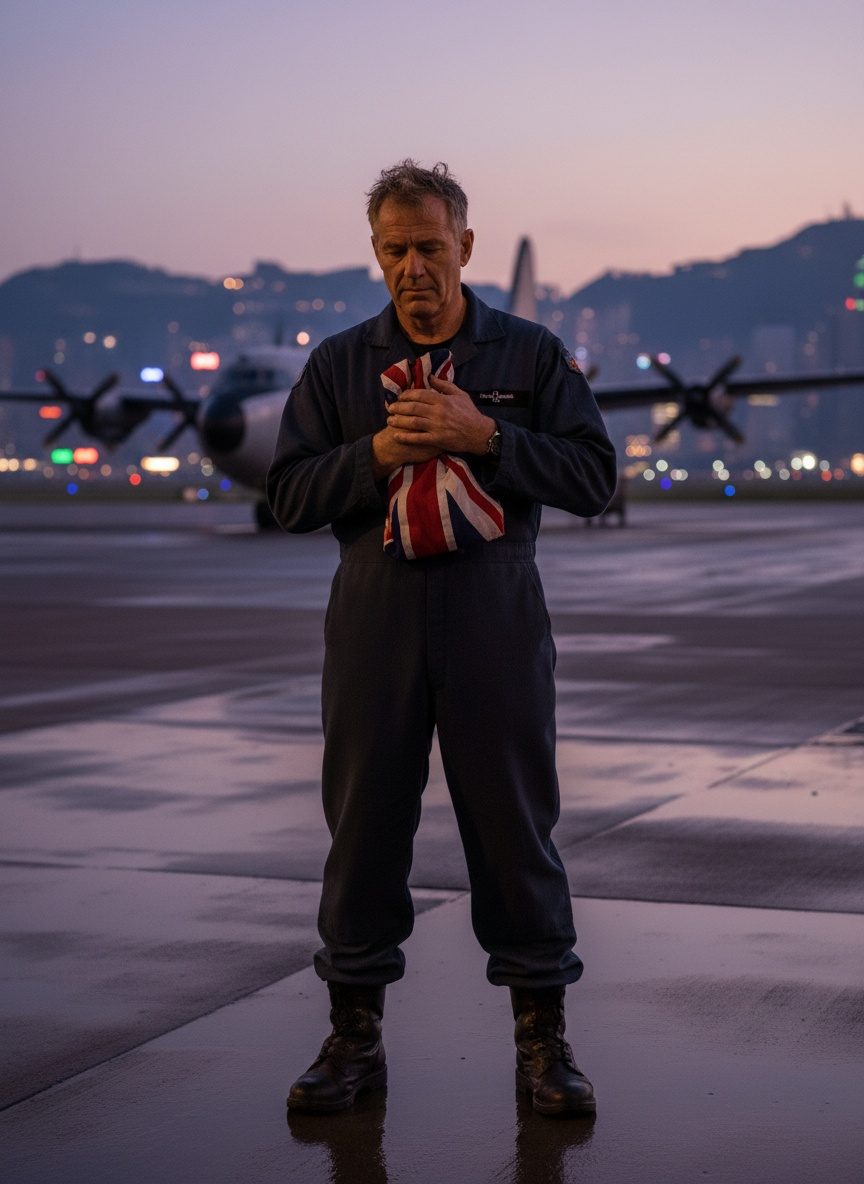
The last British flag folded at Kai Tak signaled the end of an era. Yet hours before the handover of Hong Kong, the skies were already silent of British planes.
In the shadow of looming skyscrapers and under a sky tinged with the glow of anticipation, the Royal Air Force prepared to leave Hong Kong, a place where the Union Jack had symbolized British rule, grandeur, and authority for over a century and a half. On the humid evening of June 30, 1997, an era quietly concluded not with a turbulent march of history, but with a deliberate fade into twilight. Engineers, clad in their simple khaki drill uniforms, methodically completed their tasks. No pomp or ceremony marked the folding of the last flag. The solemn act was simultaneously intimate and monumental, carrying the weight of countless untold stories.
Kai Tak Airport, known for its legendary approach that left pilots with white knuckles and passengers with stories for a lifetime, now stood in the coolness of oblivion. Its runway, drenched in the nostalgia of the past, was moments away from irrelevance. For years, the RAF had been an indelible part of Kai Tak, a strategic outpost in a region where British interests intersected worlds. Yet, unlike the hasty evacuations and blood-stained retreats seen in other parts of the sun-setting empire, Hong Kong's handover was pragmatic, clinical. A well-rehearsed ceremony commemorating the transfer of not just land, but life.
The last RAF plane lifting off from Kai Tak was witnessed by few yet understood by many. It was part of a larger, intricate dance of diplomacy. The skies that it left behind were not just changing hands; they were evolving into something new, an initiative toward an uncertain but unavoidable future. There were no loud farewells, no heroes' march; the flutter of rotor blades and jet engines rapidly diminished to echoes in the vast night, the night when the world would gaze at Hong Kong with a mixture of fascination and uncertainty.
For the ground crew, this was an ending handled with the precision of any military operation. Equipment was checked, double-checked, and loaded. Protocol was followed with almost ceremonial precision. These were men who had spent a part of their lives ensuring that British forces around the world could rely on air superiority and logistical support. Yet here at Kai Tak, there was a deeper acknowledgment that their duties were echoing into voids that would only be filled by the tides of history. As the sands slipped through the fingers of empire, there was both wistfulness and release.
There was something surreal about that final sunset, seen by pilots who had soared over this metropolis and into the heart of Asia for years. Beneath them lay a city buzzing with indifferent life, where old trams clattered along street rails and neon signs glowed, painting the night in shades of the past. To these aviators, every aerial journey was intertwined with the legacy of British rule, the complexity of its legacy, and the optimism inherent in its peaceful departure.
The characters on that final night encompassed engineers who kept the aircraft in order, logistics officers who deciphered the maiestic scatter of details, and pilots who had routinely bridged the distance between home and imperium. These individuals belonged to an empire unwilling to unravel in violence; rather, it was willing to let simplicity mark its departure, to leave behind not chaos or scars, but the potential for reinvention under a new flag and a new horizon.
As the runway lights sensationally dimmed for the last time under British administration, a chapter concluded, irrevocably. A transition not marked by fanfare but by silence, a silence that spoke volumes of the end of epochal colonial exploration and expansion. Every single soul involved in that final departure carried away a personal narrative, woven with the threads of the global grandeur that characterized the Empire, now stepping into history.
Changi Airport ceased to witness the British flag taking off, but by then it had already embarked on its journey into the annals of change, representing the last embers of a remarkable era. As the night swallowed the light of July 1st, the last remnants of the RAF gently kissed the skies of Kai Tak goodbye, knowing they left behind echoes of a comprehensive chapter now left to history's embrace.
This seemingly unspectacular moment matters for what it represents: a symbol of transition and change. The careful dismantling of old systems making way for new promises. The Empire handing over the future without clinging to bygone glories, paving a path as complex as it was inevitable. The RAF's flight into memory lanes is emblematic of turning pages—history moves, reshapes, and tells its future the stories of its past. The world watched, not with disdain, but with collective anticipation, ready to understand what it meant to say goodbye to an empire, yet not to its influence.