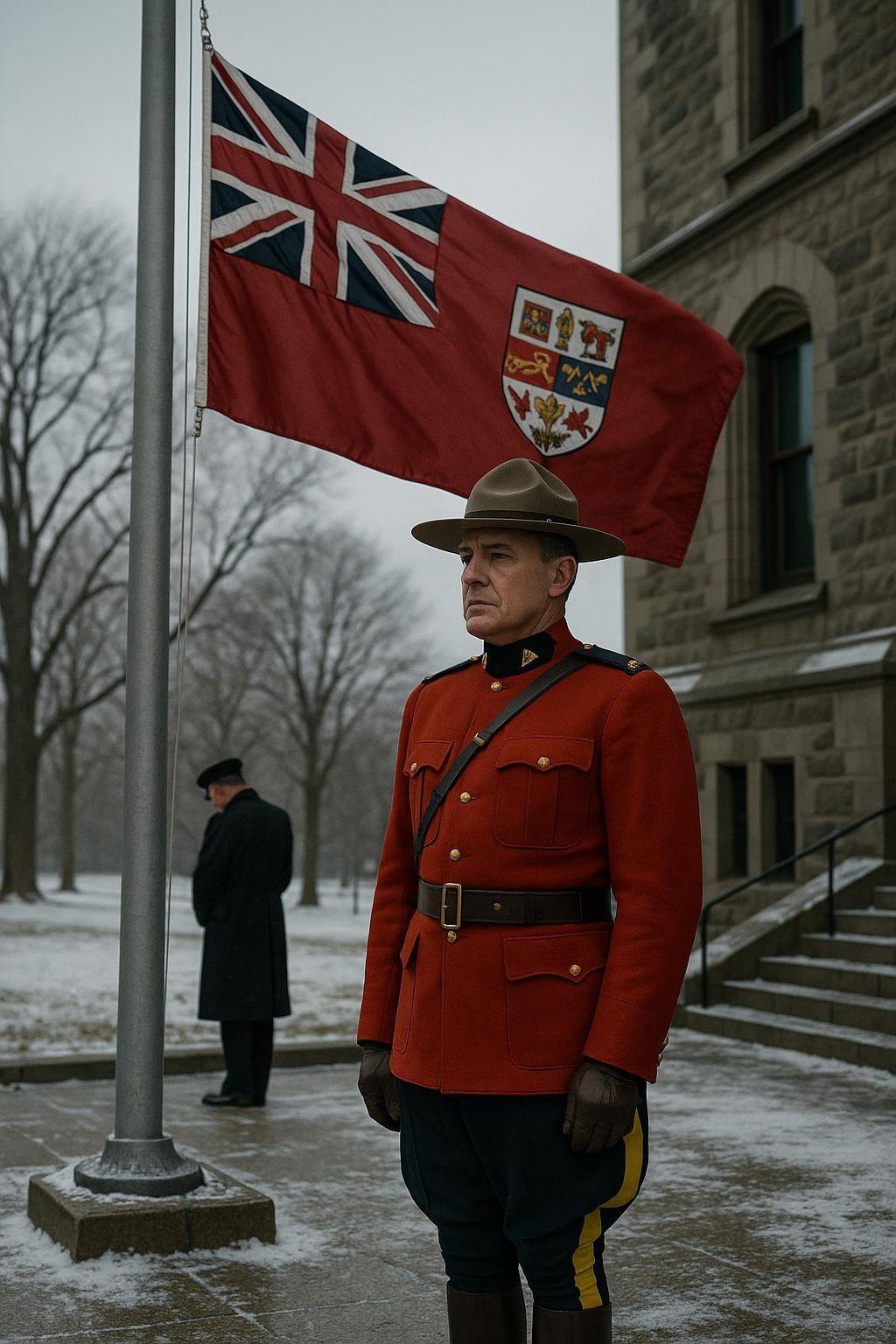
The clinking of metal and the rhythmic shuffling of boots echoed across Parliament Hill, mingling with the crisp February air that bit sharply at the faces of onlookers. Eyes were fixed on the flagpole, where the Red Ensign, Canada's banner under the British Empire, fluttered for what would be its final moments above the nation’s capital. This was no ordinary flag-lowering ceremony; behind the disciplined precision of the guards, an epoch was drawing to a close.
As the flag slipped slowly down the pole, its bold red field, adorned with the Union Jack and the Canadian coat of arms, was a tapestry woven with the threads of a young nation’s past. From the birth of a confederation in 1867, the Red Ensign had signified Canada's status within the British Commonwealth—a dominion with strong ties to the crown, but one that had steadily marched towards its own identity. This emblem had accompanied Canadians into the muddy, shell-torn trenches at Vimy Ridge, unfurled defiantly at the ill-fated shores of Dieppe, and waved triumphantly in the wake of the Allied landings at Normandy. Each of these battles had tested, and ultimately defined, Canada’s resolve to carve its own path on the world stage.
Over the decades, the Red Ensign had been more than a mere standard; it was a symbol of unity and loyalty, of close alliance with the United Kingdom during times of peril. Yet, as Canada matured through the early 20th century, calls for a distinctly Canadian flag—a flag only hers—grew louder. By the 1960s, this quest for a new symbol had reached a fever pitch, fueled by a desire to distinguish Canada unequivocally amidst the shifting tides of post-war geopolitics and emerging national identities.
The debate over a new flag was fierce and deeply emotional. On one side stood traditionalists, who cherished the ties the Red Ensign represented. For them, it was a constant reminder of shared histories and sacrifices on foreign soils. On the other side were those championing a fresh symbol—one that encapsulated Canada’s evolution from colony to country, from a partner in empire to a sovereign state within a modern world. Prime Minister Lester B. Pearson, whose vision for a newly unified nation prominently included a change of flag, found himself at the helm of an impassioned and sometimes vehement contest.
The eventual design—the now-iconic Maple Leaf flag—was chosen not without controversy but with aspirations of embracing a Canadian identity rooted in the land itself, symbolized by a symbol ubiquitous across the country's vast landscapes. Gone were the British elements; in their place, a simple red maple leaf on a field of white, flanked by two red bars. It was a design steeped in natural simplicity, yet profound in its implications—a representation of a nation stepping deliberately into a spotlight of its own making.
And so, on that frigid February morning in 1965, as the Red Ensign descended the mast, there was an undeniable sense of loss. To witness it waving for the final time stirred mixed emotions; nostalgia mingled with the prospect of a bold new chapter ahead. The crowd, composed of veterans, dignitaries, and ordinary citizens, bore witness to history as the Maple Leaf flag climbed the pole, an act as quiet as it was momentous, and a promise to safeguard its own future.
For the men and women who had fought under the Red Ensign, the transition was poignant, a reminder of the valor embedded in its folds. Yet, as the new flag reached its zenith, there was hope that the courage and unity which defined those years would now find a new symbol. That final salute to the Red Ensign was not just a farewell; it was an acknowledgment of all who had sacrificed under its colors and an invocation of pride for the undetermined sky illuminated by the maple leaf.
As the ceremony concluded, a tangible air of anticipation settled over Ottawa. It was as if the very act of hoisting the new flag acknowledged a pact with both history and the future—a recognition of Canada’s enduring connection to its past and a commitment to embrace its own narrative. For an international audience, this moment was Canada’s unequivocal declaration of identity—a declaration that it was ready to leave the shadows of the empire to become an independent beacon in its own right.
In the decades that followed, the Maple Leaf would come to symbolize this independence and unity, gracing everything from national sports jerseys to lunar missions. It’s a story told not in defiance of the past but in recognition of growth—a Canada that acknowledges its origins while celebrating its potential.
The last time the Red Ensign flew over Ottawa was more than just a ceremonial transition; it was a testament to the power of symbols and the narratives they create. This humble piece of fabric, descending one last time in the brisk Canadian cold, nodded not just to where Canada had come from, but to where it was going—a proud nation poised on the brink of rediscovery and reinvention.