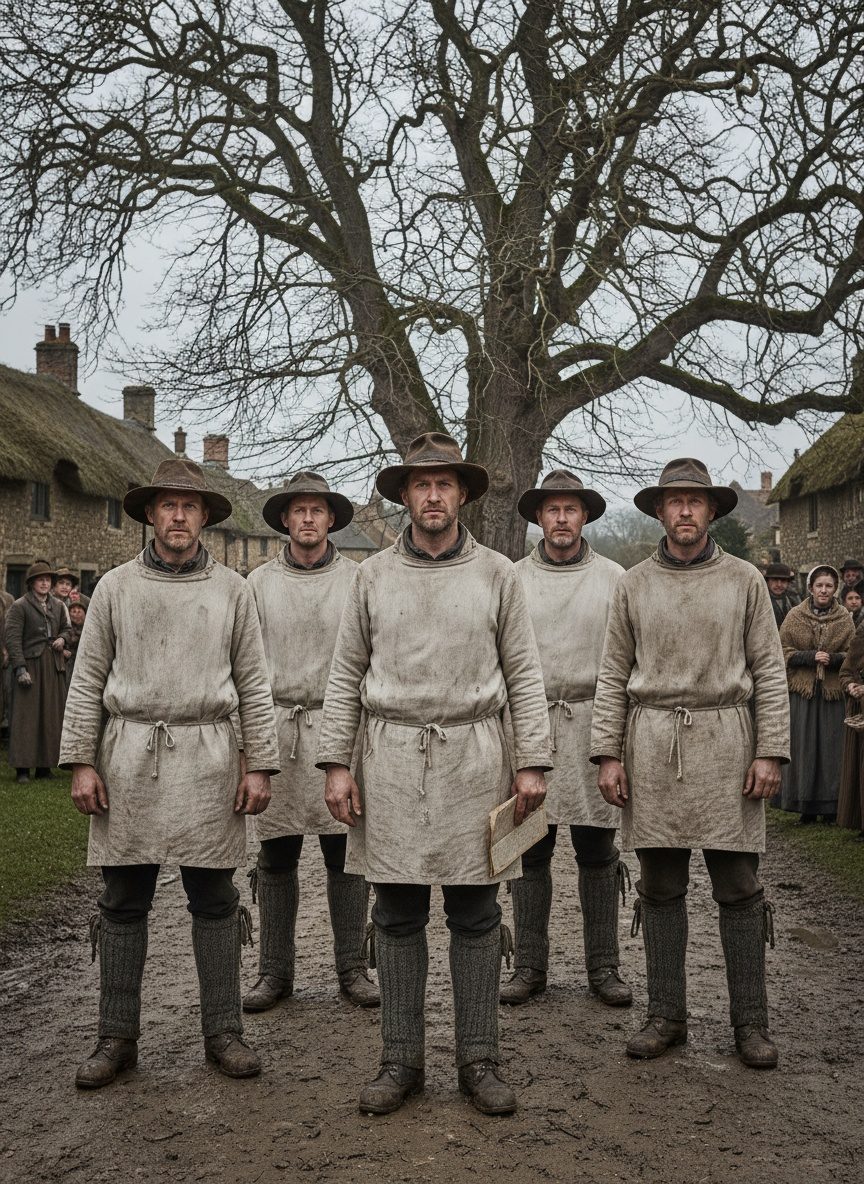
In the early hours of a crisp March day in 1834, under an ancient sycamore tree in the quiet village of Tolpuddle, Dorset, six farm laborers pledged a secret oath that would send shockwaves across the British Empire. Little did these men know, their simple act of solidarity would ignite one of the most significant movements for workers' rights, inspiring generations to come.
The Spark Beneath the Sycamore
The backdrop to this momentous event was a fertile but oppressed countryside in the depths of the Georgian era. Wages for laborers were miserably low, often reduced to a mere nine shillings a week, which condemned families to a life of poverty and hunger. But in Tolpuddle, the plight of George Loveless, James Loveless, James Hammett, James Brine, Thomas Standfield, and John Standfield was about to take a radical turn.
On that fateful day, these six men gathered at a lonely corner of their village, where an old sycamore tree offered refuge and secrecy. Here, they took an oath that marked the inception of their union, the Friendly Society of Agricultural Labourers. Their aim was unambiguous: to fight for better wages and fair treatment. However, what they viewed as a righteous and desperate act was seen as a threat by the establishment—a threat that demanded elimination.
The Heavy Hand of "Justice"
Word of the secret society quickly spread. It wasn’t long before James Frampton, a local landowner staunch in his belief in the existing social order, reported their "conspiracy" to the government. The response was swift and severe. Despite treason typically being a charge of sedition against the crown, the men were arrested under an obscure law that prohibited the swearing of secret oaths, commonly used as a means to quell mutiny among sailors.
On March 17, 1834, the Tolpuddle Martyrs, as they came to be known, were brought to trial in Dorchester before a harsh judge, Sir John Williams. They were sentenced to seven years' transportation to penal colonies in Australia—a draconian punishment intended not just to remove them but to crush the spirit of budding workers' associations across the nation.
A Nation Unites
The news of their conviction and harsh punishment cast a pall over Britain. Yet, amidst the despair, arose a remarkable response from the masses. An unprecedented outcry echoed through the industrial towns and crowded cities; it was a clarion call for justice and reform. Across the country, tens of thousands rallied, meetings were held, and petitions flooded Parliament, bearing over 800,000 signatures, demanding the men’s release.
One of the most extraordinary events took place in London on April 21, 1834, when an estimated 100,000 people marched to Whitehall, carrying the petition for their release. It was a vivid testament to the growing power and cohesion of working-class consciousness. The men, although thousands of miles away, had ignited a social revolution.
Trials and Triumph in Van Diemen’s Land
The journey to Australia was a tormenting ordeal, fraught with dire conditions and the oppressive heat of the penal colonies. The men were divided between assignments; some were set to arduous labor, others to household duties. Yet, through this period of despair, they remained unbroken in spirit, fortified by their faith and the knowledge that their cause was not forgotten.
In a particularly touching display of solidarity and resilience, each man sustained hope by clandestinely exchanging letters with their families and supporters. A letter from George Loveless became famous during their ordeal, in which he wrote, “...we shall triumph in immortal posterity, when we shall be honored in the eyes of future generations.” Little did Loveless know how prophetic these words would be.
The Journey Home
Persistent public pressure and advocacy proved to be the empire's Achilles' heel. With the cause of the Tolpuddle Martyrs turning into a national emblem for workers' rights, the government had little choice but to act. By 1837, the sentences were remitted one by one. George Loveless was the first to arrive back on British soil, greeted as a hero. The others followed, returning to a country that had fundamentally changed in their absence.
The impact of their struggle reverberated through legislative reforms, eventual improvements in labor laws, and the recognition of trade unions—though such progress took much time and strife. The sycamore sheltering their pledge became a symbol of justice, and their names synonymous with resilience and unity.
The Legacy That Endures
The tale of the Tolpuddle Martyrs is more than just a chapter in the annals of labor history; it is a testament to the power of collective action, the courage to stand united against insurmountable odds, and the unwavering belief in justice and human dignity. What started in a small village under the humble leaves of a sycamore tree became a galvanizing force, setting a precedent that the fight for fairness and workers' rights is not a localized struggle but a global movement.
Reflecting on today's world, where inequality and workers' rights continue to pose challenges across various industries and nations, the story of the Tolpuddle Martyrs rings with profound relevance. Their legacy is a reminder that change is possible when voices rise together and that even the smallest gestures of defiance can kindle revolutions.